Parts of a boat
Short answer: The basic parts of a boat are the hull (its body), the bow at the front, the stern at the back, the transom across the stern, the gunwale along the top edge of each side, the keel along the bottom and the deck on top.
Pick a part on the drawing, or a name in the list, to see what it is.
Which part is marked in red?
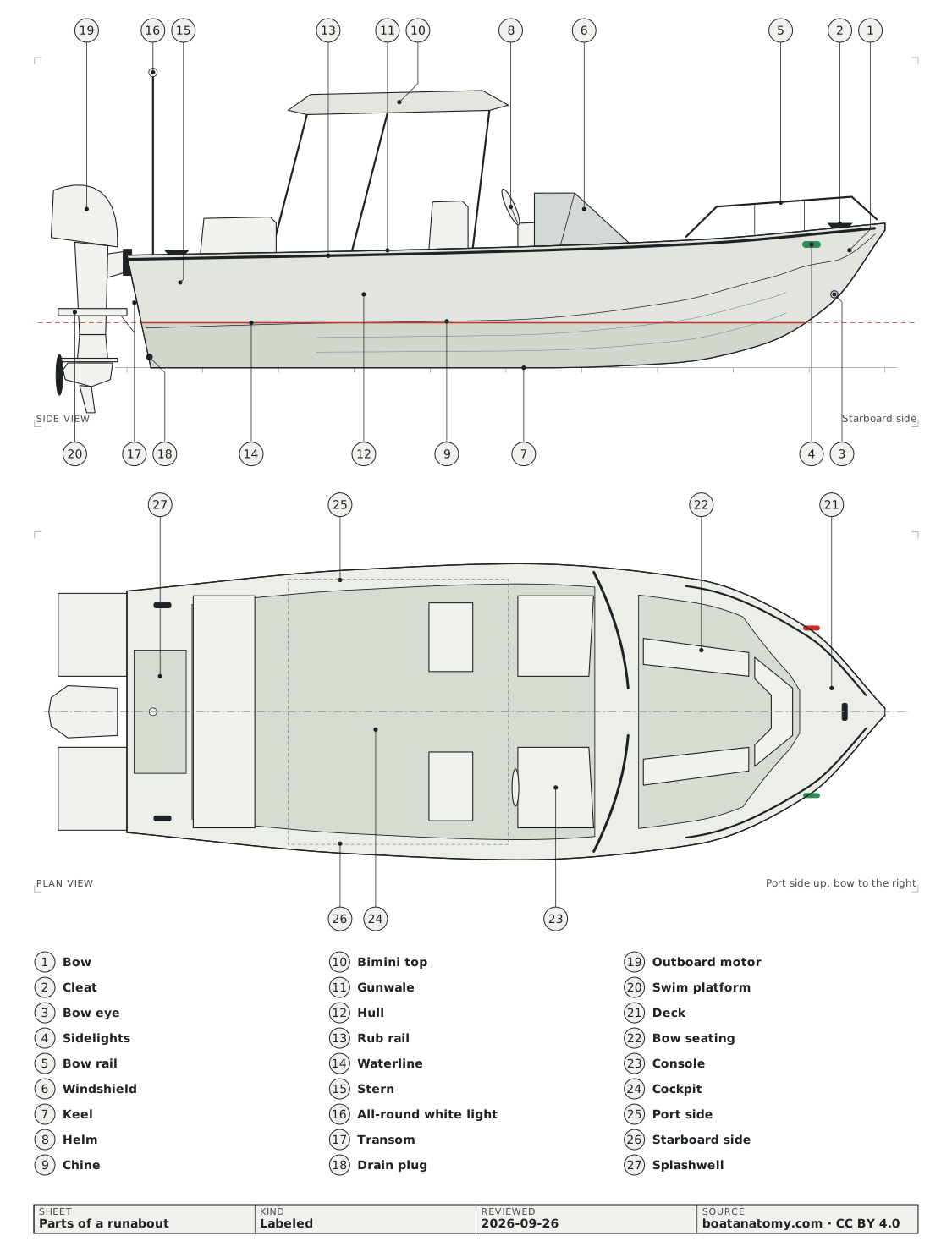
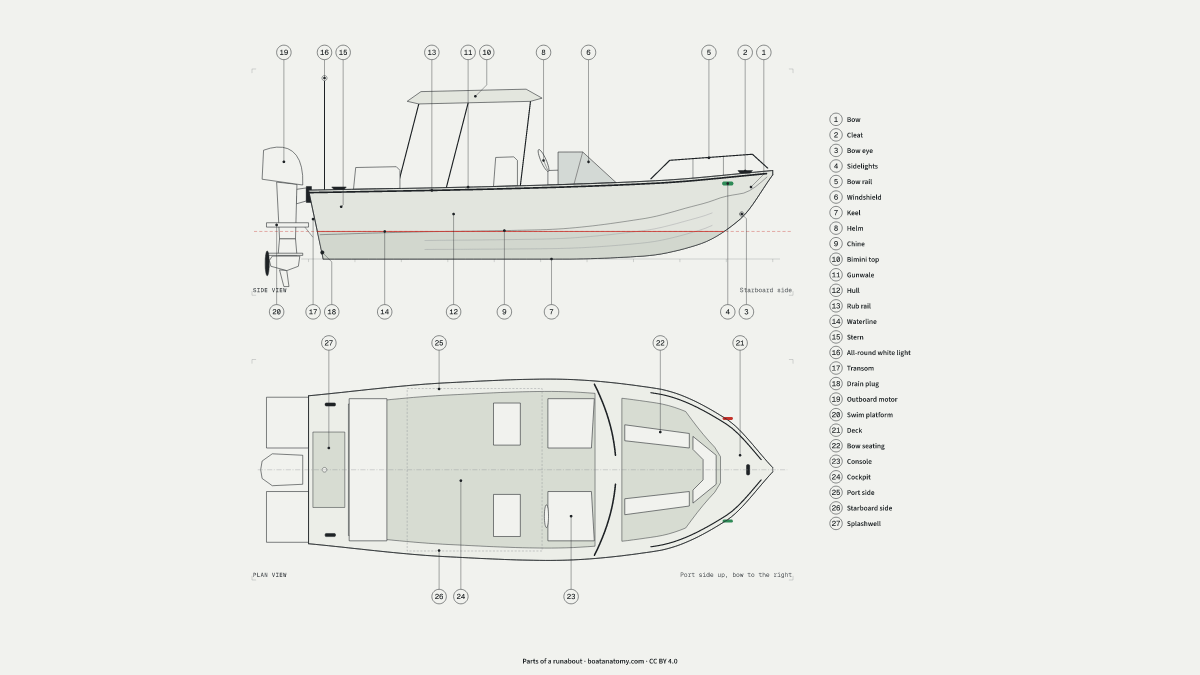
Parts of a runabout, side view and plan view Drawn to scale Checked
The 27 parts on this drawing
The hull and its sides
- Bow
The bow is the front, or forward end, of a boat.
Also called front, stem head
- Keel
The keel is the backbone of the hull, running fore and aft along the centerline at the bottom.
- Chine
The chine is the corner along the hull where the bottom meets the side.
Also called hard chine
- Gunwale
The gunwale, pronounced “gunnel”, is the upper edge of the boat’s side.
Also called gunnel
- Hull
The hull is the body of the boat, including the part below the waterline.
Also called hull shell
- Rub rail
The rub rail is a permanent protective strip along the outside of the hull, often running its whole length, that does the job of a fender.
Also called rubrail, rubbing strake
- Waterline
The waterline is the line where the surface of the water meets the hull.
Also called WL
- Stern
The stern is the back, or aft end, of a boat.
Also called back, aft end
- Transom
The transom is the surface across the stern of the boat that faces aft.
- Port side
Port is the left side of the boat when you face the bow.
Also called port
- Starboard side
Starboard is the right side of the boat when you face the bow.
Also called starboard
Deck, cockpit and helm
- Windshield
The windshield is the clear glass or plastic screen in front of the helm that shelters the people behind it from the wind.
Also called windscreen
- Helm
The helm is the wheel or tiller that steers the boat, and by extension the place it is steered from.
Also called steering station, wheel
- Bimini top
A bimini top is a canvas top on a metal frame over the cockpit that gives shade and shelter from sun and rain.
Also called bimini
- Swim platform
The swim platform is a low platform at the stern for getting on and off the boat from the water.
Also called swim step
- Deck
The deck is the horizontal surface that closes in the top of the hull and forms the boat’s outside floor.
- Bow seating
A bowrider has an open seating area in the bow, in front of the helm.
Also called bow cockpit
- Console
The console is the cabinet at the helm that holds the steering, the engine controls and the instruments.
Also called helm console
- Cockpit
The cockpit is the open well of the boat where people sit and from which it is steered.
- Splashwell
The splashwell, or motorwell, is the walled area just inside the transom that stops water coming through the motor cut-out from reaching the passenger area.
Also called motor well
Fittings, lights and motor
- Cleat
A cleat is a horned fitting on deck that lines are made fast to.
Also called bow cleat, stern cleat
- Bow eye
The bow eye is an eye bolt on the stem that gives an attaching point when the boat is on a trailer.
Also called trailer eye
- Sidelights
Sidelights are the navigation lights on each side of the bow: red on the port side, green on the starboard side.
Also called navigation lights, running lights, bow lights
- Bow rail
The bow rail is a metal guardrail fitted around the bow.
Also called bow pulpit
- All-round white light
This pole carries an all-round white light, which shows over an unbroken arc of 360 degrees.
Also called stern light
- Drain plug
The drain plug is a plug or valve low in the transom that controls the draining of water from the hull.
Also called transom drain plug, bung
- Outboard motor
An outboard motor is a self-contained engine, gear case and propeller unit mounted on the transom.
Also called outboard, outboard engine
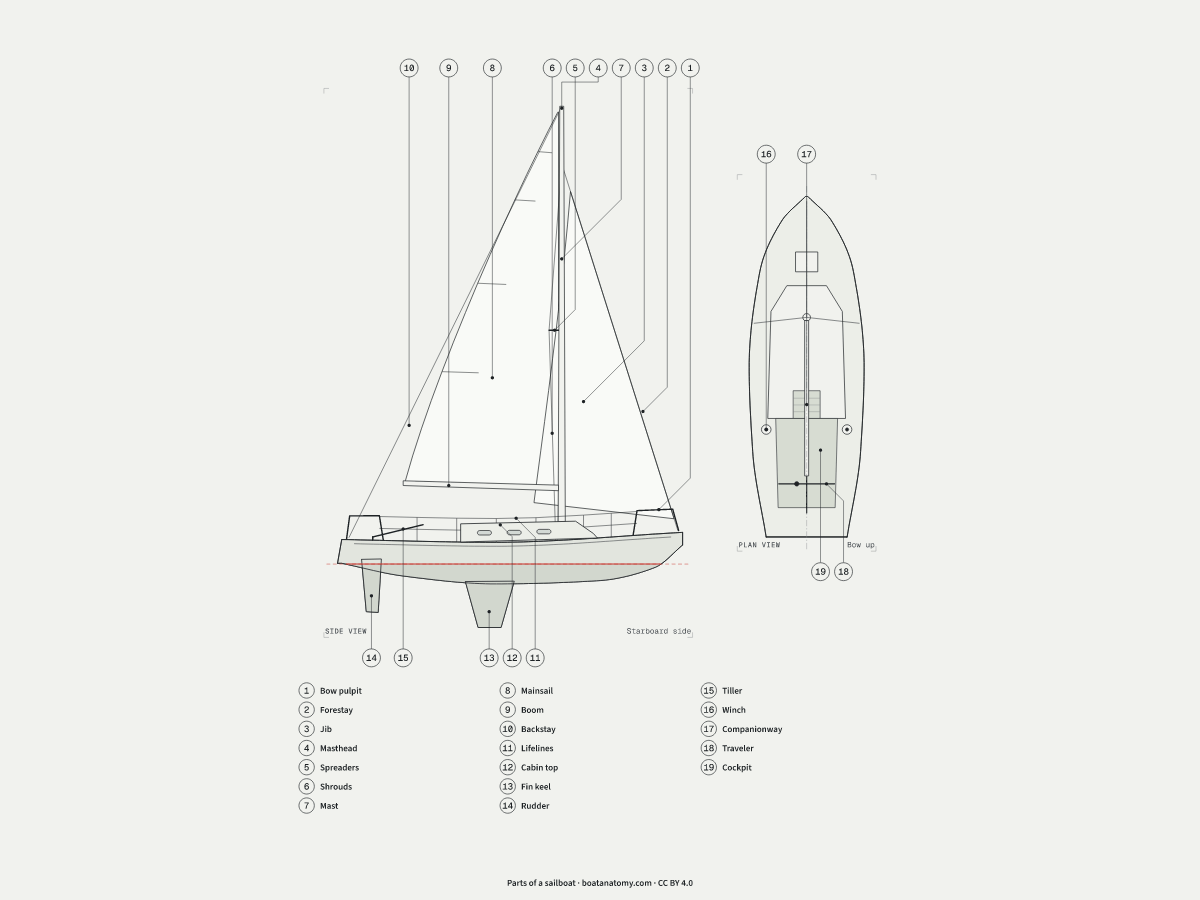
Parts of a sailboat
Pick a part on the drawing, or a name in the list, to see what it is.
Which part is marked in red?
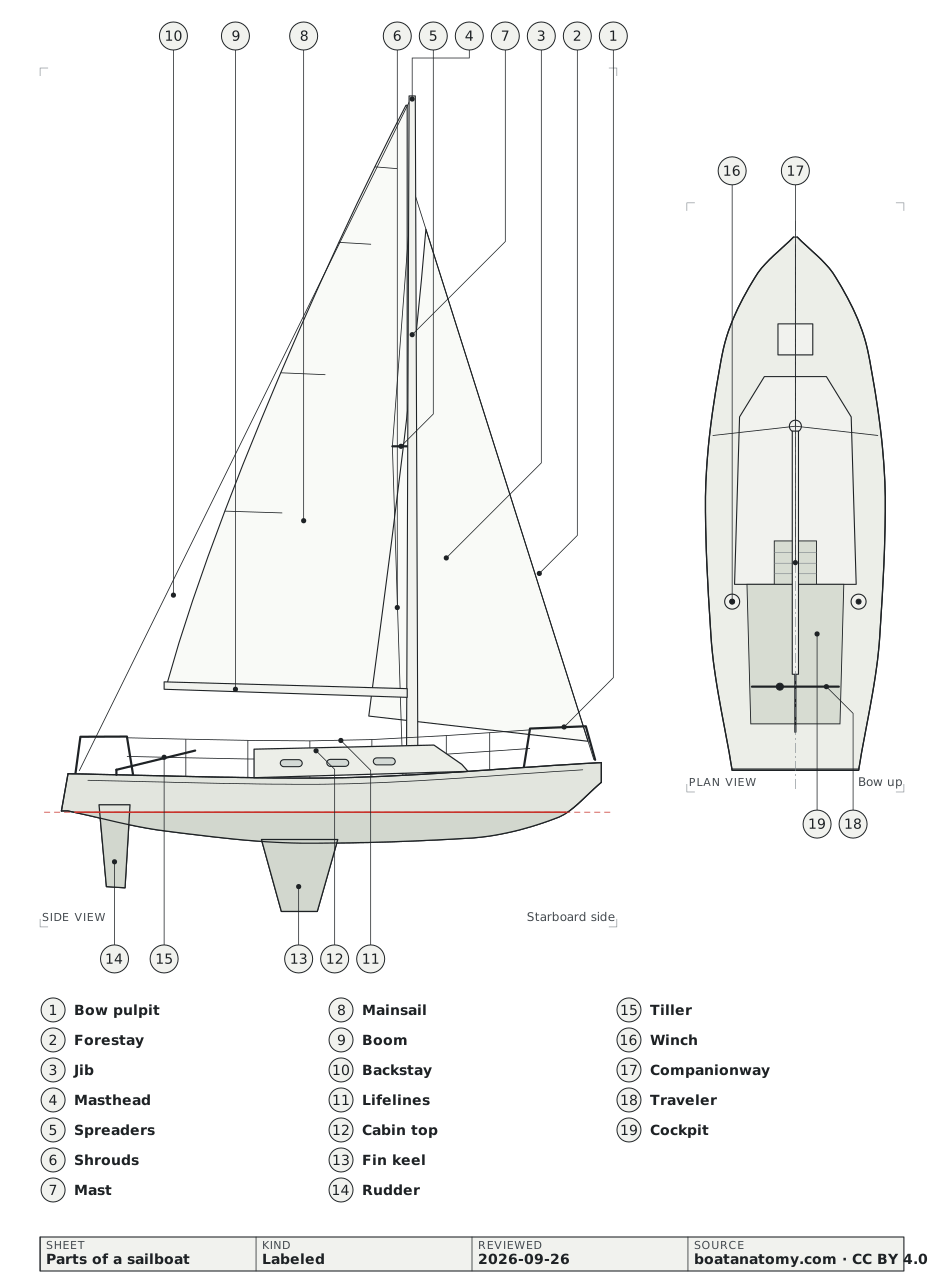
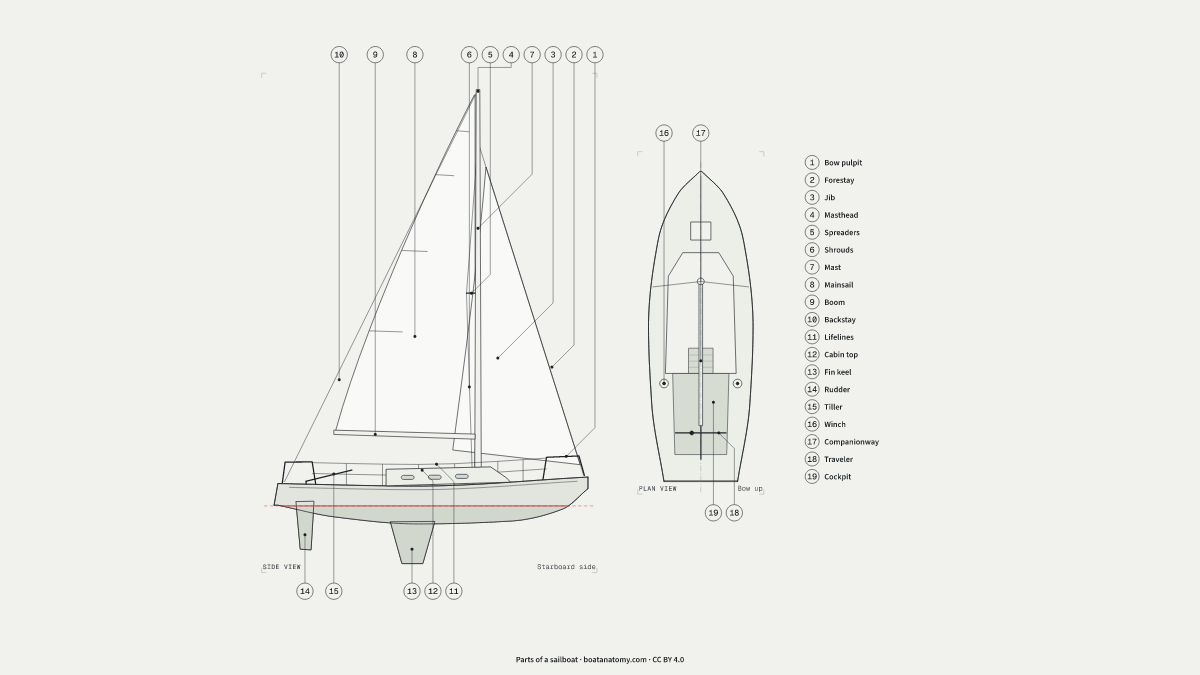
Parts of a sailboat, side view and plan view Drawn to scale Checked
The 19 parts on this drawing
Mast, sails and rigging
- Forestay
The forestay is the wire that runs from the mast forward to the bow; the jib is set on it.
Also called headstay
- Jib
The jib is the triangular sail set forward of the mast, on the forestay.
Also called headsail
- Masthead
The masthead is the top of the mast.
- Spreaders
Spreaders are the struts that stick out from each side of the mast and hold the shrouds away from it.
Also called crosstrees
- Shrouds
Shrouds are the wires from each side of the boat to the mast that hold it up sideways.
Also called side stays
- Mast
The mast is the upright spar that carries the sails.
Also called spar
- Mainsail
The mainsail is the boat’s principal sail, set on the mast and along the boom.
Also called main
- Boom
The boom is the spar that runs aft from the mast along the foot of the mainsail.
- Backstay
The backstay is the wire from the top of the mast to the stern that supports the mast from aft.
Deck and cockpit
- Bow pulpit
The bow pulpit is the metal guardrail at the bow, to which the lifelines are usually connected.
Also called pulpit
- Lifelines
Lifelines are the wires around the deck edge, held up by stanchions, that help keep people aboard.
Also called guardrails
- Cabin top
The cabin top, or coachroof, is the part of the cabin raised above the deck to give headroom below.
Also called coachroof, cabin trunk, deckhouse
- Winch
A winch is a deck machine for pulling on a rope or wire, used to hoist sails and adjust the sheets and rigging.
Also called sheet winch
- Companionway
The companionway is the entrance and steps from the cockpit down into the cabin.
- Traveler
The traveler is a rod or track across the deck along which a fitting slides, here carrying the lower end of the mainsheet.
Also called mainsheet traveler
- Cockpit
The cockpit is the open well of the boat where people sit and from which it is steered.
Keel, rudder and tiller
- Fin keel
A fin keel is a deep, thin, fixed fin under a sailboat’s hull that resists the sideways push of the wind on the sails.
Also called keel
- Rudder
The rudder is the blade under the stern that turns to steer the boat.
- Tiller
The tiller is the lever attached to the rudder that is moved to steer the boat.
Terms often confused
SternTransom
The stern is the whole back end of the boat; the transom is the flat surface across that end which faces aft.
GunwaleRub rail
The gunwale is the top edge of the side itself; the rub rail is a separate protective strip fixed along the outside of the hull, which the drawing places a little below that edge.
HelmConsole
The helm is the wheel or tiller and the place it is worked from; the console is the cabinet at the helm that holds the steering and the engine controls.
Parts of a boat in more detail
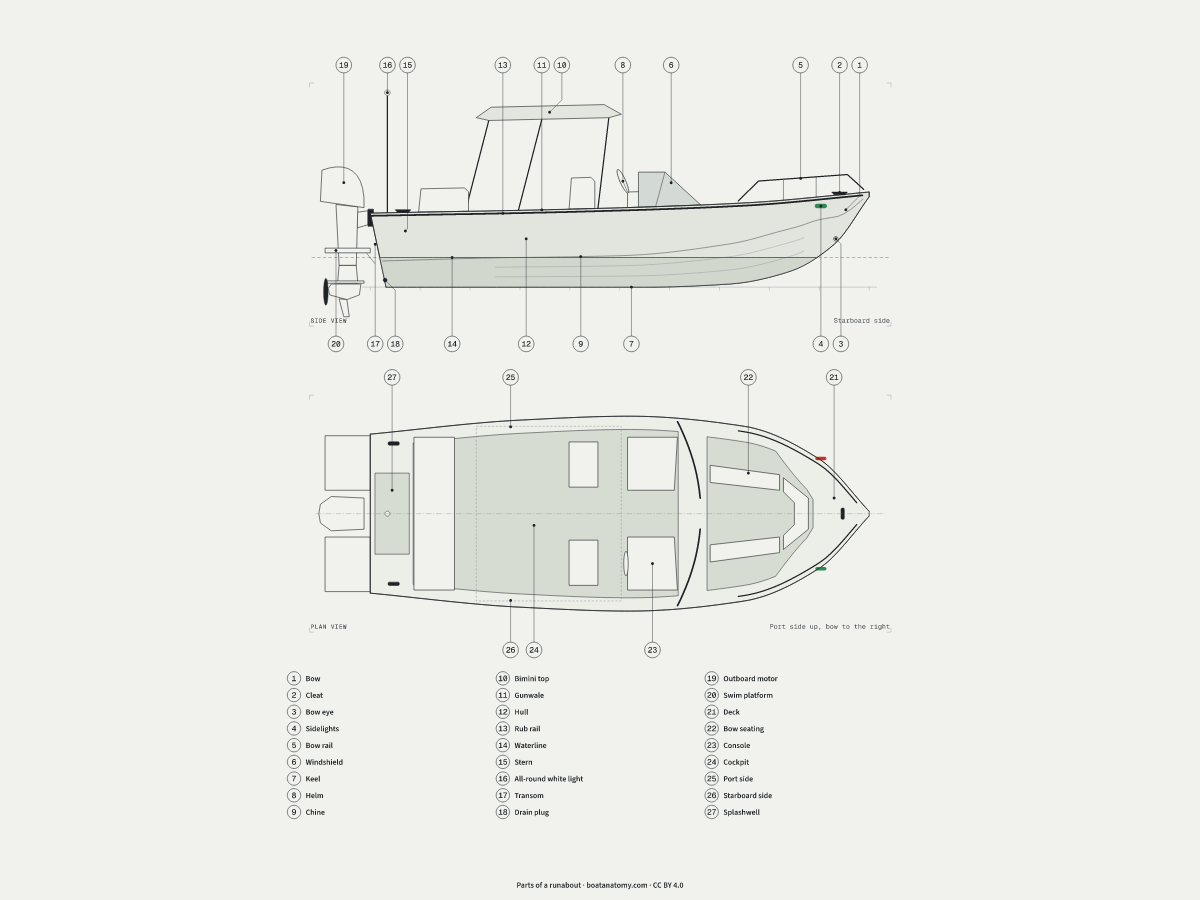
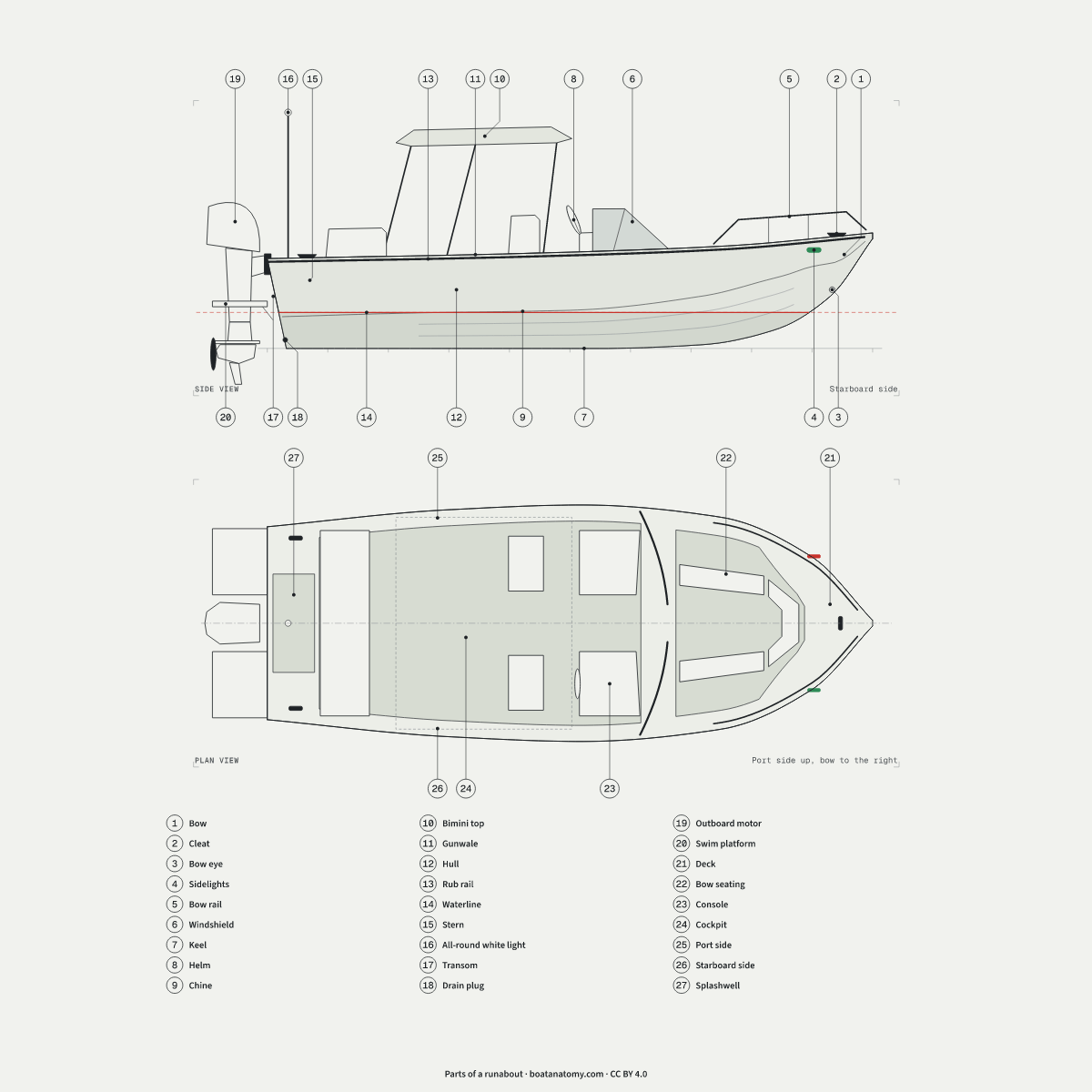
The first drawing shows a 21-foot outboard bowrider twice at one scale, once from its starboard side and once from above. It is an original drawing of a typical boat of that kind, with no make or model behind it. On the printed sheets the numbers run from the bow toward the stern, first on the side view and then on the plan.
Start with four words
The front of the boat is the bow and the back is the stern. With your face toward the bow, the left-hand side is port and the right-hand side is starboard. Those two names belong to the boat and stay put when you turn around, which is why the plan view prints them on the hull.
Work down from the top edge
On the side view, follow the hull from the top. The upper edge of each side is the gunwale, and the curve that edge traces from bow to stern is the sheer. Below it the side runs down to the red line, where the water meets the hull at this drawing’s load. The part under that line still counts: the hull is the whole body of the boat, underwater portion included.
Two long edges are easy to confuse. The chine is the corner where the bottom turns into the side, while the keel runs along the centerline at the very bottom. At the back, the transom is the surface across the stern that faces aft, and on this boat it carries the outboard motor.
The sailboat drawing
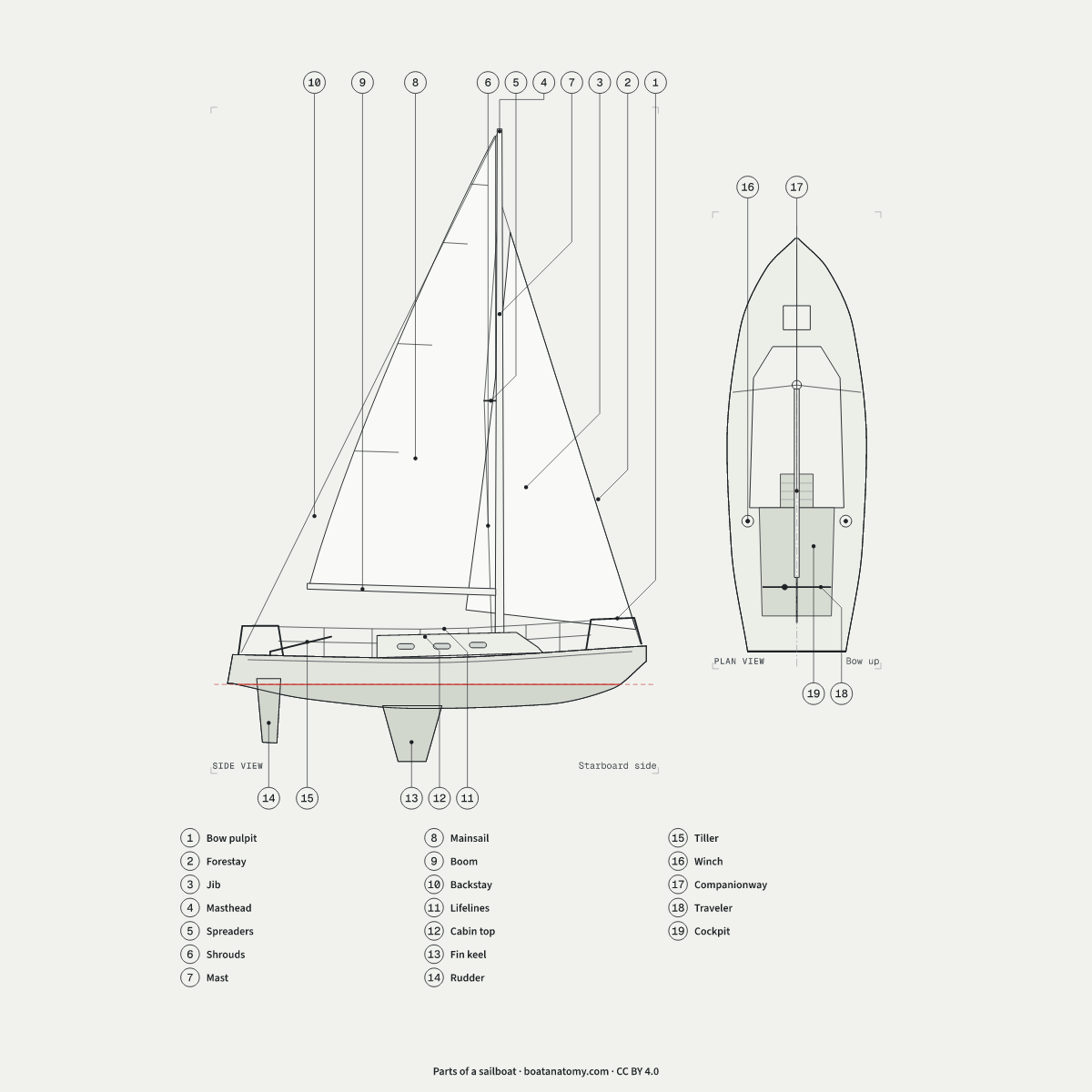
The second drawing is a 28-foot sloop. It too is an original drawing of a typical boat, not a copy of any model. Its hull shares the runabout’s vocabulary; the new words belong to the rig above the deck and the appendages below it. A fin keel hangs deep and thin under the hull, where it resists the sideways push of the wind on the sails, and the rudder under the stern is the blade that turns to steer.
Common questions
What are the basic parts of a boat called?
Course glossaries start with the bow (front), stern (back), port (left, facing forward) and starboard (right), then name the hull, the gunwale along the top of each side and the keel along the bottom.
What is the front of a boat called?
The front of a boat is the bow. Its forward edge, rising from the keel to the top of the hull, is the stem, and any direction toward the bow is forward.
What is the floor of a boat called?
Sailors call the floor of a cockpit or cabin the sole. On the plan view of the runabout it is the darker area inside the cockpit and the bow seating.
What are the sides of a boat called?
Facing the bow, the left side is port and the right side is starboard. The surfaces of the hull sides between the waterline and the gunwale are the topsides.
What is the top edge of a boat called?
The top edge of each side is the gunwale, pronounced “gunnel”. Seen from the side, the curve it follows from bow to stern is the sheer.
Print and practice
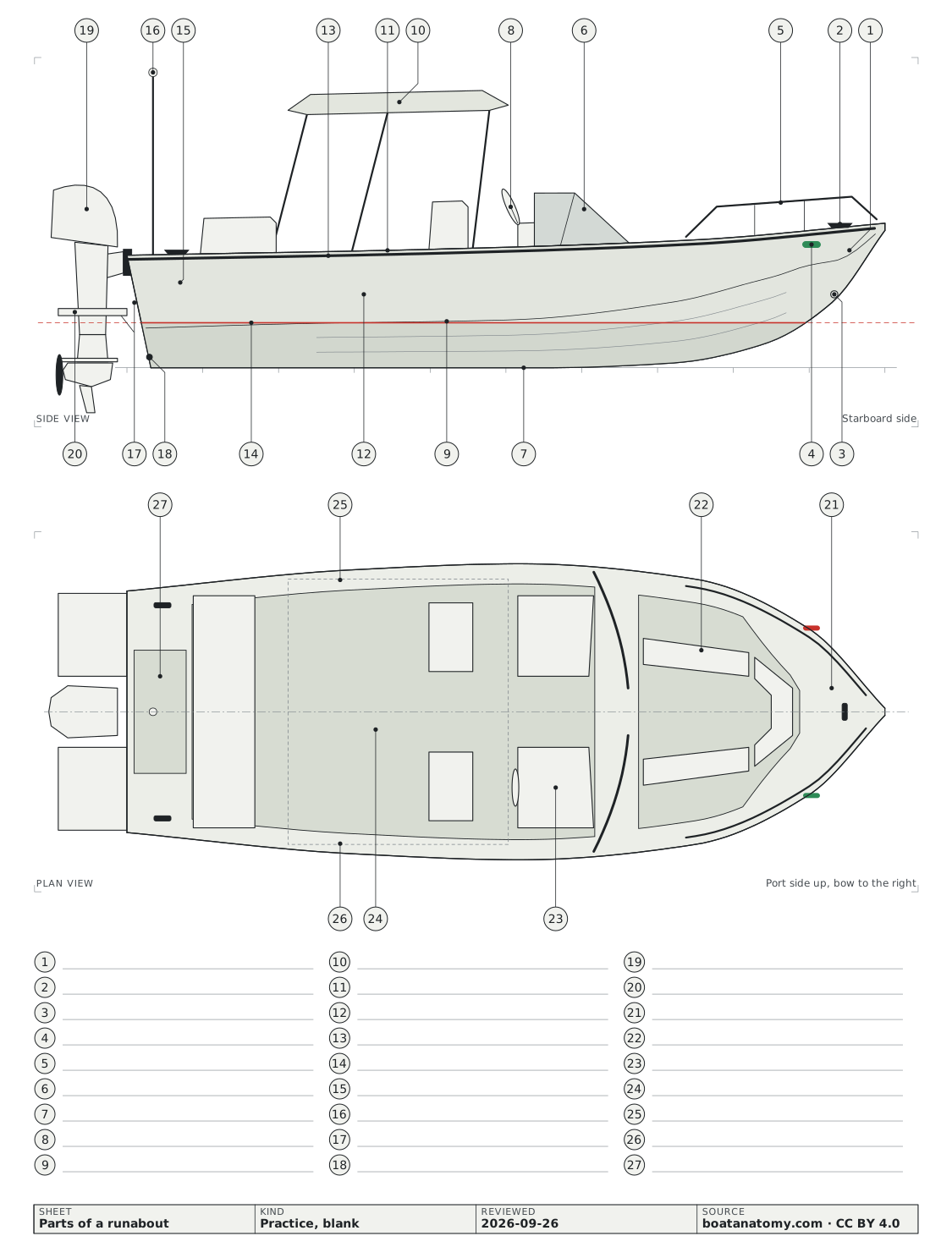
All worksheets- Parts of a runabout Labeled sheet Blank sheet to fill in
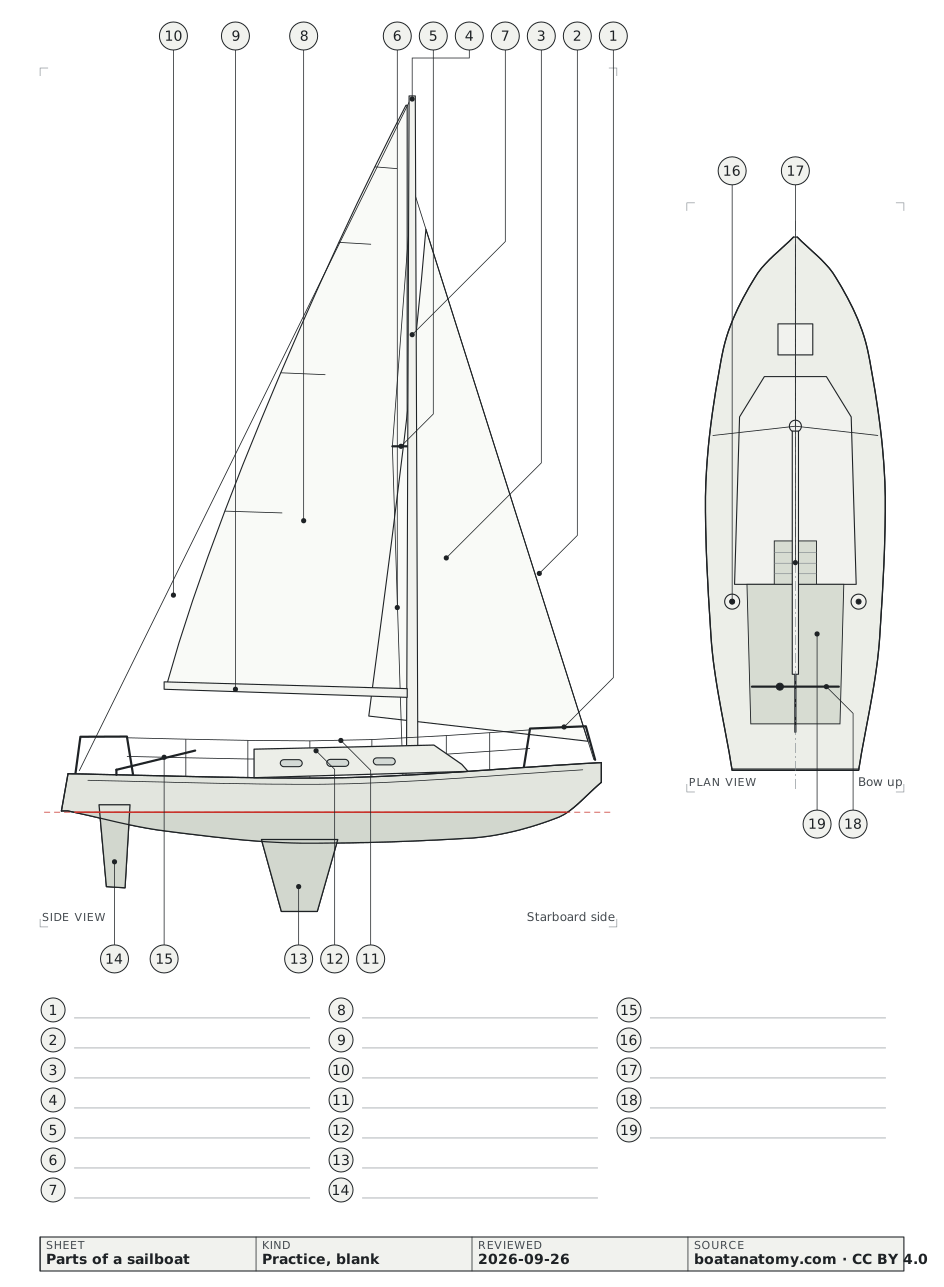
- Parts of a sailboat Labeled sheet Blank sheet to fill in