Boat terminology
Short answer: Boat terminology covers the parts of a boat (bow, stern, hull, gunwale), directions aboard (forward, aft, port, starboard), everyday words (galley for the kitchen, head for the toilet, line for rope) and the measurements on a spec sheet (beam, draft, freeboard).
148 boat and nautical terms
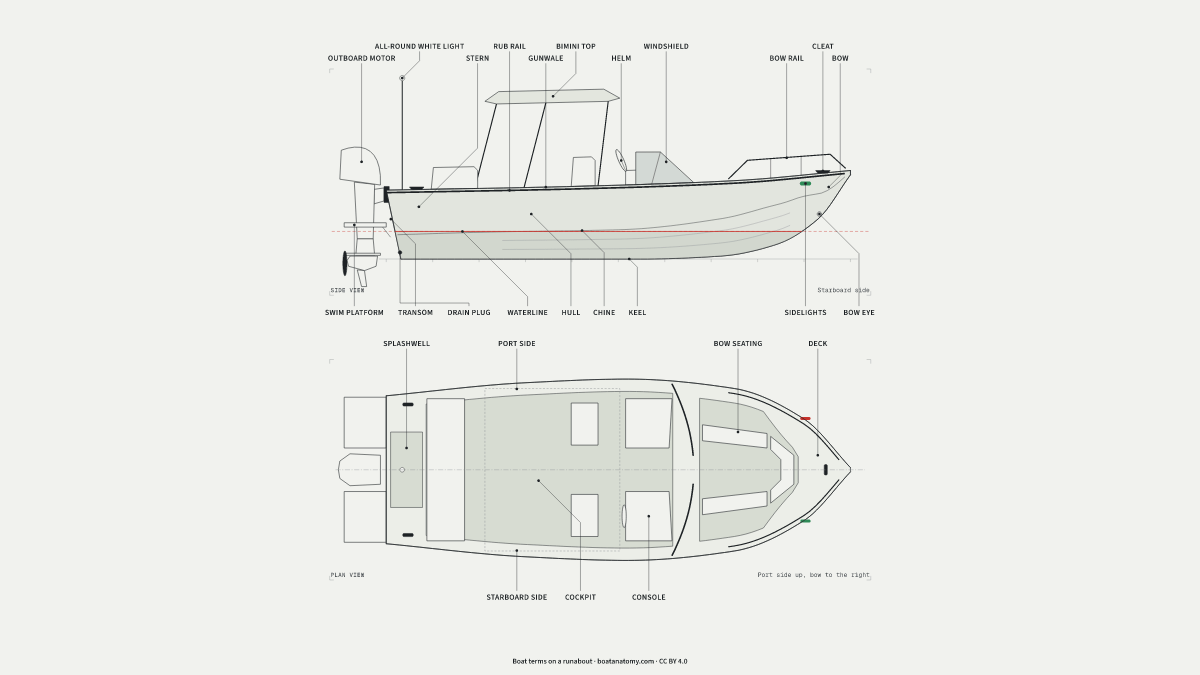
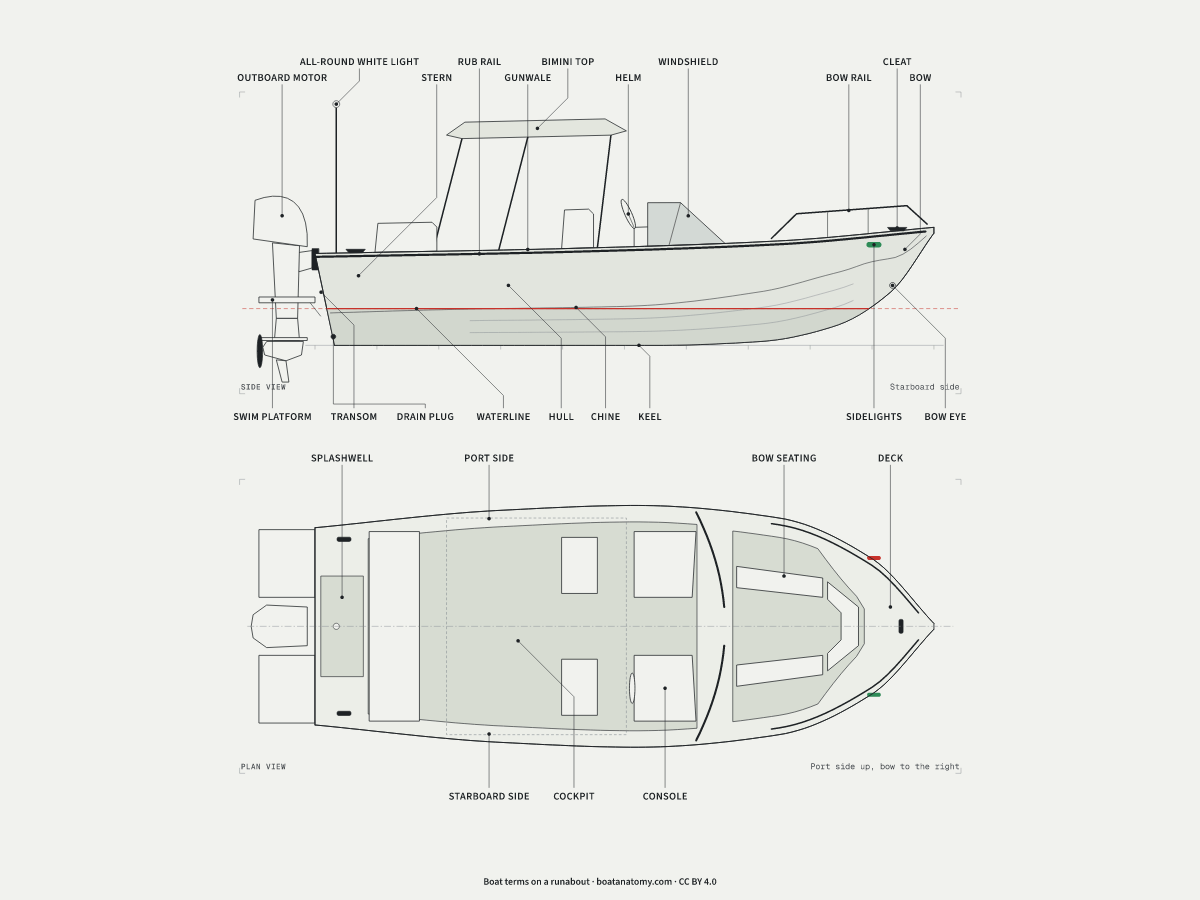
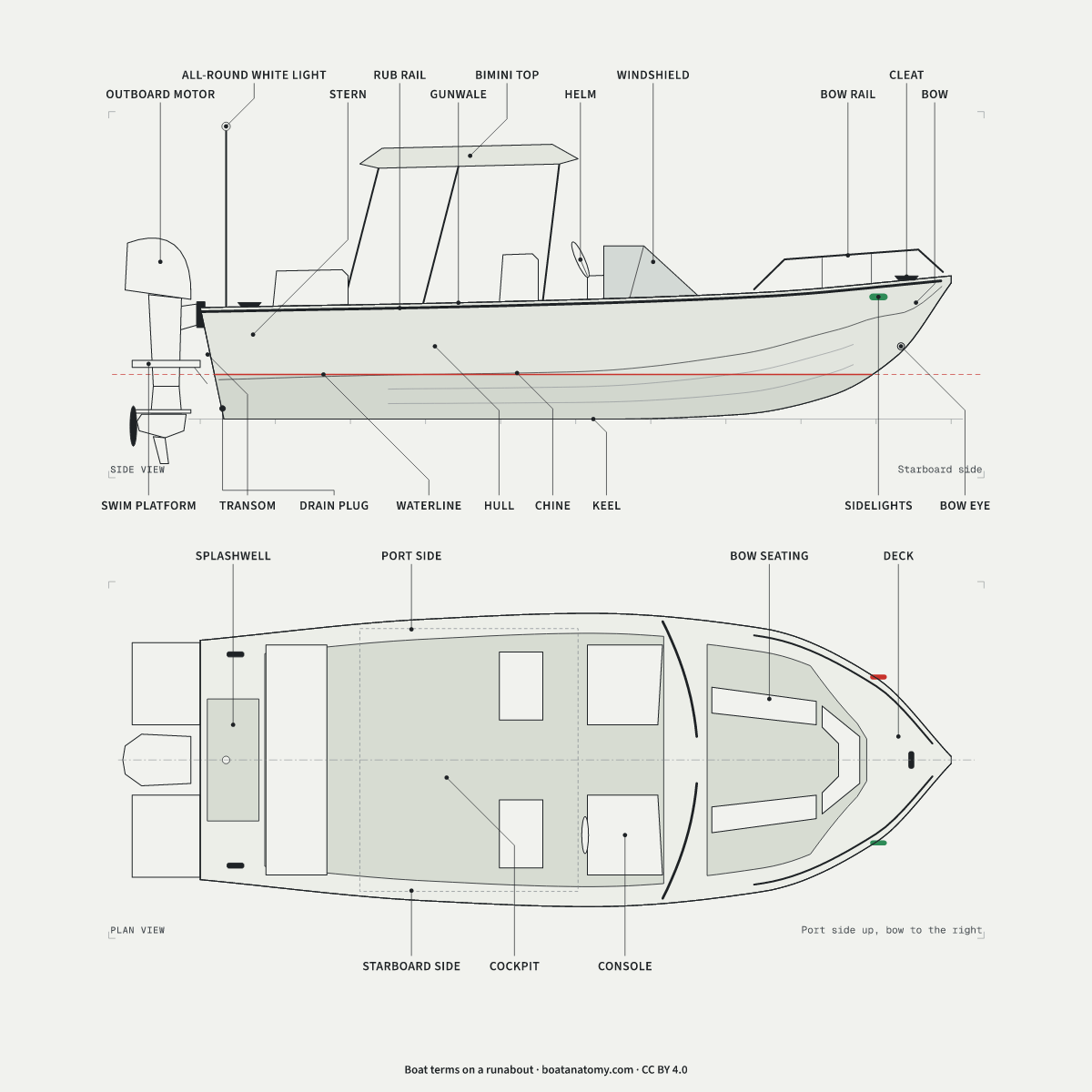
- Abeam also on the beam
-
Abeam means at right angles to the boat’s centerline, straight out from its side.
- Aft also after
-
Aft means toward the stern.
- Aground also run aground
-
A boat is aground when its keel or bottom is stuck fast on the bottom of the waterway.
- Ahead
-
Ahead means in a forward direction, in front of the boat's bow.
- All-round white light also stern light
-
An all-round white light shows over an unbroken arc of 360 degrees; on the runabout it sits on a pole at the stern.
- Amidships also midships
-
Amidships is the middle of the boat, halfway between bow and stern.
- Anchor also hook
-
An anchor is a device that engages the bottom and, by resisting being dragged, keeps a boat within a given radius.
- Astern
-
Astern means behind the boat; a boat going astern is moving backward, in reverse.
- Backstay
-
The backstay is the wire from the top of the mast to the stern that supports the mast from aft.
- Beam also breadth
-
Beam is the width of a boat at its widest point; US boat regulations measure it between the outer sides, excluding handles and similar fittings.
- Berth also bunk
-
A berth is a place to sleep on a boat; the word also means the place a boat occupies in a harbor.
- Bilge also bilges
-
The bilge is the lowest part of the inside of the hull, where water collects.
- Bilge pump
-
A bilge pump is a pump that clears out water that collects in the bilge.
- Bimini top also bimini
-
A bimini top is a canvas top on a metal frame over the cockpit that gives shade and shelter from sun and rain.
- Body plan
-
The body plan is the end view of a lines plan, with the sections forward of amidships drawn on the right and those aft on the left.
- Boom
-
The boom is the spar that runs aft from the mast along the foot of the mainsail.
- Bottom also hull bottom
-
The bottom is the underside of the hull, which meets the sides at the chines.
- Bow also front, stem head
-
The bow is the front, or forward end, of a boat.
- Bow eye also trailer eye
-
The bow eye is an eye bolt on the stem that gives an attaching point when the boat is on a trailer.
- Bow pulpit also pulpit
-
The bow pulpit is the metal guardrail at the bow, to which the lifelines are usually connected.
- Bow rail also bow pulpit
-
The bow rail is a metal guardrail fitted around the bow.
- Bow seating also bow cockpit
-
A bowrider has an open seating area in the bow, in front of the helm.
- Bulb keel also bulbed keel
-
A bulb keel is a fin keel with a cigar-shaped bulb of lead at its tip, as the keel-types sheet draws it.
- Bulbous bow also bulb bow
-
A bulbous bow is a rounded swelling of the hull at the bow, below the waterline, found mostly on ships.
- Bulkhead
-
A bulkhead is a wall or partition inside a boat that divides it into compartments; many add strength or keep water out.
- Buttock line also buttock, butt line
-
A buttock line is the shape made by slicing the hull with a vertical fore-and-aft plane, drawn in the sheer plan.
- Cabin
-
A cabin is an enclosed space on a boat, usually a small room where people can live or sleep.
- Cabin top also coachroof, cabin trunk, deckhouse
-
The cabin top, or coachroof, is the part of the cabin raised above the deck to give headroom below.
- Canoe stern also double-ender, pointed stern
-
A canoe stern comes to a point much like the bow, so the boat is a double-ender with no flat transom.
- Capacity plate also capacity label
-
A capacity plate is the label that US regulations require on monohull boats under 20 feet, other than sailboats, canoes, kayaks and inflatables, giving the maximum persons and weight.
- Cast off
-
To cast off is to let go of the lines that hold a boat to a dock or mooring so it can leave.
- Catamaran also cat
-
A catamaran has two hulls side by side joined by a deck or bridge deck, with open water between them.
- Centerboard also centreboard, drop keel, swing keel
-
A centerboard is a movable plate, pivoted at its forward end, that is raised or lowered through the keel of a sailboat.
- Centerline also centreline
-
The centerline is the line running fore and aft down the middle of the boat.
- Chine also hard chine
-
The chine is the corner along the hull where the bottom meets the side.
- Cleat also bow cleat, stern cleat
-
A cleat is a horned fitting on deck that lines are made fast to.
- Clipper bow
-
A clipper bow’s stem forms a concave curve that projects forward above the waterline in a long overhang.
- Coaming also cockpit coaming
-
A coaming is a raised edge around a cockpit or hatch opening that helps keep water out.
- Cockpit
-
The cockpit is the open well of the boat where people sit and from which it is steered.
- Cockpit sole also sole, floor
-
The cockpit sole is the floor of the cockpit; the drawings set it below the deck.
- Companionway
-
The companionway is the entrance and steps from the cockpit down into the cabin.
- Console also helm console
-
The console is the cabinet at the helm that holds the steering, the engine controls and the instruments.
- Counter stern also counter
-
A counter stern extends aft above the waterline in a long overhang.
- Cruiser stern also rounded stern
-
A cruiser stern is rounded, with a convex profile, and shows less flat surface at the back than a transom stern.
- Cuddy also cuddy cabin
-
A cuddy is a small cabin or shelter on a boat.
- Deadrise also deadrise angle
-
Deadrise is the angle between the bottom of the hull and a horizontal line, seen in a cross-section.
- Deck
-
The deck is the horizontal surface that closes in the top of the hull and forms the boat’s outside floor.
- Deep-V hull also deep-V, deep vee, deep-vee
-
A deep-V hull keeps a steep V along the whole bottom; BoatUS and industry guides usually describe it as having more than 20 degrees of deadrise at the transom.
- Depth also depth of hull
-
Depth is the height of the hull from the keel to the deck.
- Displacement
-
Displacement is the mass of the water a boat pushes aside while floating.
- Dock line also mooring line
-
Dock lines, also called mooring lines, are the lines that tie a boat to a dock, pier or float.
- Draft also draught
-
Draft is how deep the hull sits: the vertical distance from the keel to the surface of the water.
- Drain plug also transom drain plug, bung
-
The drain plug is a plug or valve low in the transom that controls the draining of water from the hull.
- Fathom
-
A fathom is a unit of length used for water depth and rope, equal to 6 feet, about 1.83 meters.
- Fender also bumper
-
A fender is a portable bumper hung over the side to cushion contact between the hull and a dock or another boat.
- Fin keel also keel
-
A fin keel is a deep, thin, fixed fin under a sailboat’s hull that resists the sideways push of the wind on the sails.
- Flare
-
Flare is the outward slope of the hull sides as they rise from the waterline.
- Flat-bottom hull also flat bottom, flat-bottomed hull
-
A flat-bottom hull has a bottom that is flat, or nearly so, from side to side, meeting the sides at a hard chine.
- Forefoot
-
The forefoot is the part of the bow where the stem meets the keel.
- Forestay also headstay
-
The forestay is the wire that runs from the mast forward to the bow; the jib is set on it.
- Forward also fore
-
Forward, or fore, means toward the bow.
- Freeboard
-
Freeboard is the height of the boat’s side above the water: the depth of the hull minus its draft.
- Full keel also long keel
-
A full keel runs along much of the bottom of the hull, with the rudder hung on its after end, as the keel-types sheet draws it.
- Galley
-
The galley is the kitchen on a boat.
- Gunwale also gunnel
-
The gunwale, pronounced “gunnel”, is the upper edge of the boat’s side.
- Half-breadth plan
-
The half-breadth plan is the view from above; it shows the waterlines, and only one side because the hull is symmetric.
- Halyard also halliard
-
A halyard is the line used to hoist and lower a sail.
- Hardtop also hard top
-
A hardtop is a rigid top fixed over a boat's cabin top or console that shelters the driver, and sometimes passengers, from the weather.
- Hatch
-
A hatch is an opening in the deck to the space below, and the cover, often watertight, that closes it.
- Head also heads
-
The head is the toilet on a boat.
- Heel also heeling
-
Heel is a temporary lean of the boat to one side, caused by wind, waves or a fast turn.
- Helm also steering station, wheel
-
The helm is the wheel or tiller that steers the boat, and by extension the place it is steered from.
- Hull also hull shell
-
The hull is the body of the boat, including the part below the waterline.
- Hull speed
-
Hull speed is a rule of thumb for displacement hulls: 1.34 times the square root of the waterline length in feet, in knots.
- Hull-to-deck joint also hull-deck joint
-
The hull-to-deck joint is where a separately molded hull and deck are joined; the drawing puts it at the gunwale, under the rub rail.
- Jib also headsail
-
The jib is the triangular sail set forward of the mast, on the forestay.
- Jibe also gybe, jibing, gybing
-
To jibe, or gybe, is to turn the stern through the wind, so the wind comes from the other side and the sails swing across.
- Keel
-
The keel is the backbone of the hull, running fore and aft along the centerline at the bottom.
- Knot also kn, kt
-
A knot is a unit of speed equal to one nautical mile per hour, about 1.15 statute miles per hour.
- Lazarette also lazaret
-
A lazarette is a storage or service compartment in the after part of a boat, often beneath the cockpit or aft deck.
- Leeward also lee, lee side
-
Leeward, said “loo-ard”, is the direction the wind blows toward, and the side of the boat away from the wind.
- Length overall also LOA
-
Length overall is a straight horizontal line from the foremost to the aftermost part of the boat, leaving out fittings such as bow sprits, rudders and motor brackets.
- Lifelines also guardrails
-
Lifelines are the wires around the deck edge, held up by stanchions, that help keep people aboard.
- Lifting strakes also strakes
-
Lifting strakes are narrow ridges running fore and aft along the bottom of a planing hull, as the drawings show them.
- Line also rope
-
Aboard a boat, rope is called line unless a piece has a name of its own, such as a halyard or a sheet.
- Lines plan also lines drawing, set of lines
-
A lines plan draws a hull in three views: the sheer plan from the side, the half-breadth plan from above and the body plan from the end.
- List
-
A list is a lasting lean to one side caused by weight that is unevenly placed.
- Mainsail also main
-
The mainsail is the boat’s principal sail, set on the mast and along the boom.
- Make fast also belay
-
To make fast is to secure a line to a cleat, bitt or similar fitting so that it can neither slip nor jam.
- Mast also spar
-
The mast is the upright spar that carries the sails.
- Masthead
-
The masthead is the top of the mast.
- Modified-V hull also modified-V, modified vee, modified-vee
-
A modified-V hull has a V bottom with less deadrise at the transom than a deep V, somewhere between a flat bottom and a deep V.
- Monohull
-
A monohull is a boat with a single hull. US boat regulations define it as a boat whose waterline forms a single closed curve.
- Mooring
-
A mooring is the line or chain that holds a boat to a fixed object, such as a dock or a weight on the bottom.
- Motor cut-out also notch, motor notch
-
A motor cut-out is a lowered section of the transom’s top edge where an outboard motor is mounted.
- Multihull also multi-hull
-
A multihull is a boat with more than one hull side by side, such as a catamaran or trimaran; a single-hulled boat is a monohull.
- Nautical mile also sea mile
-
A nautical mile is exactly 1,852 meters, about 1.15 statute miles, and is based on one minute of latitude.
- Outboard motor also outboard, outboard engine
-
An outboard motor is a self-contained engine, gear case and propeller unit mounted on the transom.
- PFD also personal flotation device, life jacket, lifejacket
-
PFD stands for personal flotation device; in US regulations (33 CFR 175.13) it means a flotation device approved by the Coast Guard. A wearable PFD, such as a life jacket, is worn on the body; a throwable PFD is thrown to a person in the water.
- Planing also planing mode
-
Planing is the mode in which a boat’s weight is carried mostly by hydrodynamic lift instead of buoyancy.
- Plumb bow also vertical bow, straight stem
-
A plumb bow has a stem that runs straight up and down, at or near vertical.
- Pontoon boat also pontoon
-
Under 33 CFR 173.3, a pontoon boat has a broad, flat deck fixed on top of closed cylinders that keep it afloat.
- Port
-
Port is the left side of the boat when you face the bow.
- Propeller also prop, screw
-
A propeller is a hub with radiating blades set in a helical pattern that drives the boat when it turns in the water.
- Raked bow also raked stem
-
A raked bow has a straight stem that slopes forward as it rises.
- Reef also reefing
-
To reef is to reduce a sail's area by folding or rolling part of it away.
- Reverse transom also sugar-scoop stern
-
A reverse transom leans forward at the top, so the stern slopes forward from the waterline up to the deck.
- Rode also anchor line, anchor rode
-
The rode is the anchor line, of rope, chain or both, that connects the anchor to the boat.
- Round-bottom hull also round bottom, round-bilge hull
-
A round-bottom hull turns from bottom to side in a curve instead of a hard chine.
- Rub rail also rubrail, rubbing strake
-
The rub rail is a permanent protective strip along the outside of the hull, often running its whole length, that does the job of a fender.
- Rudder
-
The rudder is the blade under the stern that turns to steer the boat.
- Sheer also sheer line, sheerline
-
The sheer is the topmost line of the boat’s side, seen from the side as a curve from bow to stern.
- Sheer plan also profile
-
The sheer plan is the side view of a lines plan, with the buttock lines projected onto it.
- Sheet also mainsheet, jib sheet
-
A sheet is the line, fastened to a sail's lower aft corner or to its boom, that controls the angle of the sail.
- Shrouds also side stays
-
Shrouds are the wires from each side of the boat to the mast that hold it up sideways.
- Sidelights also navigation lights, running lights, bow lights
-
Sidelights are the navigation lights on each side of the bow: red on the port side, green on the starboard side.
- Splashwell also motor well
-
The splashwell, or motorwell, is the walled area just inside the transom that stops water coming through the motor cut-out from reaching the passenger area.
- Spoon bow
-
A spoon bow is an overhanging bow whose underside is curved like the bowl of a spoon.
- Spreaders also crosstrees
-
Spreaders are the struts that stick out from each side of the mast and hold the shrouds away from it.
- Spring line also spring
-
A spring line runs forward or aft at a sharp angle between the boat and the dock, unlike a breast line, which runs straight across.
- Starboard
-
Starboard is the right side of the boat when you face the bow.
- Station also section
-
A station is a cross-section of the hull: a curve in the body plan and a straight line in the other two views.
- Stem
-
The stem is the forward end of the hull, rising from the keel to the top of the hull at the bow.
- Stern also back, aft end
-
The stern is the back, or aft end, of a boat.
- Stern eyes also transom eyes, tie-down eyes
-
Stern eyes are the eye bolts low on the transom, drawn here as attaching points for a boat on a trailer.
- Sternlight also stern light
-
A sternlight is a white light at the stern that shows aft over an arc of 135 degrees.
- Swim platform also swim step
-
The swim platform is a low platform at the stern for getting on and off the boat from the water.
- T-top also T top
-
Industry guides usually describe a T-top as a frame fixed to a center console that holds a canvas or hard top over the helm.
- Tack also tacking, come about
-
To tack is to turn the bow through the wind, so the wind blows on the sails from the other side.
- Tender also dinghy
-
A tender, often a dinghy, is a small boat that carries people and supplies between a larger boat and the shore.
- Tiller
-
The tiller is the lever attached to the rudder that is moved to steer the boat.
- Topsides
-
Topsides are the sides of the hull between the waterline and the gunwale.
- Transom also square stern
-
The transom is the surface across the stern of the boat that faces aft.
- Transom height
-
Transom height is measured from the lowest point along the top of the transom where water could come in, down to a line extending the bottom of the hull at the centerline.
- Traveler also mainsheet traveler
-
A traveler is a rod or track across the deck along which a fitting slides; on the sloop it carries the lower end of the mainsheet.
- Trim
-
Trim is a boat's fore-and-aft angle, down by the bow or by the stern; trimming the sails means adjusting their angle.
- Trimaran
-
A trimaran has three hulls side by side: a main hull in the middle and a smaller outer hull, or float, on each side.
- Tritoon also tri-toon
-
A tritoon is a pontoon boat built on three rows of floats rather than two.
- Underway also under way
-
In the Inland Navigation Rules, underway means a vessel is not at anchor, made fast to the shore or aground; it need not be moving.
- V-hull also vee hull, V-bottom, V bottom
-
A V-hull's bottom forms a V in cross-section, with its point at the keel and a chine where it meets each side.
- Wake
-
The wake is the track of disturbed water that a moving boat leaves astern.
- Waterline also WL
-
The waterline is the line where the surface of the water meets the hull.
- Waterline length also LWL, length on the waterline
-
Waterline length is the length of the hull along the waterline, which changes as load and trim move the waterline.
- Winch also sheet winch
-
A winch is a deck machine for pulling on a rope or wire, used to hoist sails and adjust the sheets and rigging.
- Windlass also anchor windlass
-
A windlass is a winch used to haul in and let out the anchor line or chain.
- Windshield also windscreen
-
The windshield is the clear glass or plastic screen in front of the helm that shelters the people behind it from the wind.
- Windward also weather side
-
Windward is the direction the wind blows from, and the side of the boat facing the wind.
- Wing keel also winged keel
-
A wing keel is a shallow fin with wings at its foot that spread the ballast sideways, as the keel-types sheet draws it.
Boat terminology in more detail
Boats keep their own words for things that have ordinary names ashore, mostly because the ordinary names are ambiguous on the water.
Directions first
Forward means toward the bow and aft means toward the stern. Amidships is the middle, halfway between the two ends, and an object abeam lies straight out from the side, at right angles to the centerline. Port and starboard name fixed sides of the vessel, so a crew member facing aft still calls the same side port. Windward is the side the wind blows from, and leeward, said “loo-ard”, is the side it blows toward.
Words used aboard
The kitchen on a boat is the galley and the toilet is the head. A berth is a place to sleep, and also the place a boat occupies in a harbor. Rope is called line unless a piece has a name of its own, such as a halyard or a sheet. Speed is given in knots, one nautical mile per hour, and water depth sometimes in fathoms of 6 feet.
Words with two senses
A few entries carry more than one meaning. Keel names both the backbone along the bottom and the fin under a sailboat. Bilge names the curved part of the hull between bottom and side, and also the lowest space inside the hull, where water collects. Trim is a boat’s fore-and-aft angle, and trimming the sails means adjusting their angle. Two words for leaning are easy to swap: heel is a temporary lean, from wind, waves or a fast turn, while a list is a lasting one, caused by weight placed unevenly.
Common questions
What are the four sides of a boat called?
The four sides of a boat are the bow at the front, the stern at the back, and, facing the bow, port on the left and starboard on the right.
What does aft mean on a boat?
Aft means toward the stern. Its opposite, forward or fore, means toward the bow.
What is the bathroom on a boat called?
The bathroom on a boat is called the head, and the kitchen is the galley.
Why is rope called line on a boat?
Aboard a boat, rope is called line unless a piece has a name of its own, such as a halyard or a sheet.
What is a knot in boating?
A knot is a unit of speed: one nautical mile per hour, about 1.15 statute miles per hour. A nautical mile is exactly 1,852 meters.