Beam of a boat
Short answer: Beam is the width of a boat at its widest point. US regulations measure it between the outer sides, leaving out handles and similar fittings. Naval architects often quote the widest beam at the design waterline, which on a flared hull is narrower.
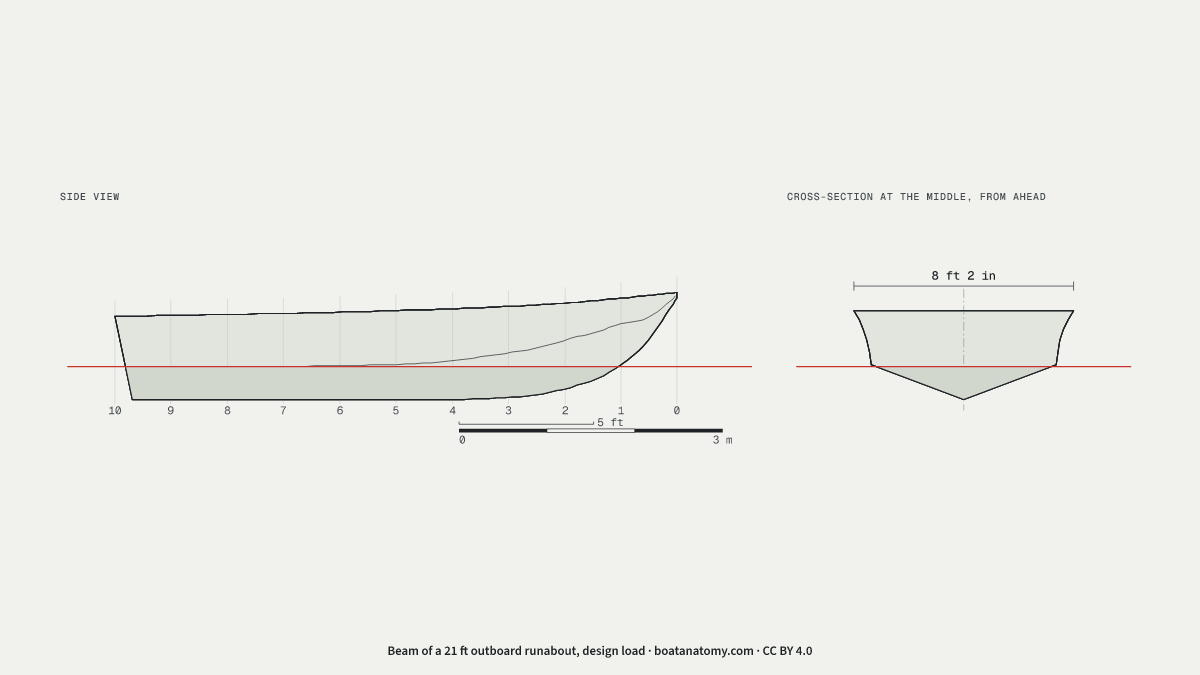
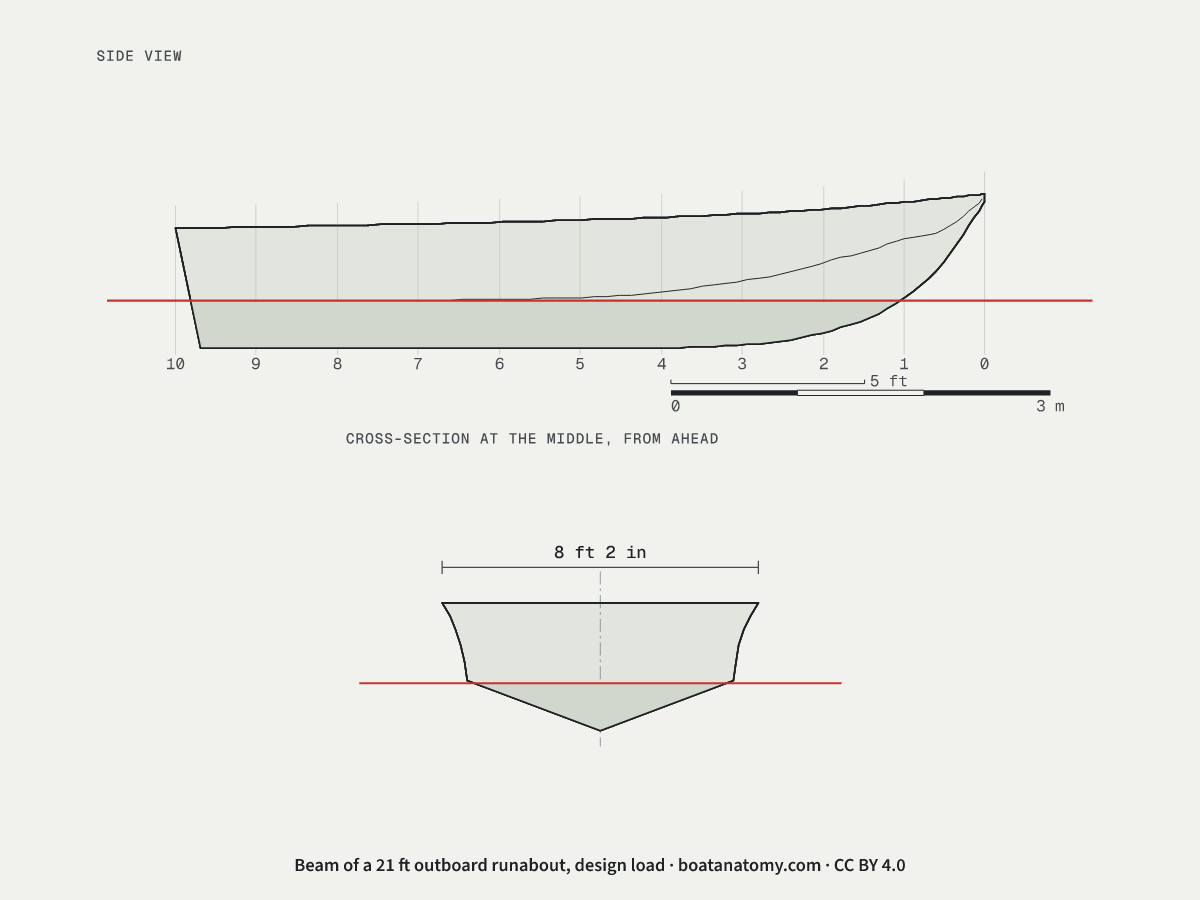
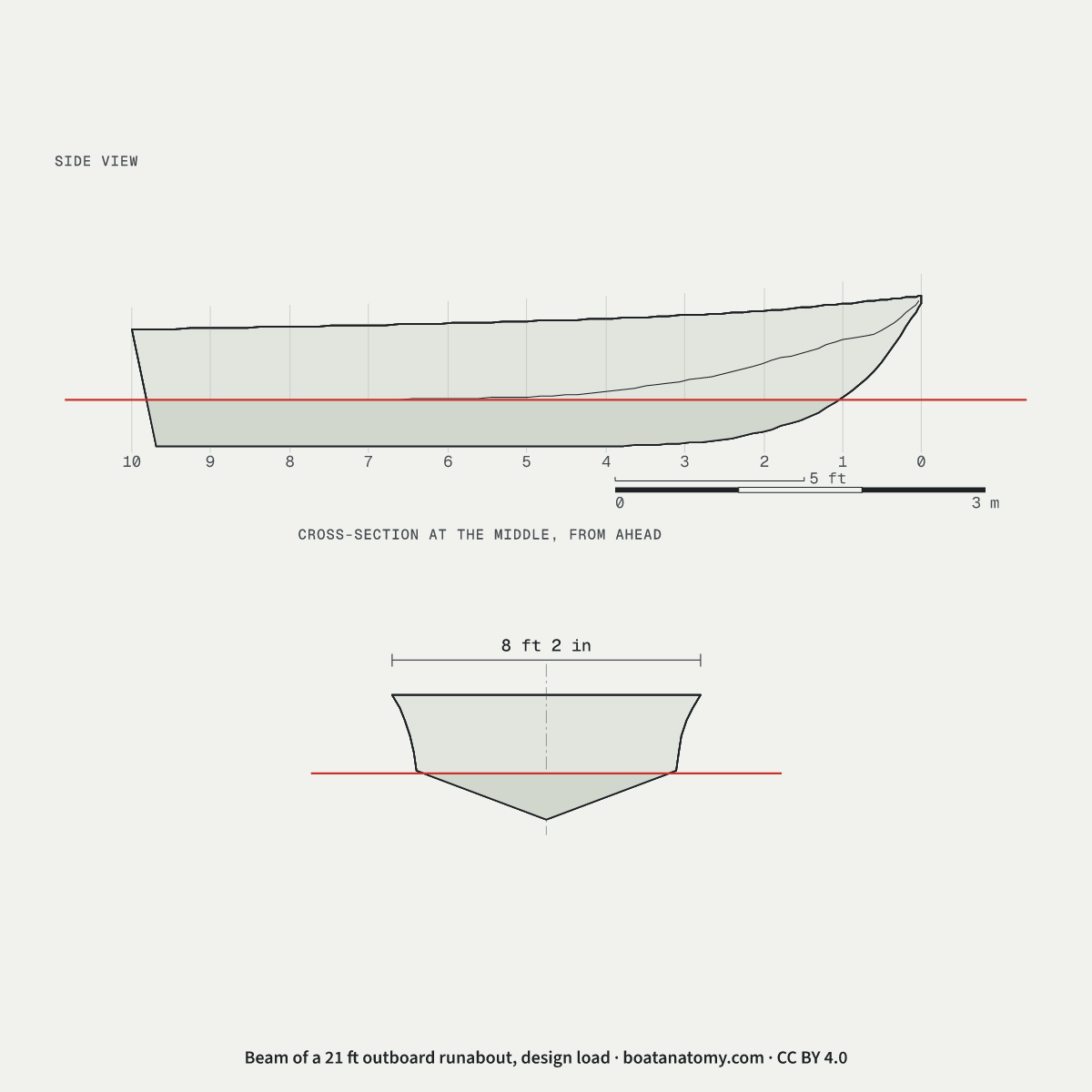
21 ft outboard runabout Drawn to scale, three loads Checked
The numbers at each load
| Measure | Light | Design | Heavy | With load |
|---|---|---|---|---|
| Draft, changes with load | 0.32 m 1 ft 1 in | 0.38 m 1 ft 3 in | 0.46 m 1 ft 6 in | Changes |
| Beam, fixed | 2.50 m 8 ft 2 in | 2.50 m 8 ft 2 in | 2.50 m 8 ft 2 in | Fixed |
| Freeboard, changes with load | 0.70 m 2 ft 3 in | 0.64 m 2 ft 1 in | 0.56 m 1 ft 10 in | Changes |
| Depth, fixed | 1.02 m 3 ft 4 in | 1.02 m 3 ft 4 in | 1.02 m 3 ft 4 in | Fixed |
| LOA, fixed | 6.40 m 21 ft | 6.40 m 21 ft | 6.40 m 21 ft | Fixed |
| LWL, changes with load | 5.49 m 18 ft | 5.60 m 18 ft 4 in | 5.73 m 18 ft 10 in | Changes |
Numbers are for this drawing's 21 ft outboard runabout. Read your own boat's figures off its spec sheet or capacity plate. Light: Tanks low, one person aboard: the drawing’s highest waterline. Design: The waterline the hull is drawn to, with a typical day’s load. Heavy: Full tanks, several people and gear: the drawing’s lowest-riding waterline.
What the number does not tell you
Terms often confused
Overall beamWaterline beam
Overall beam spans the outer sides of the boat; waterline beam spans the hull where it meets the water, and flare makes the overall figure larger.
LOALWL
Length overall runs from the foremost to the aftermost part of the boat; waterline length runs only where the hull meets the water.
Beam of a boat in more detail
Beam is a boat’s greatest width. The word first named the timbers laid across a ship to hold it together, and from those came its sense of the ship’s greatest breadth. Federal rules and naval-architecture texts measure it at different heights, and on a hull whose sides flare the two figures differ. The explorer draws both on the same runabout.
Overall beam and waterline beam
Federal boat regulations measure beam across the outer sides of the boat and leave out handles and similar fittings, attachments and extensions. That gives the overall width, found near the gunwale on this hull because its sides flare outward. Industry guides usually describe beam the same way, as the widest distance between the gunwales.
Naval architecture courses use beam for the width of each section, and a single beam figure for a ship usually means the widest beam at the design waterline. On the drawing the waterline beam comes out narrower than the overall beam, because the hull widens above the water. That outward slant of the sides above the waterline is called flare.
Length overall and waterline length
Length also has an overall figure and a waterline figure. The regulations take length as a straight horizontal line from the foremost to the aftermost part of the boat, without bow sprits, rudders, outboard motor brackets or handles. Boating courses teach length overall the same way, from the tip of the bow to the stern in a straight line.
Waterline length runs only between the points where the water meets the stern and the bow. Because it depends on where the water sits, it changes with load and trim, while length overall stays put. At the explorer’s heavy load the waterline length grows as the hull settles. The freeboard page measures how high the same runabout’s sides stand above the water.
Beam and trailer width
A boat’s beam and the width allowed on the road are separate questions. Federal highway rules for commercial vehicles set a 102-inch width limit on the National Network and let states permit wider loads. Private towing falls under each state’s own rules, which this page does not cover.
Common questions
What is the beam of a boat?
The beam of a boat is its greatest width. A boating-course glossary defines beam as the maximum width of a vessel.
Is beam measured at the waterline or at the widest point?
Beam is measured both ways. Federal boat rules measure it between the outer sides of the boat; naval architecture texts usually mean the widest beam at the design waterline.
What is the difference between LOA and LWL?
LOA, length overall, runs from the foremost to the aftermost part of the boat. LWL, waterline length, is shorter and changes as load moves the waterline.
How is boat length measured?
Boat length is measured in a straight horizontal line from the foremost to the aftermost part of the boat, leaving out fittings such as bow sprits, rudders and outboard motor brackets.
Why is it called the beam?
The word beam first named the timbers laid across a ship to hold it together, and from those came its sense of the ship’s greatest breadth.