Transom on a boat
Short answer: A transom is the surface across the stern of a boat that faces aft, and on an outboard boat the motor mounts on it. Builders call it full when it spans the stern at side height, and notched when it has a motor cut-out.
Pick a part on the drawing, or a name in the list, to see what it is.
Which part is marked in red?
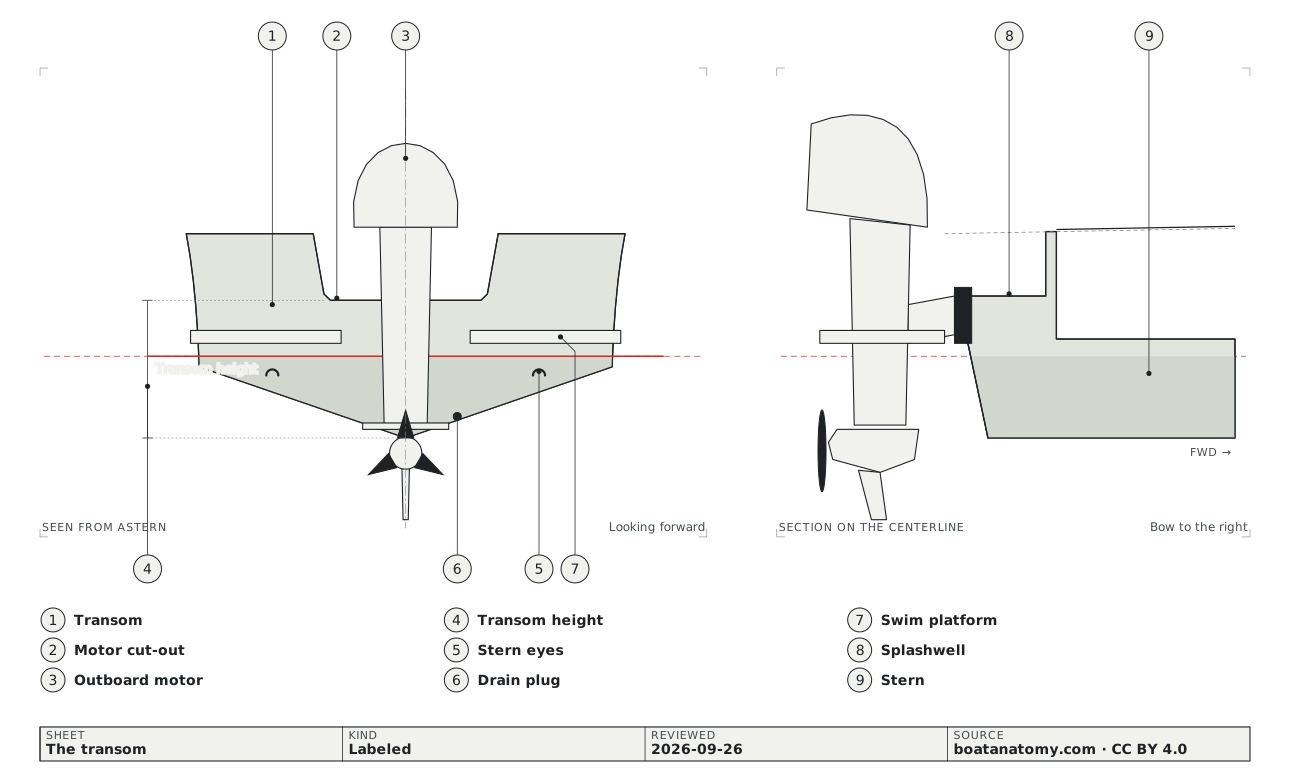
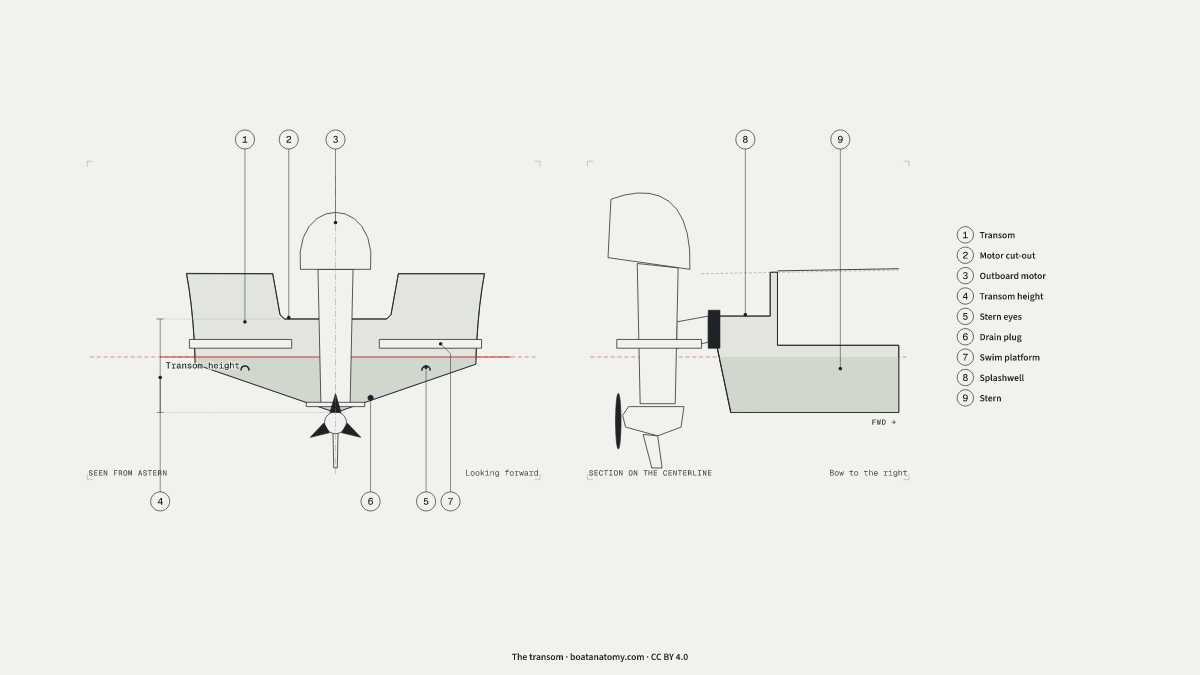
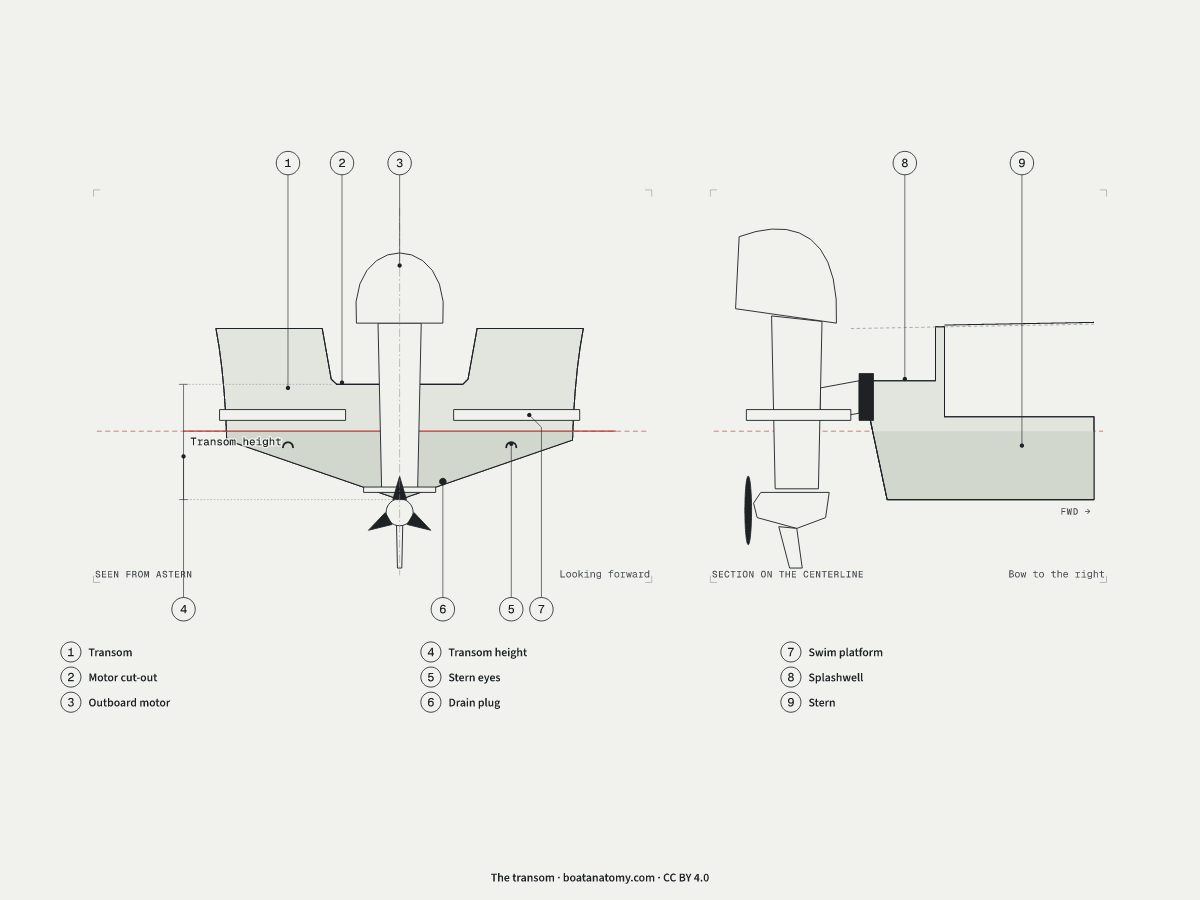
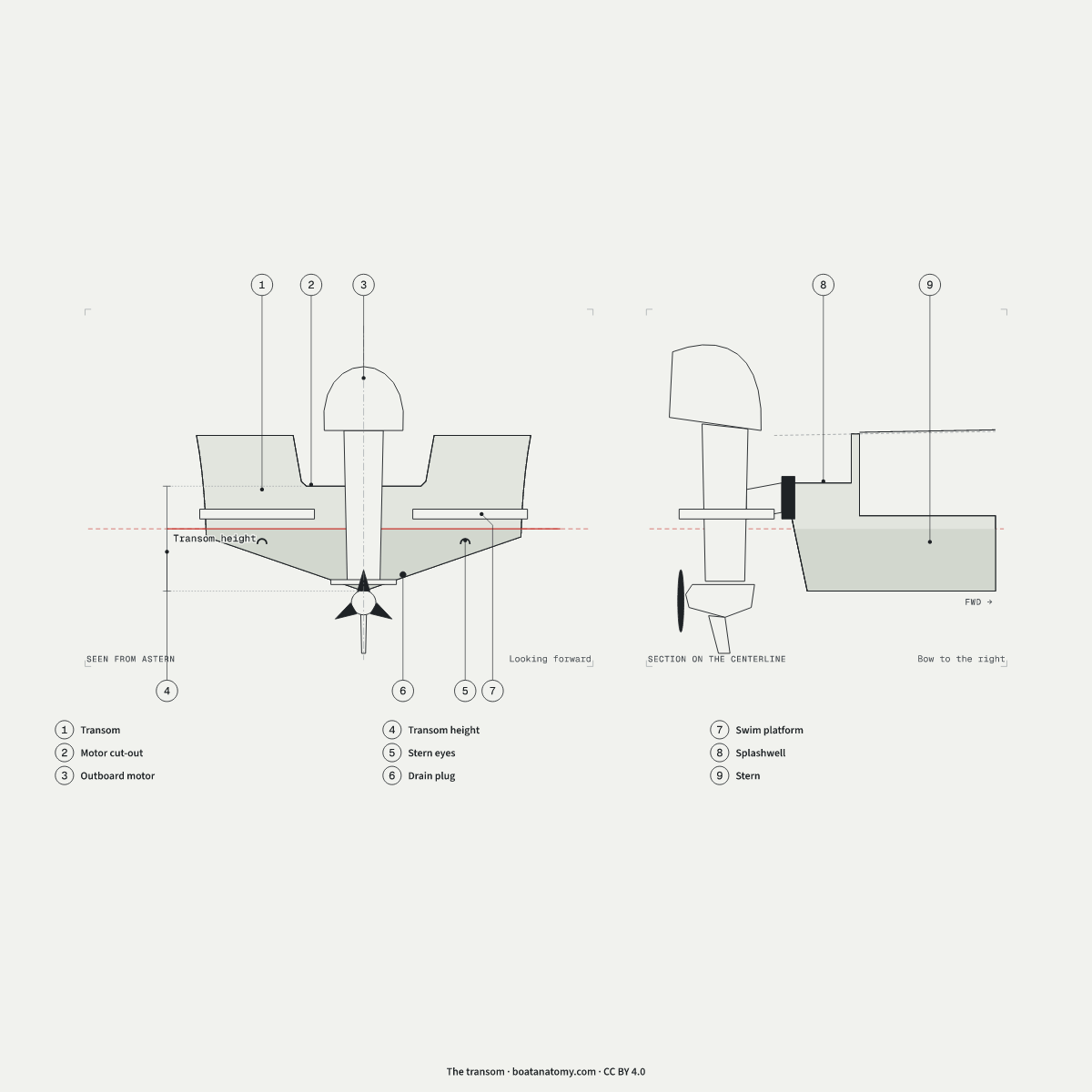
The transom, seen from astern and section on the centerline Drawn to scale Checked
The 9 parts on this drawing
- Transom
The transom is the surface across the stern of the boat that faces aft.
- Motor cut-out
A motor cut-out is a lowered section of the transom’s top edge where an outboard motor is mounted.
Also called notch, motor notch
- Outboard motor
An outboard motor is a self-contained engine, gear case and propeller unit mounted on the transom.
Also called outboard
- Transom height
Transom height is measured from the lowest point along the top of the transom where water could come in, down to a line extending the bottom of the hull at the centerline.
- Stern eyes
The stern eyes on this drawing are eye bolts low on the transom, used as attaching points when the boat is on a trailer.
Also called transom eyes, tie-down eyes
- Drain plug
The drain plug is a plug or valve low in the transom that controls the draining of water from the hull.
Also called bung
- Swim platform
The swim platform is a low platform at the stern for getting on and off the boat from the water.
Also called swim step
- Splashwell
The splashwell, or motorwell, is the walled area just inside the transom that stops water coming through the motor cut-out from reaching the passenger area.
Also called motor well
- Stern
The stern is the back, or aft end, of a boat.
Also called aft end
Terms often confused
TransomStern
The transom is one surface; the stern is the whole region at the back of the boat that contains it.
Transom heightFreeboard
Transom height runs down from the lowest point where water could come over the transom to an extension of the bottom line; freeboard is measured up from the water.
Transom on a boat in more detail
Seen from astern, the transom is the whole face across the back of the hull. US boat regulations define it as the surface at the stern that projects or faces aft, which is why the stern view shades the entire aft face, from the bottom to the top edge. A hull with a transom stern stops at a flat or nearly flat surface there, and that surface is what the word names.
Transom height
On small outboard boats the regulations use the transom as a reference line, so its height has an exact definition. Transom height runs from the lowest point along the top of the transom where water could come in, down to a line that extends the bottom of the hull at the centerline. The rule leaves any keel out of the measurement, and the drawing follows it.
Full, notched and Euro transoms
Builders usually call a transom full when it spans the stern at side height, and notched when its top has an outboard cut-out. An industry guide says outboards on full transoms usually need a bracket, and describes a Euro transom as that bracket built into the hull. The regulations use “full transom” in another sense, for a transom wider than half the boat’s maximum beam.
On many outboard boats the top edge has a lowered cut-out where the motor mounts. Inside it, a walled splashwell, which the regulations call a motorwell, stops water that comes through the cut-out from reaching the passenger area. The centerline section on the right shows the well sitting forward of the transom.
Fittings on the transom
The outboard motor, a complete engine, gear case and propeller unit, is mounted on the transom itself. Low down on each side, the drawing adds stern eyes, attaching points for a boat on a trailer, and a drain plug controls the draining of water from the hull. The swim platform, where fitted, gives a low step at the stern for boarding from the water.
What it is made of
Boating writers describe fiberglass transoms as usually built around a core of marine plywood or a composite board, sandwiched between layers of fiberglass. BoatUS editors describe rebuilding a rotted core as usually a job for a professional, since it must come out from between the fiberglass skins. This site does not cover repair.
The word
The same word names a crossbar over a door and, in American usage, the small window above it. Dictionaries trace it to Latin by different routes: Merriam-Webster through Old French traversain, “set crosswise”, and Etymonline from transtrum, “crossbeam”.
Common questions
What does the transom do on a boat?
The transom closes the back of the hull. On an outboard boat the transom also carries the motor, which is mounted on it.
Do all boats have a transom?
Not every boat has a transom. A canoe stern comes to a point much like the bow, so a double-ender has no flat transom across the back.
What is transom height?
Transom height, under the federal definition, is the vertical distance from the lowest point along the top of the transom where water could come in, down to a line extending the bottom of the hull, leaving out any keel.
What is a full transom?
A full transom, in everyday use, spans the stern at full side height with no motor cut-out. The federal rules use the term differently, for a transom wider than half the boat’s maximum beam.
What is the cut-out in the top of a transom?
The cut-out in the top of a transom is a lowered section of the top edge where the outboard mounts. Federal rules call the walled area inside it a motorwell: it stops water that comes through the cut-out from reaching the passenger area.
Why is it called a transom?
The word transom also names a crossbar over a door. Dictionaries trace it to Latin by different routes, one through Old French for “set crosswise”, the other from a word for crossbeam.
What is a transom made of?
The transom of a fiberglass boat is usually built around a core of marine plywood or a composite board, sandwiched between layers of fiberglass.
Print and practice
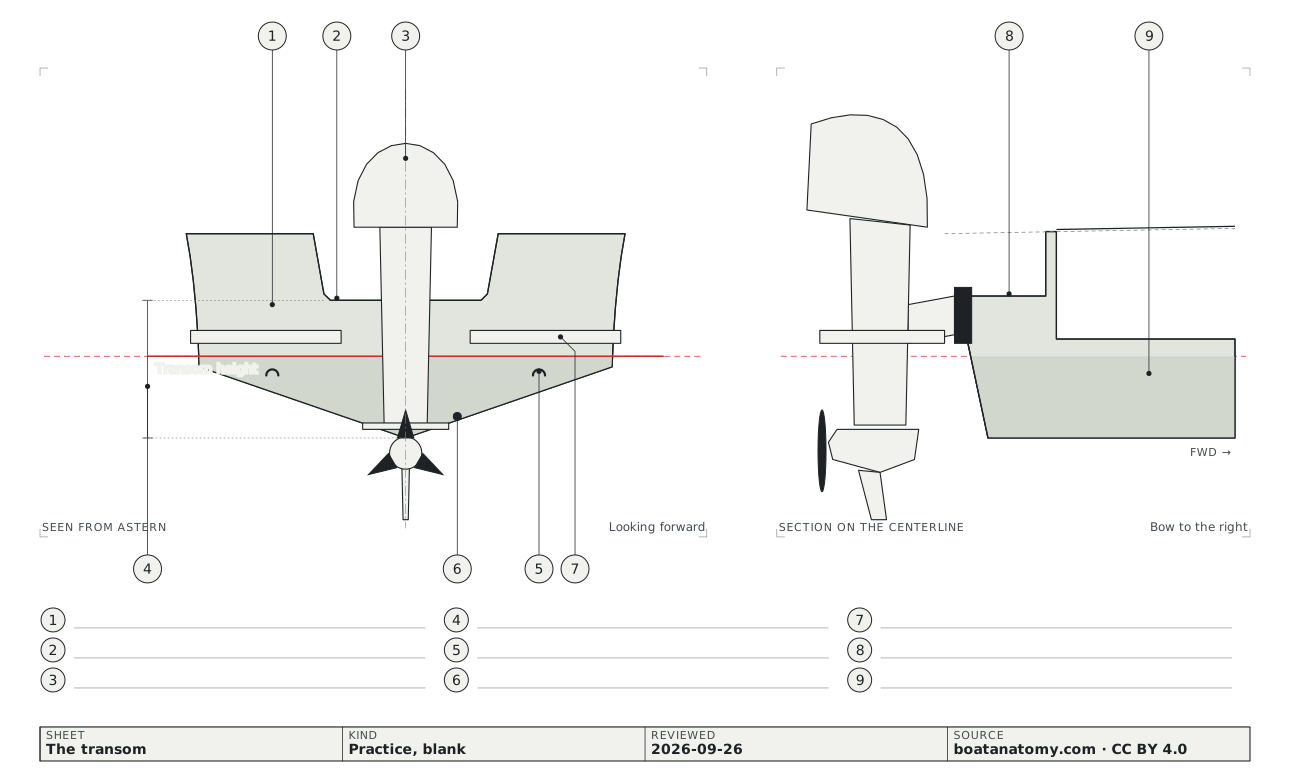
All worksheets- The transom Labeled sheet Blank sheet to fill in