Freeboard
Short answer: Freeboard is the height of a boat’s side above the waterline. Naval architects define it as depth minus draft, so load that deepens the draft reduces the freeboard by the same amount. Boating courses measure it to the lowest point where water could come aboard.
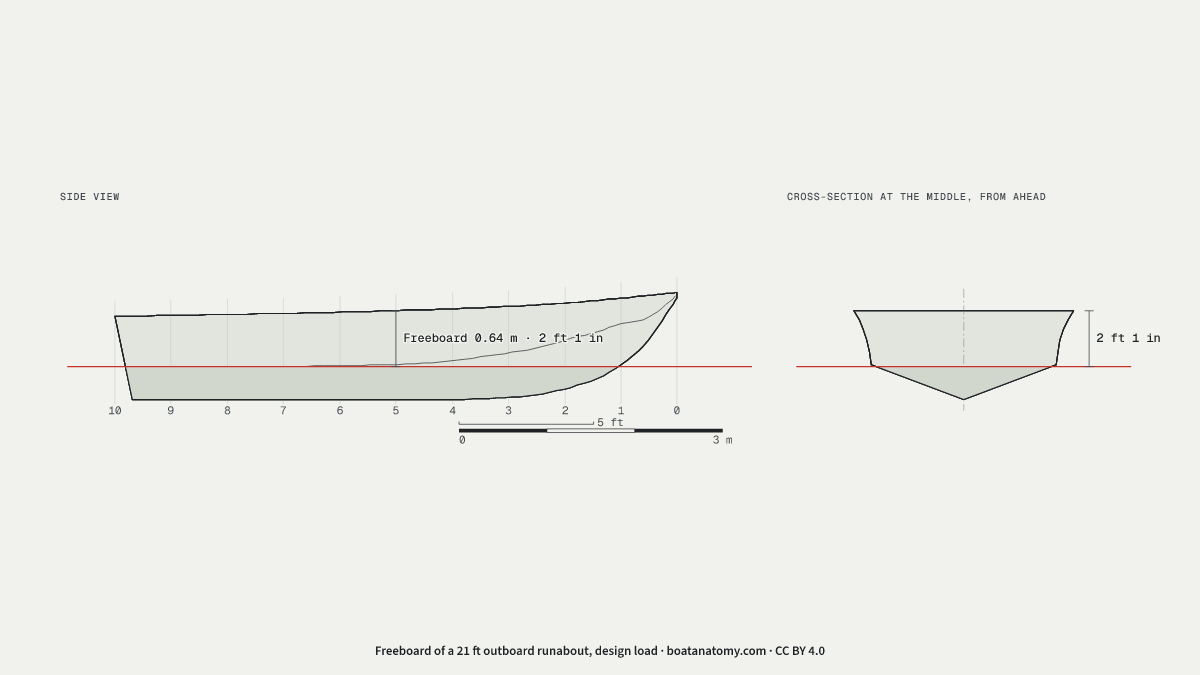
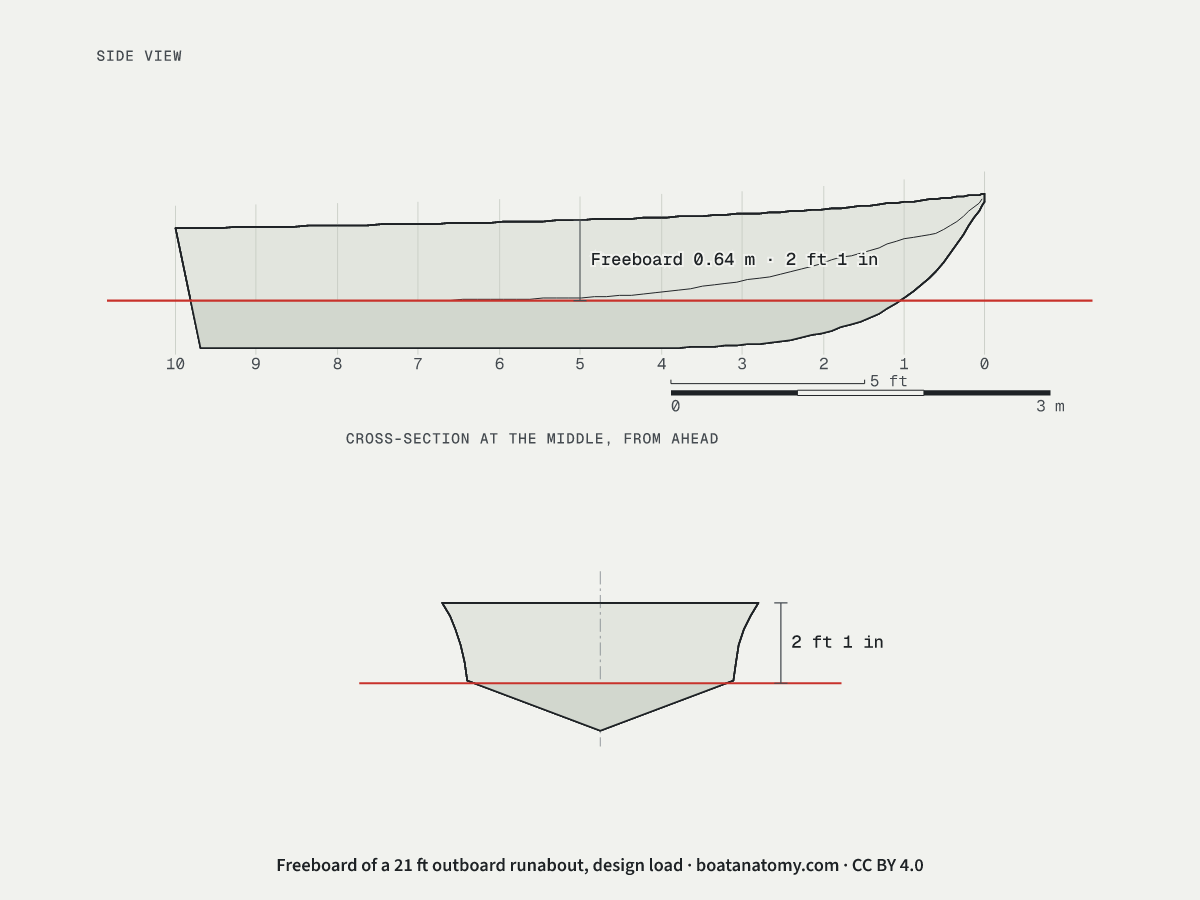
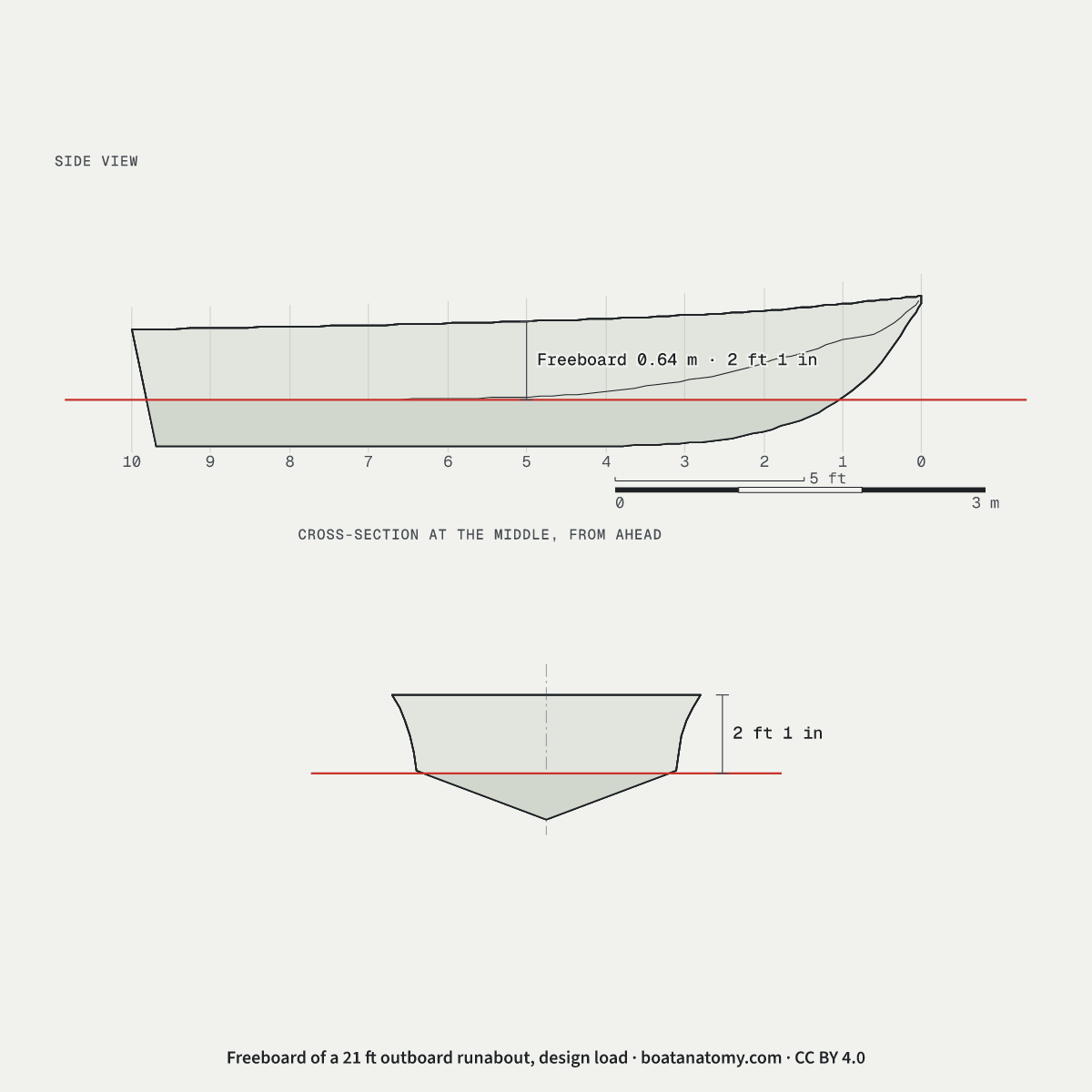
21 ft outboard runabout Drawn to scale, three loads Checked
The numbers at each load
| Measure | Light | Design | Heavy | With load |
|---|---|---|---|---|
| Draft, changes with load | 0.32 m 1 ft 1 in | 0.38 m 1 ft 3 in | 0.46 m 1 ft 6 in | Changes |
| Beam, fixed | 2.50 m 8 ft 2 in | 2.50 m 8 ft 2 in | 2.50 m 8 ft 2 in | Fixed |
| Freeboard, changes with load | 0.70 m 2 ft 3 in | 0.64 m 2 ft 1 in | 0.56 m 1 ft 10 in | Changes |
| Depth, fixed | 1.02 m 3 ft 4 in | 1.02 m 3 ft 4 in | 1.02 m 3 ft 4 in | Fixed |
| LOA, fixed | 6.40 m 21 ft | 6.40 m 21 ft | 6.40 m 21 ft | Fixed |
| LWL, changes with load | 5.49 m 18 ft | 5.60 m 18 ft 4 in | 5.73 m 18 ft 10 in | Changes |
Numbers are for this drawing's 21 ft outboard runabout. Read your own boat's figures off its spec sheet or capacity plate. Light: Tanks low, one person aboard: the drawing’s highest waterline. Design: The waterline the hull is drawn to, with a typical day’s load. Heavy: Full tanks, several people and gear: the drawing’s lowest-riding waterline.
What the number does not tell you
Terms often confused
FreeboardTopsides
Topsides are the hull sides above the waterline; freeboard is a measurement of how high they stand.
FreeboardDepth
Depth is the full height of the hull from keel to deck; freeboard is the part of it left above the water.
Freeboard in more detail
Freeboard is the height of a boat’s side above the water, and the Naval Academy’s hull-geometry text reduces it to a subtraction: depth minus draft. The explorer draws both on one runabout, the same boat the beam page measures across, and shows the subtraction change as the load changes.
Why it shrinks under load
Depth is fixed by the hull, so every extra inch of draft comes straight off the freeboard. Switch from light to heavy and the red waterline climbs the hull side, and the freeboard figure falls by exactly the amount the draft rises.
Reserve buoyancy and load lines
Reserve buoyancy is the watertight volume of a vessel above its waterline, the part of the hull that freeboard measures from the side. Cargo ships carry a load line, or Plimsoll mark, amidships on each side, showing the deepest lawful loaded draft and so a minimum freeboard. US load line rules exempt pleasure craft that are not used in trade; a small boat’s limits are on its capacity plate, described below.
Two ways to measure it
Sources agree on the idea and differ on the top reference point. The ITTC dictionary measures from the undisturbed water surface to the edge of a reference deck. Boating courses measure instead to the lowest point of the boat where water could come on board, and on an open boat that point can sit lower than the deck edge amidships.
Freeboard also varies along the boat. The sheer, the top line of the side seen from the side, curves from bow to stern, so the height above the water differs from station to station even at one load. The explorer measures amidships.
Where a small boat’s load limits are
US regulations require most monohull boats under 20 feet to carry a plate with a maximum persons and weight capacity, and the Coast Guard tells boaters not to exceed the load it specifies.
Common questions
What is freeboard on a boat?
Freeboard is the height of a boat’s side above the water. The Naval Academy’s hull-geometry text defines it as the depth of the hull minus its draft.
How is freeboard measured?
Freeboard is measured up from the water surface. The ITTC dictionary measures to the edge of a reference deck; boating courses measure to the lowest point where water could come on board.
Why does freeboard change?
Freeboard changes because draft changes. Load and trim move the waterline up or down the side, and whatever the draft gains, the freeboard loses.
Is freeboard the same at the bow and the stern?
Freeboard differs from bow to stern. The sheer, the top line of the side, curves along the boat, so the height above the water changes along its length.
What is the Plimsoll mark?
The Plimsoll mark is the load line painted amidships on each side of a cargo ship. It shows the deepest the ship may lawfully be loaded, which sets a minimum freeboard.
Do small boats have a load line?
Small pleasure boats carry no load line: US load line rules exempt pleasure craft not used in trade. Most monohull boats under 20 feet carry a capacity plate instead.