Boat hull
Short answer: The hull is the body of a boat, including the part below the waterline. Hull types are named two separate ways: by how the hull moves at speed (displacement, semi-displacement or planing) and by shape (flat, V, round, multihull).
Pick a part on the drawing, or a name in the list, to see what it is.
Which part is marked in red?
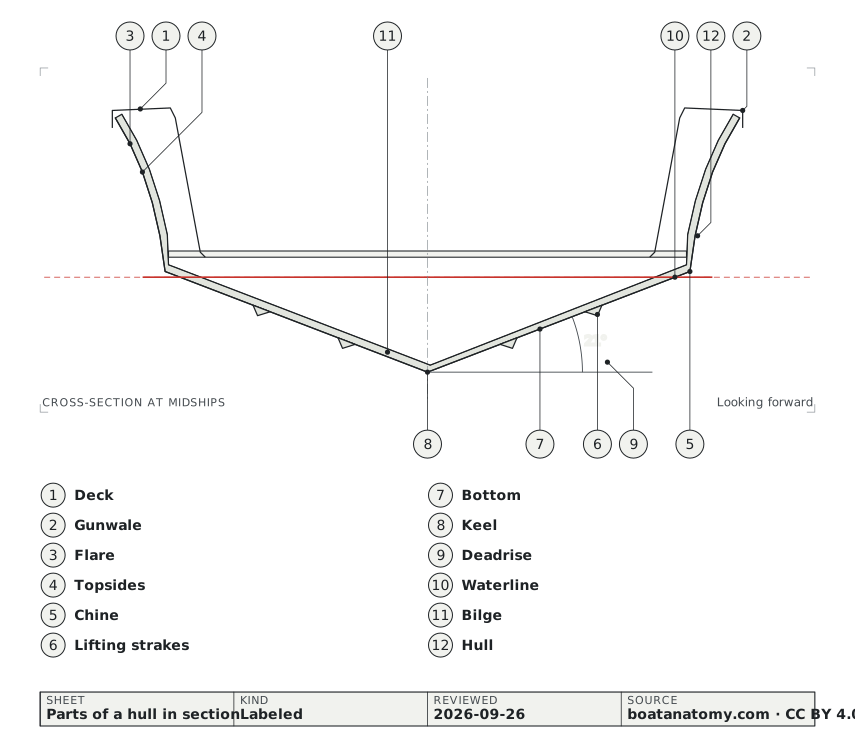
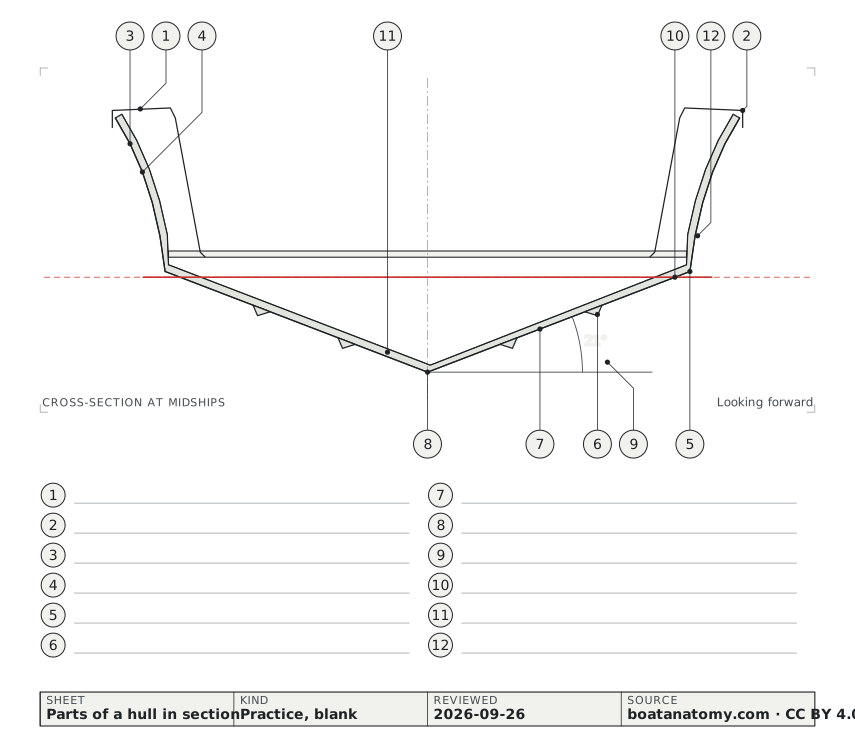
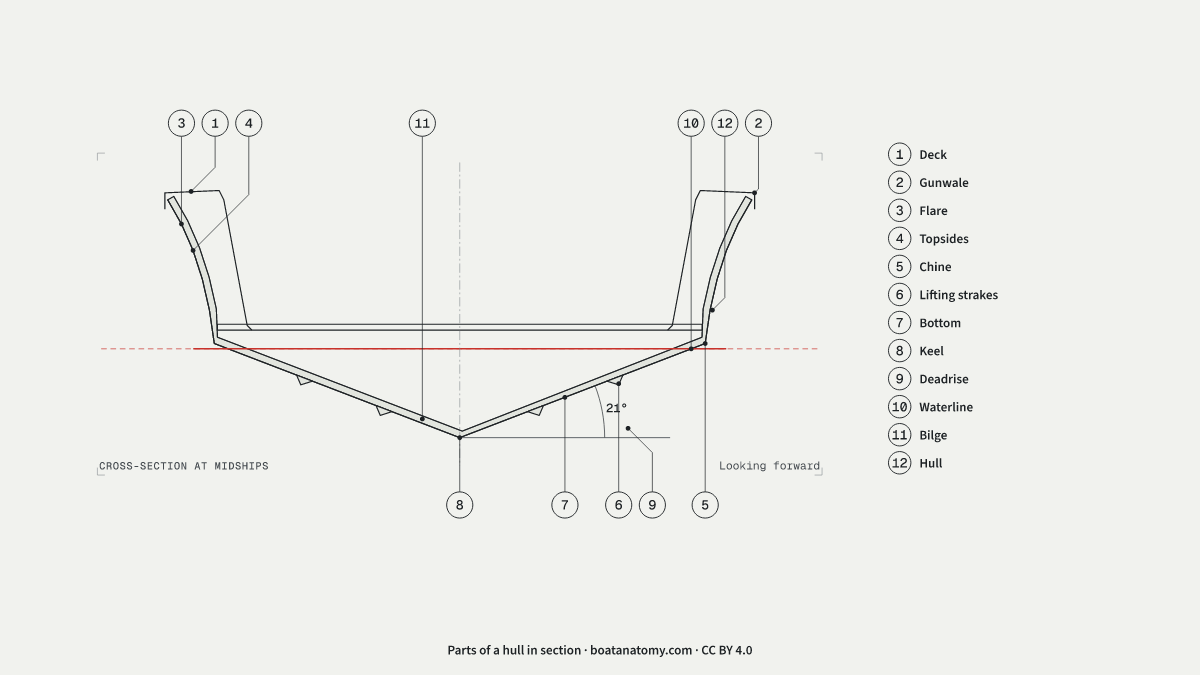
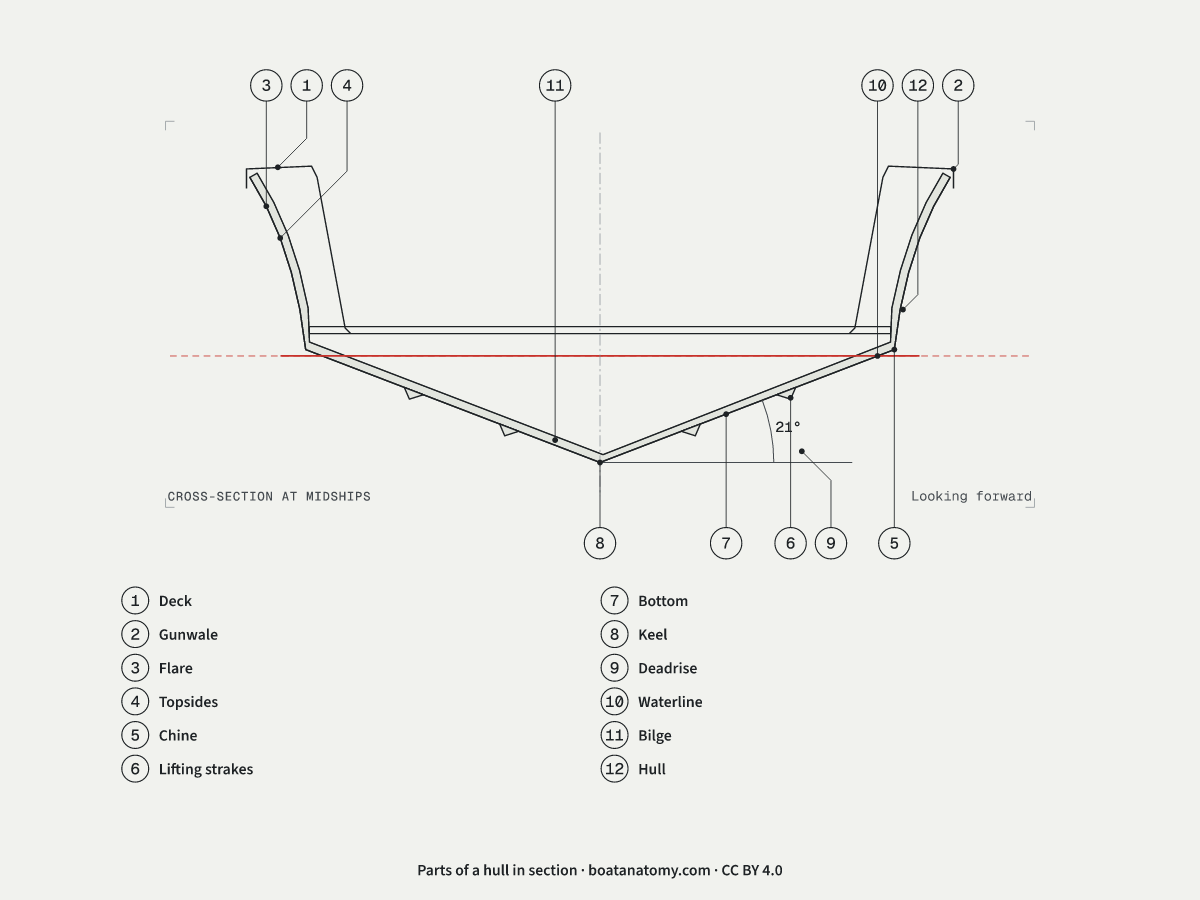
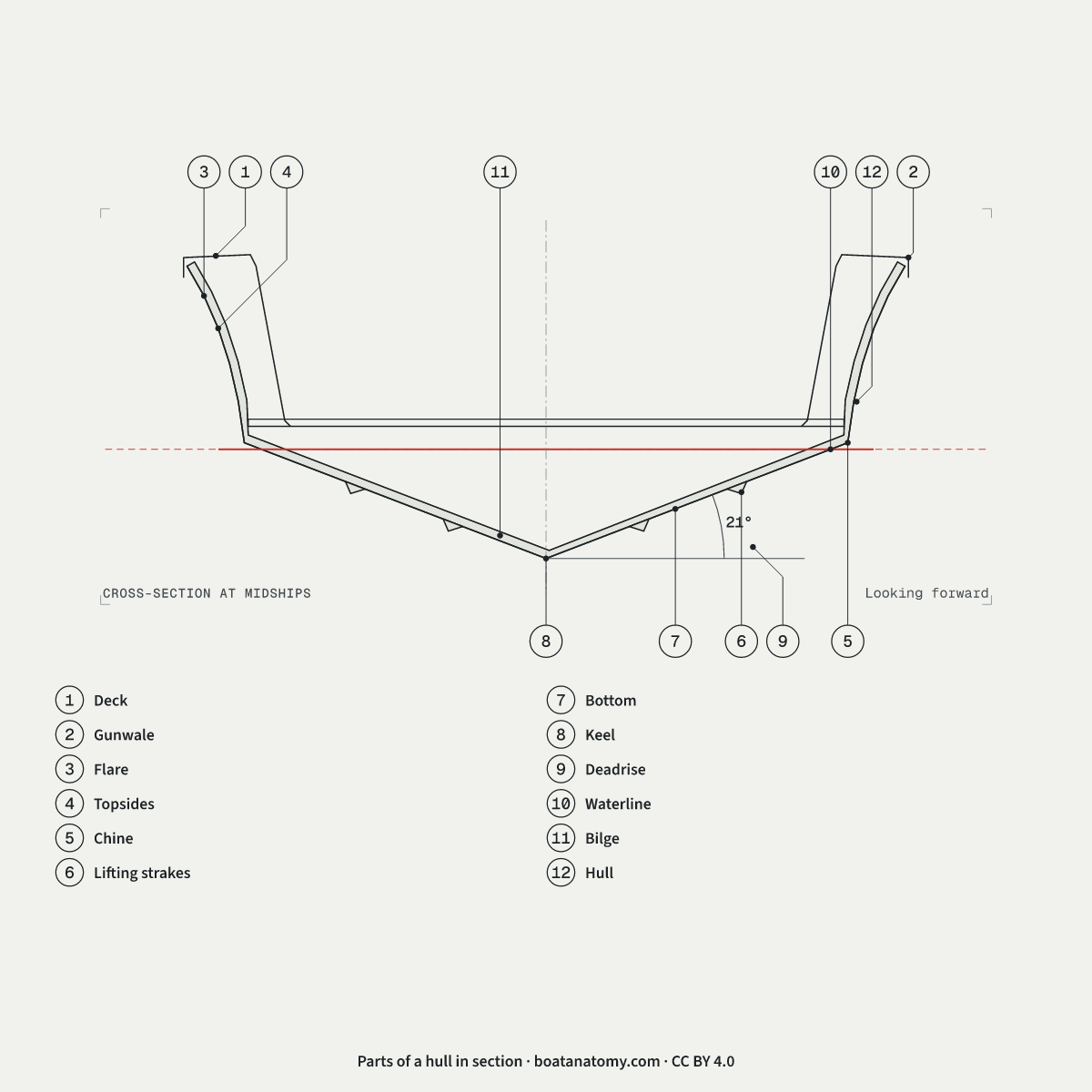
Parts of a hull in section, cross-section at midships Drawn to scale Checked
The 12 parts on this drawing
- Deck
The deck is the horizontal surface that closes in the top of the hull and forms the boat’s outside floor.
- Gunwale
The gunwale, pronounced “gunnel”, is the upper edge of the boat’s side.
Also called gunnel
- Flare
Flare is the outward slope of the hull sides as they rise from the waterline.
- Topsides
Topsides are the sides of the hull between the waterline and the gunwale.
- Chine
The chine is the corner along the hull where the bottom meets the side.
Also called hard chine
- Lifting strakes
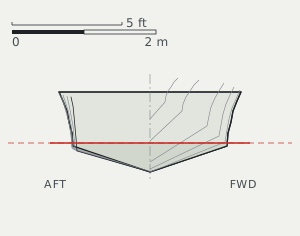
On the drawings, lifting strakes are the narrow ridges drawn fore and aft along the bottom of the planing hulls.
Also called strakes
- Bottom
The bottom is the underside of the hull, which meets the sides at the chines.
Also called hull bottom
- Keel
The keel is the backbone of the hull, running fore and aft along the centerline at the bottom.
- Deadrise
Deadrise is the angle between the bottom of the hull and a horizontal line, seen in a cross-section.
Also called deadrise angle
- Waterline
The waterline is the line where the surface of the water meets the hull.
Also called WL
- Bilge
The bilge is the lowest part of the inside of the hull, where water collects.
Also called bilges
- Hull
The hull is the body of the boat, including the part below the waterline.
Also called hull shell
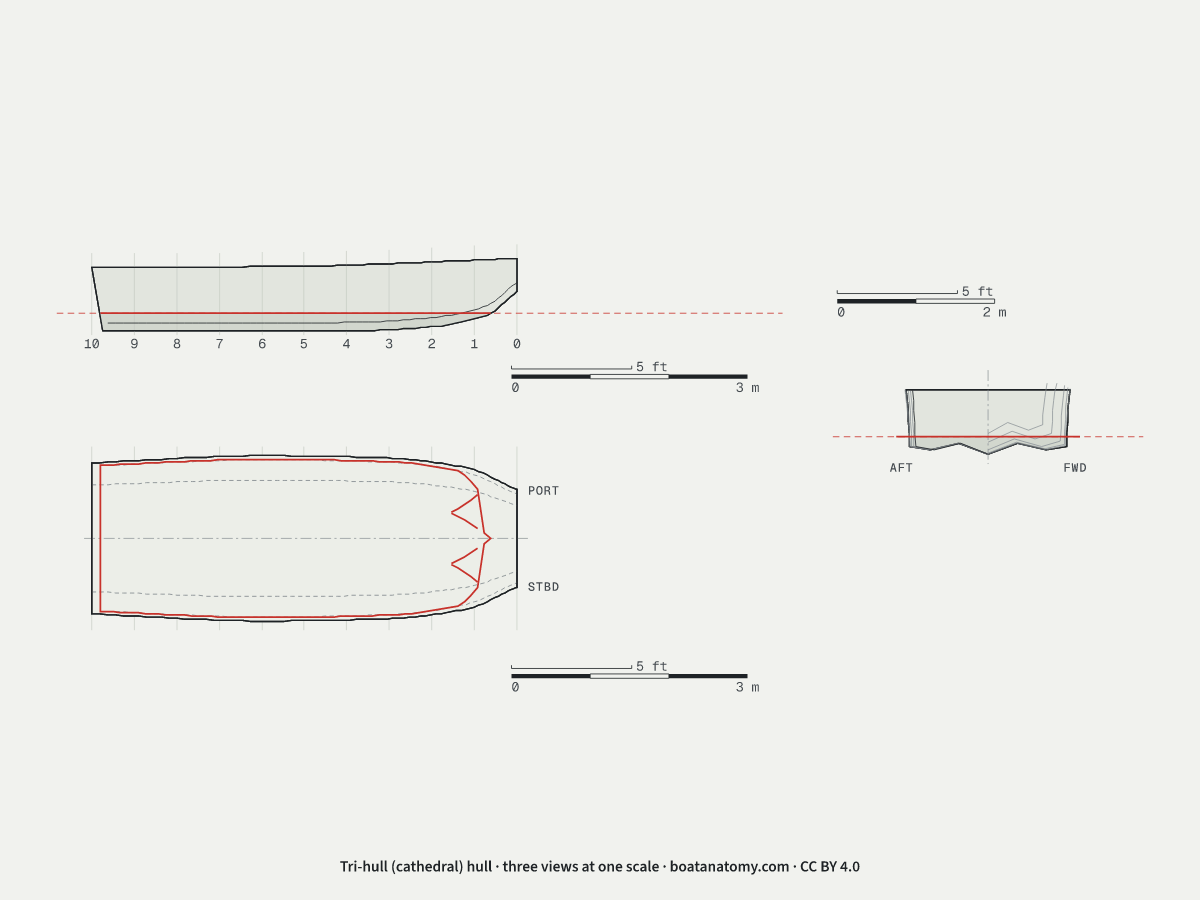
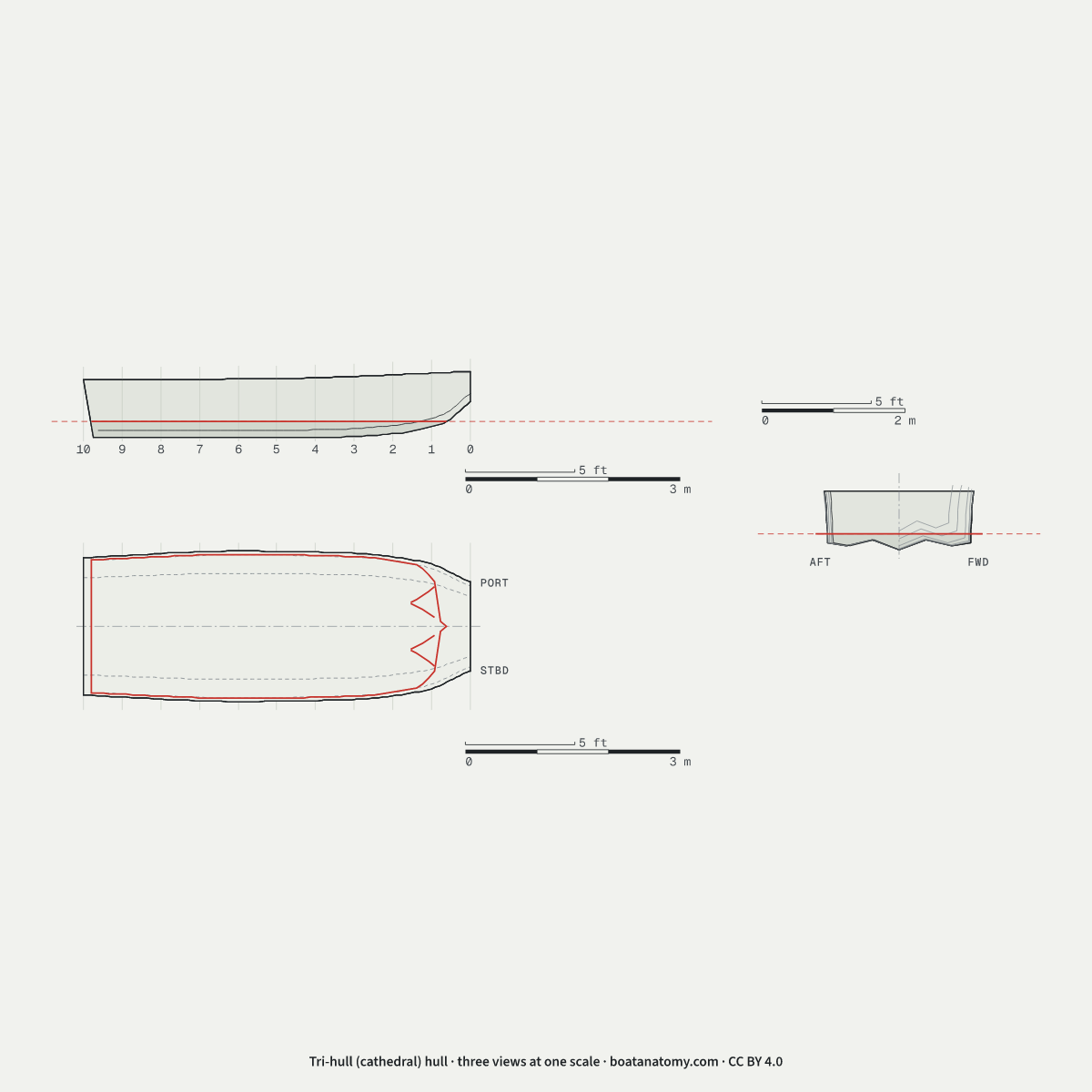
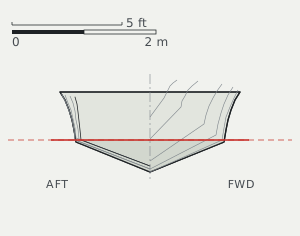
Twelve hulls, three views, one scale
12 hulls Every hull at one scale Checked
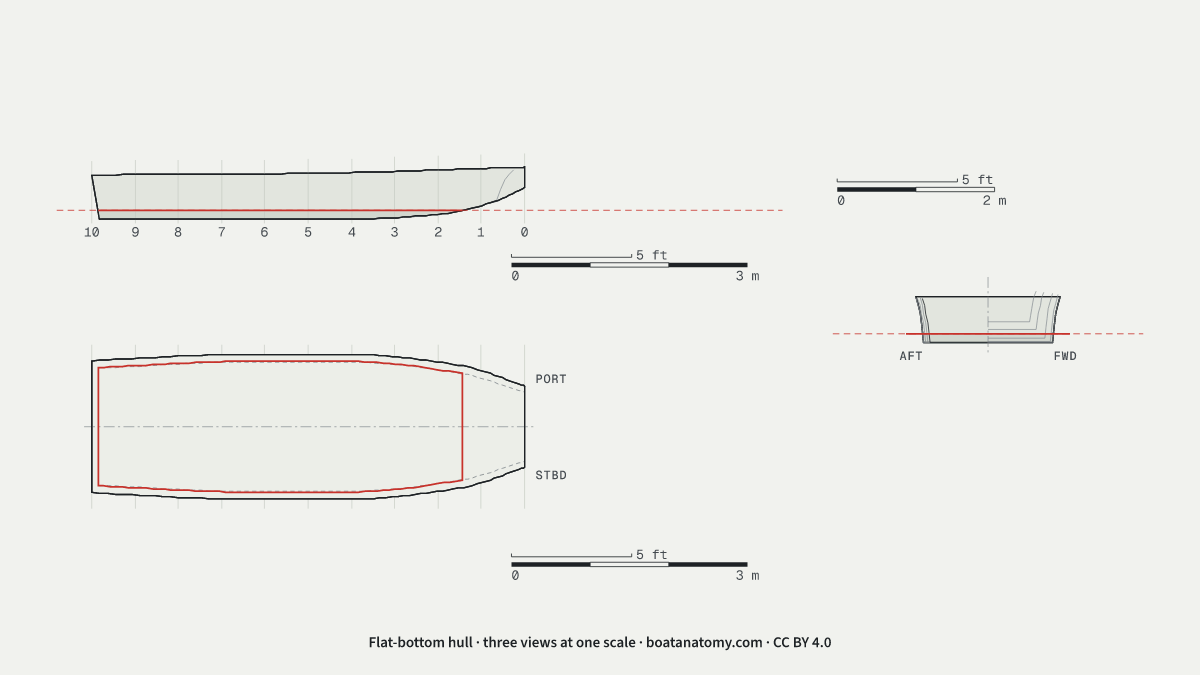
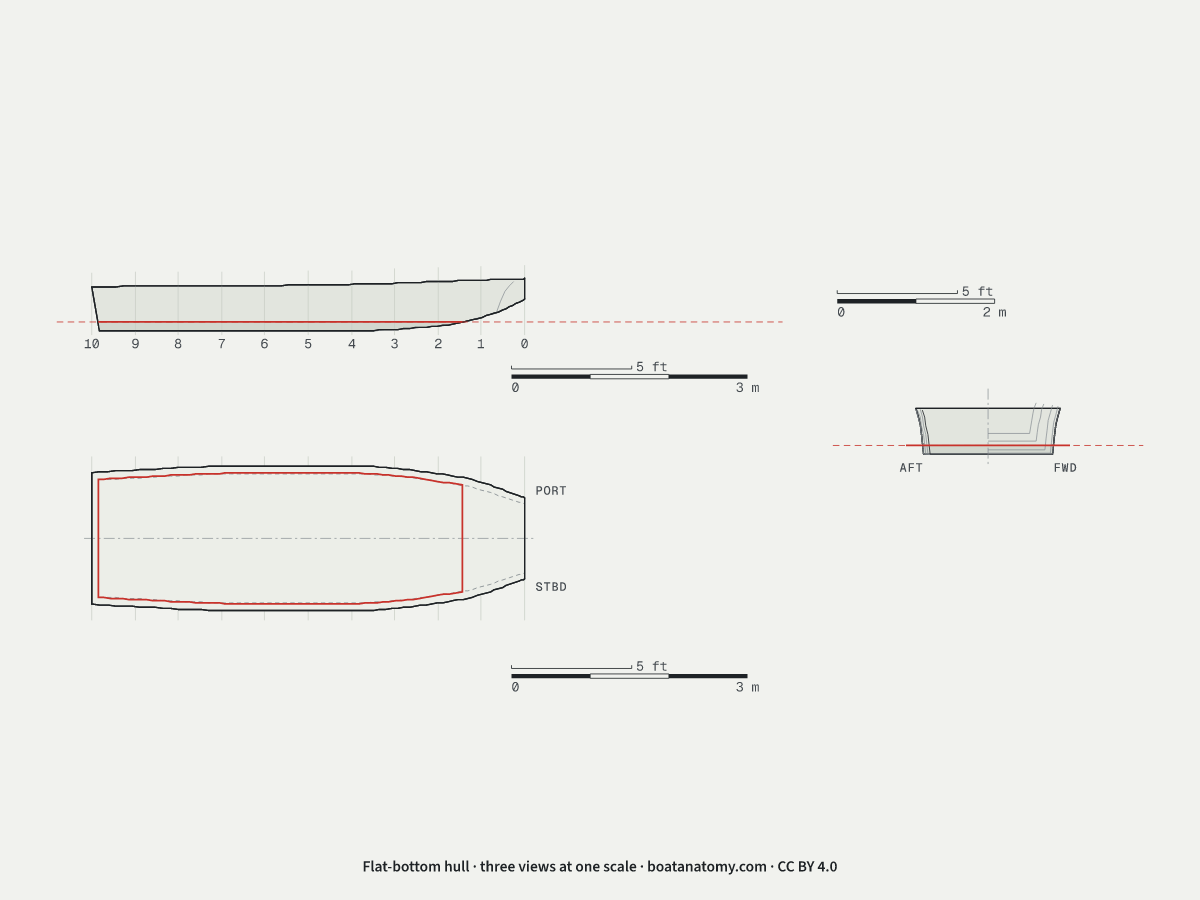
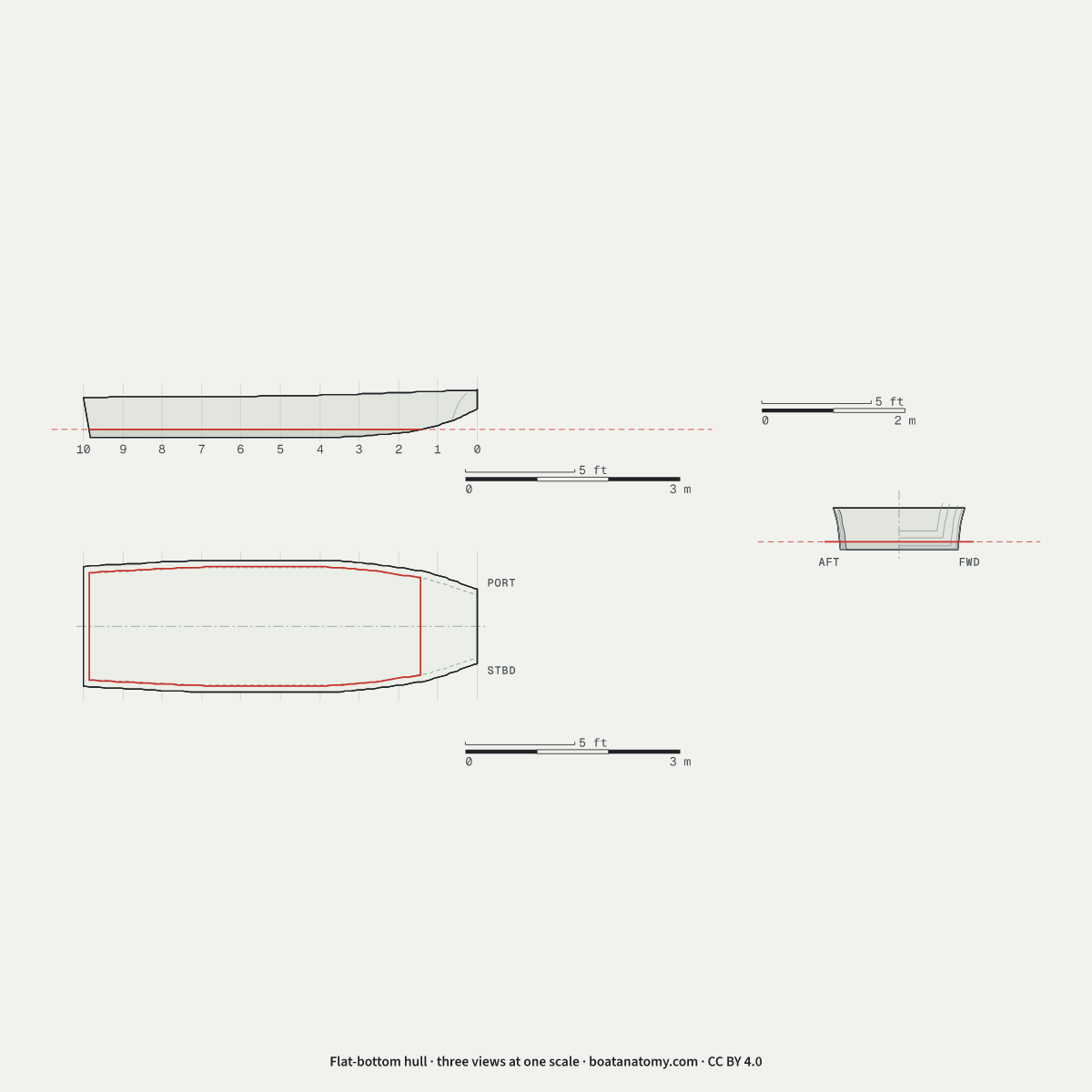
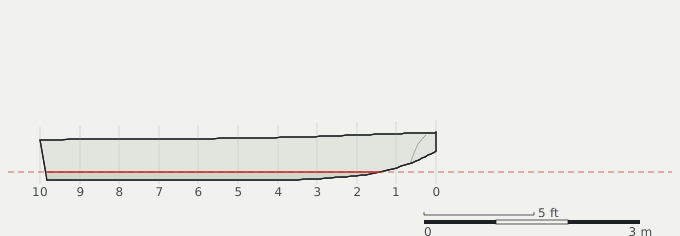
Flat-bottom hull
A flat-bottom hull has a bottom that is flat, or nearly so, from side to side, meeting the sides at a hard chine.
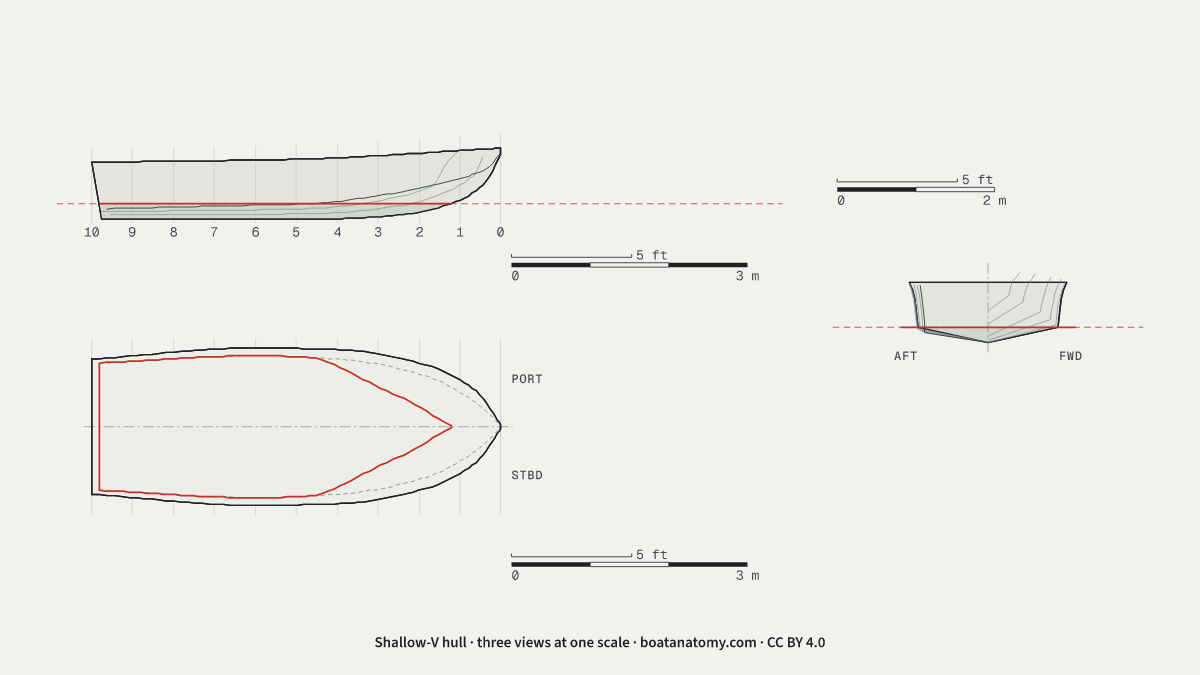
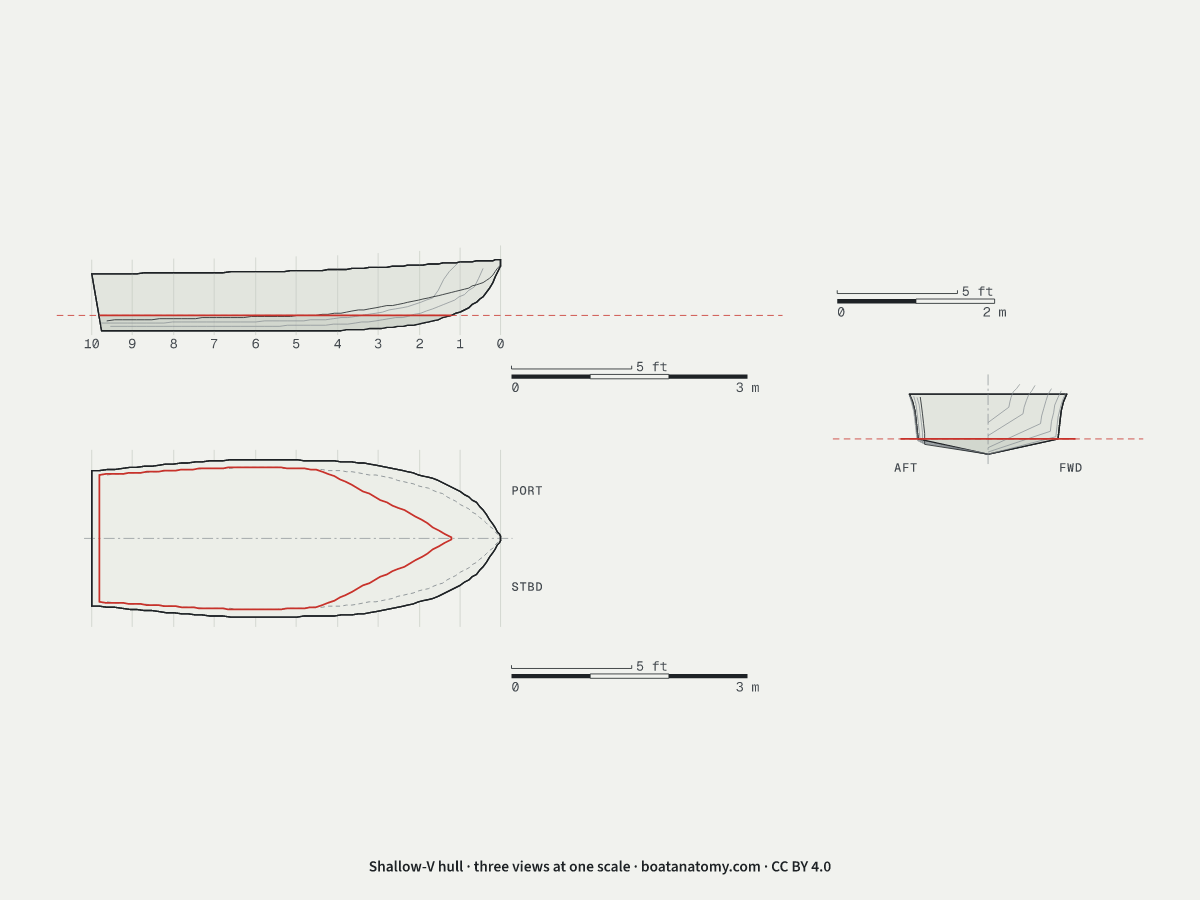
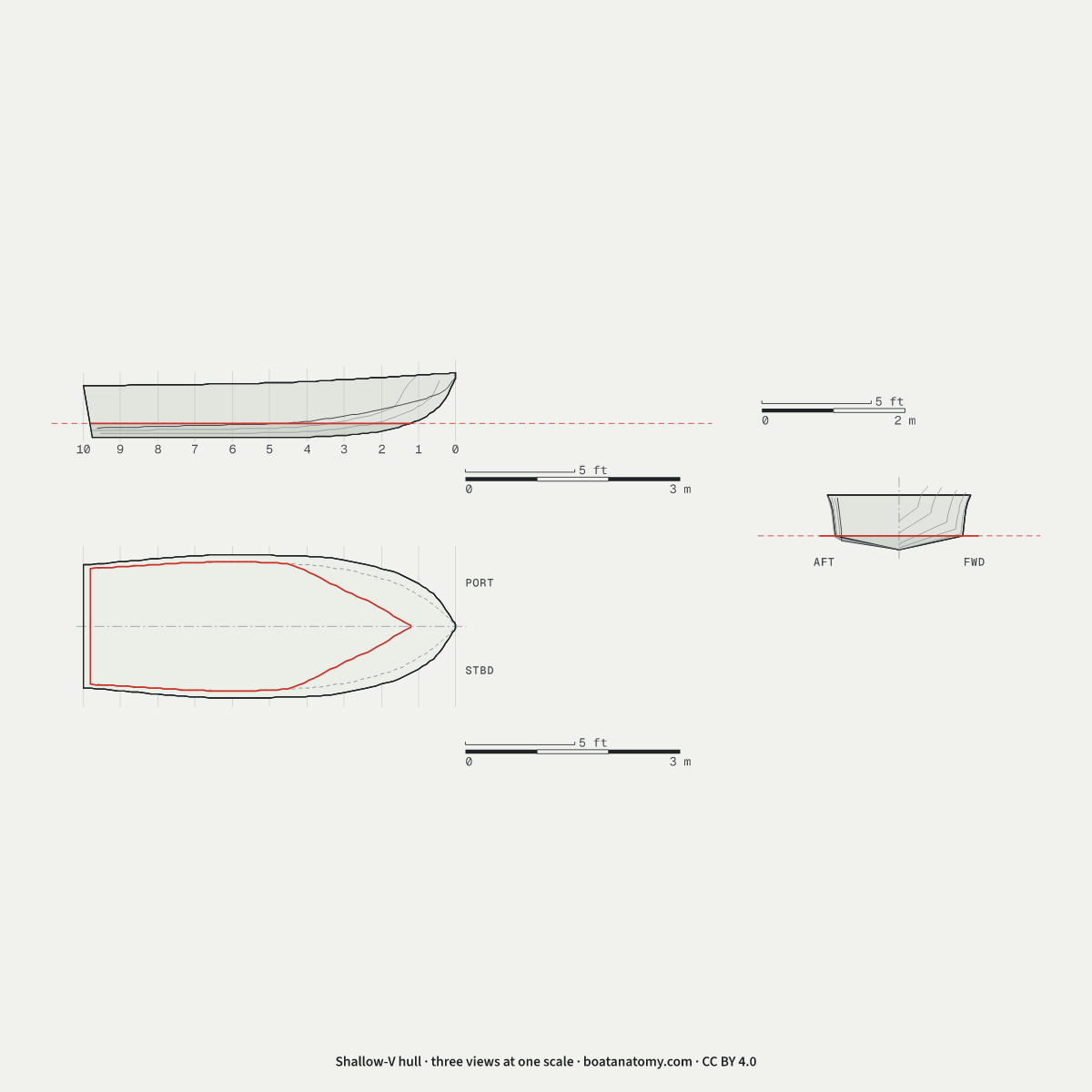
Shallow-V hull
A shallow-V hull has a V-shaped bottom with only a small deadrise angle.
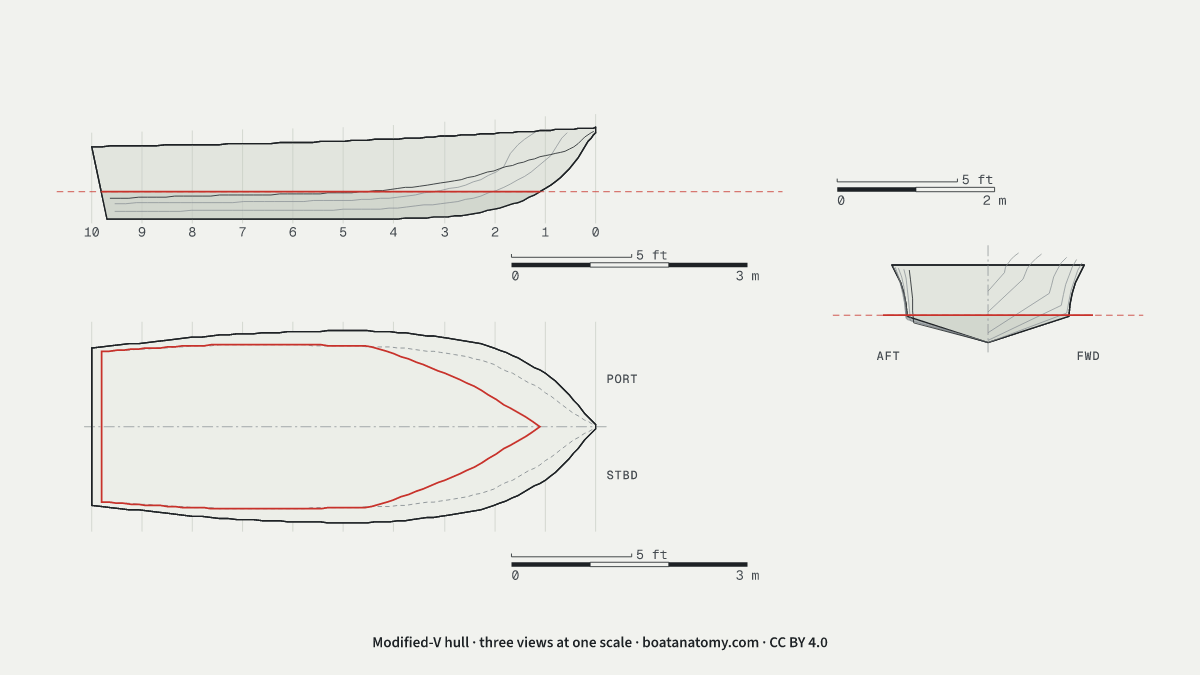
Modified-V hull
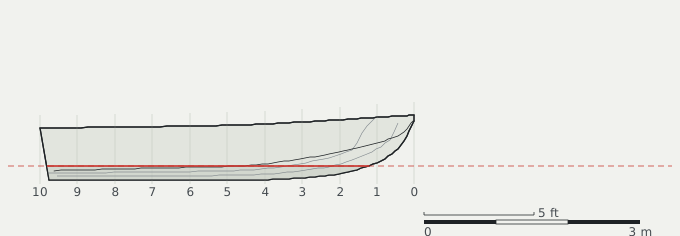
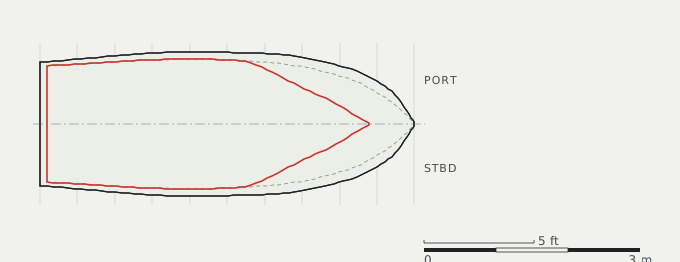
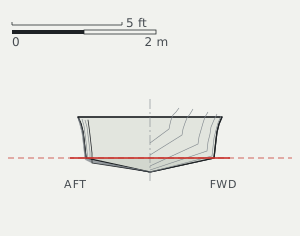
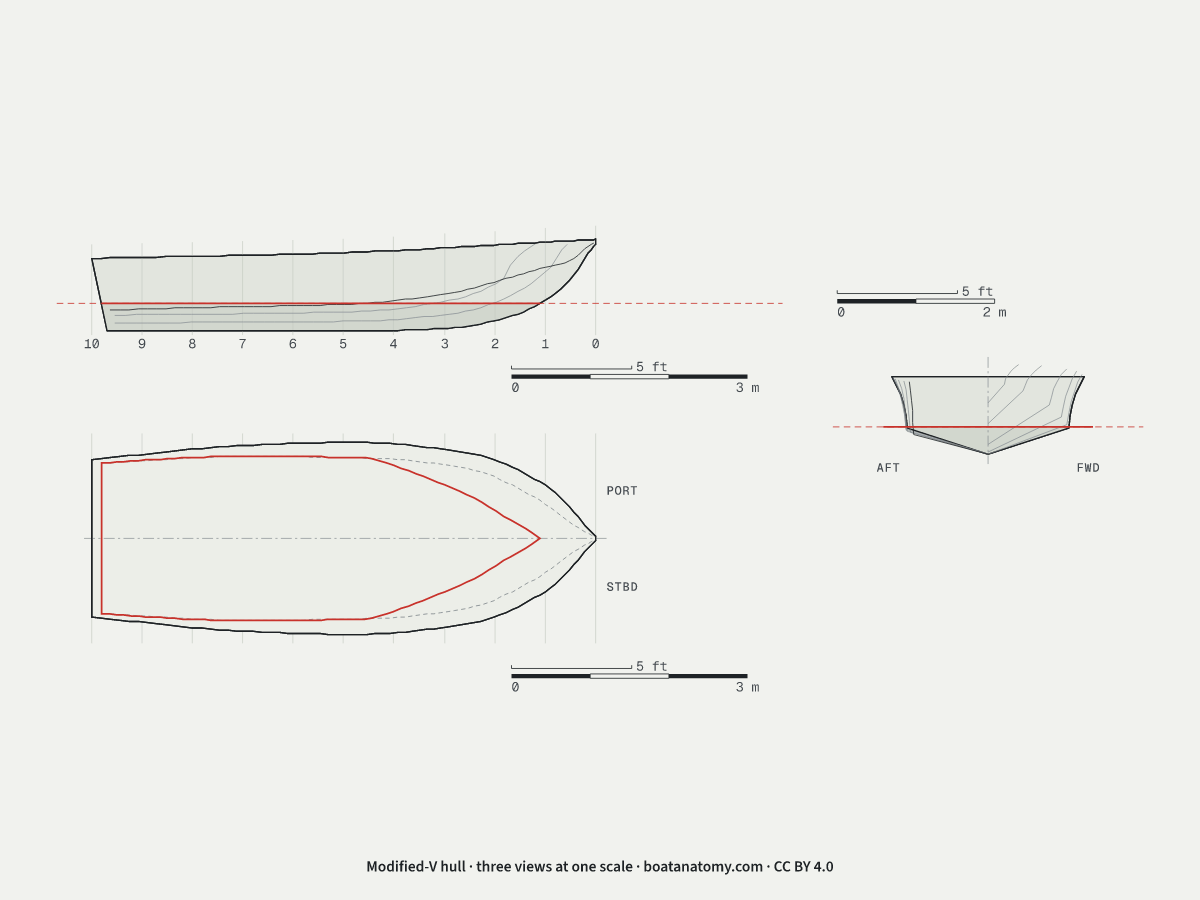
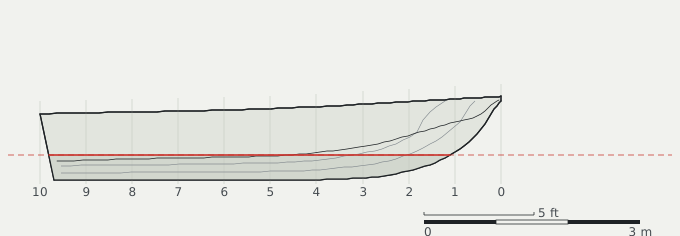
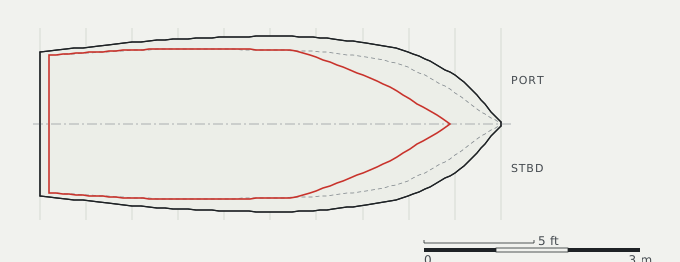
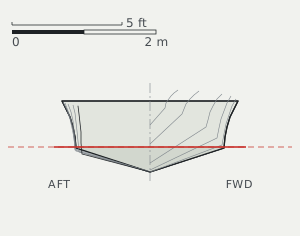
A modified-V hull has a V bottom with less deadrise at the transom than a deep V, somewhere between a flat bottom and a deep V.
Deep-V hull
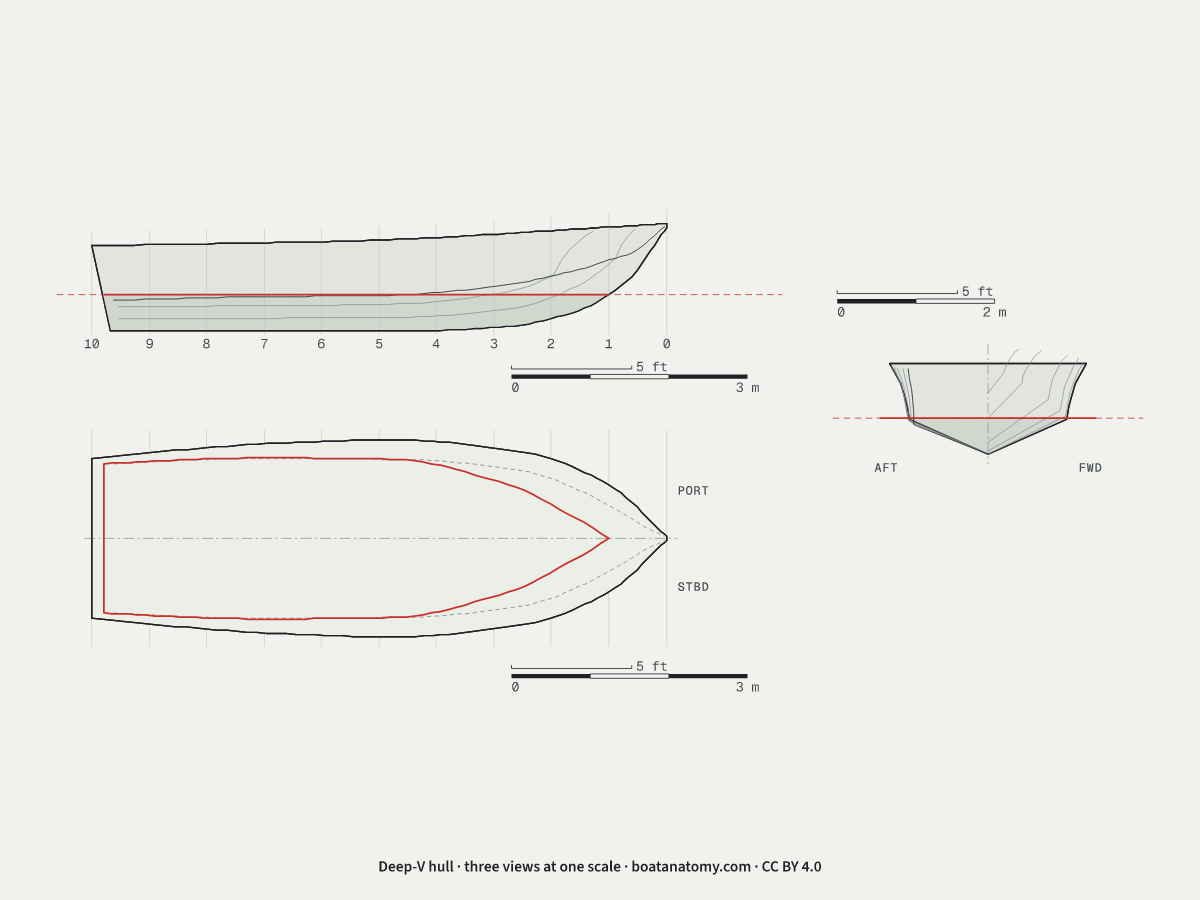
A deep-V hull keeps a steep V along the whole bottom; BoatUS and industry guides usually describe it as having more than 20 degrees of deadrise at the transom.
Round-bottom hull
A round-bottom hull turns from bottom to side in a curve instead of a hard chine.
Catamaran hull
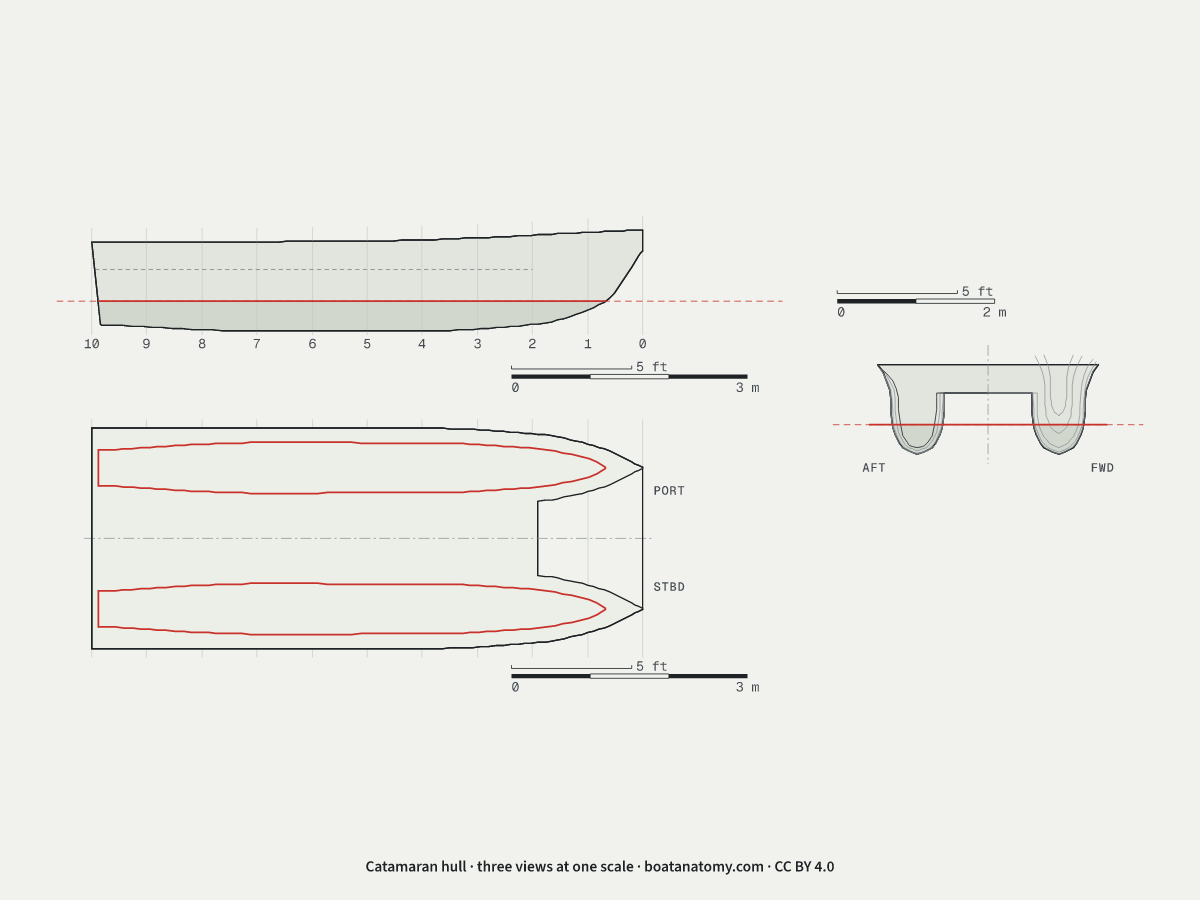
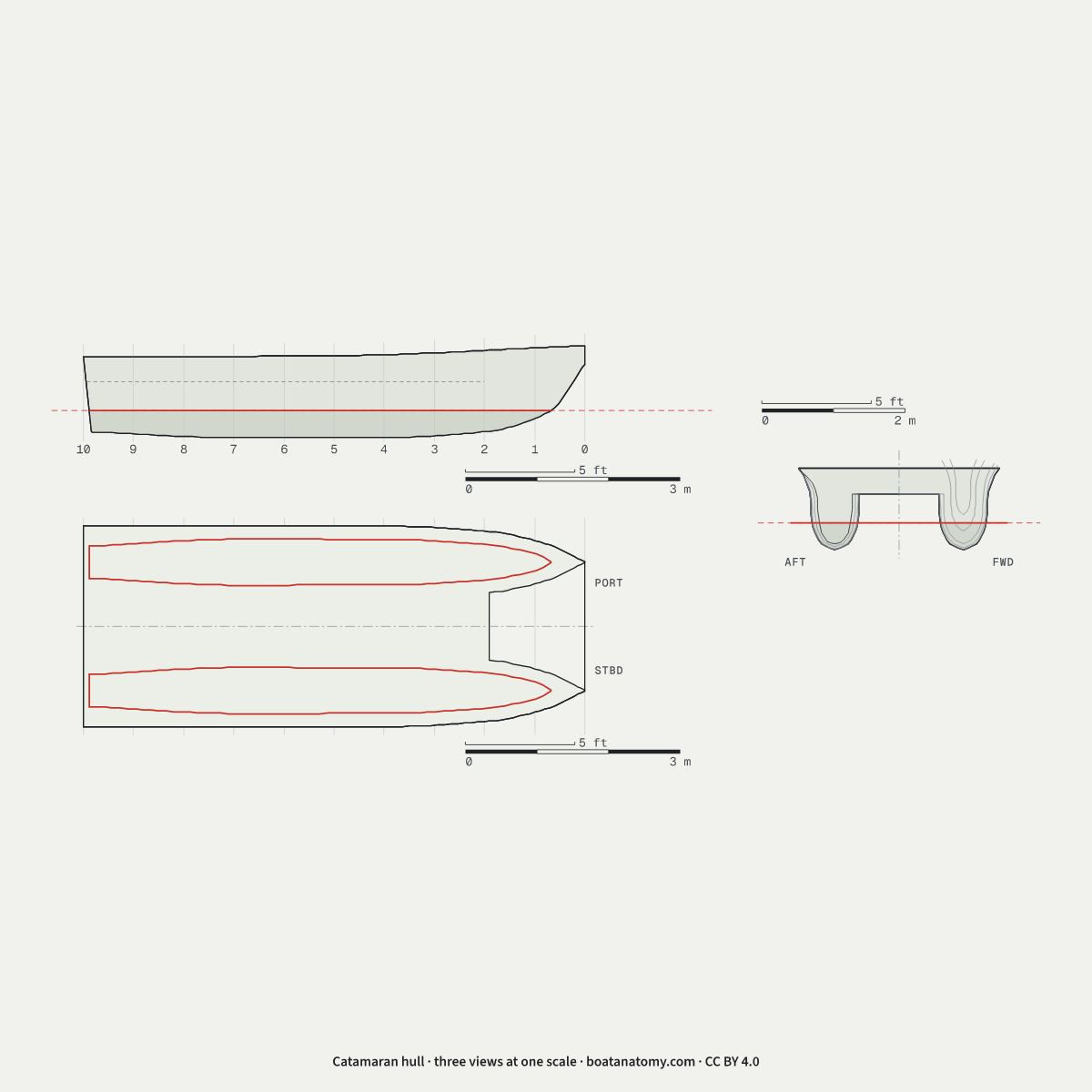
A catamaran has two hulls side by side joined by a deck or bridge deck, with open water between them.
Tri-hull (cathedral) hull
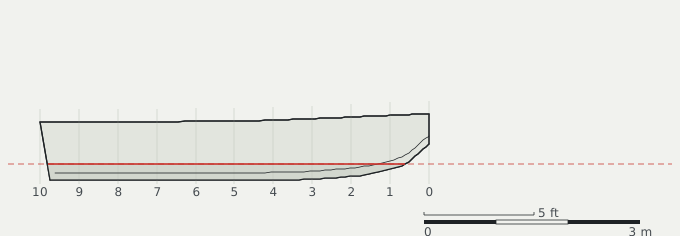
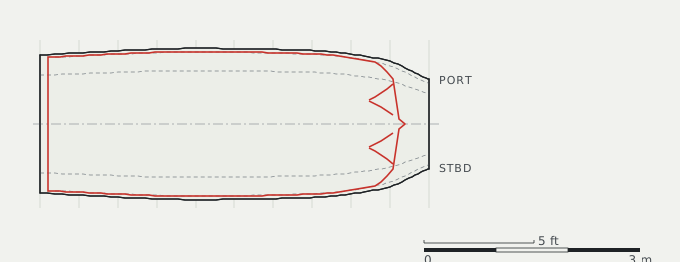
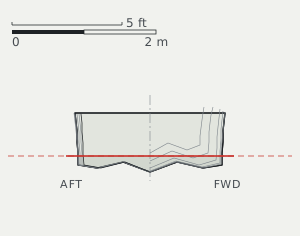
This drawing has a center V and a smaller sponson on each side: the M-shaped bottom that industry guides call a tri-hull or cathedral hull.
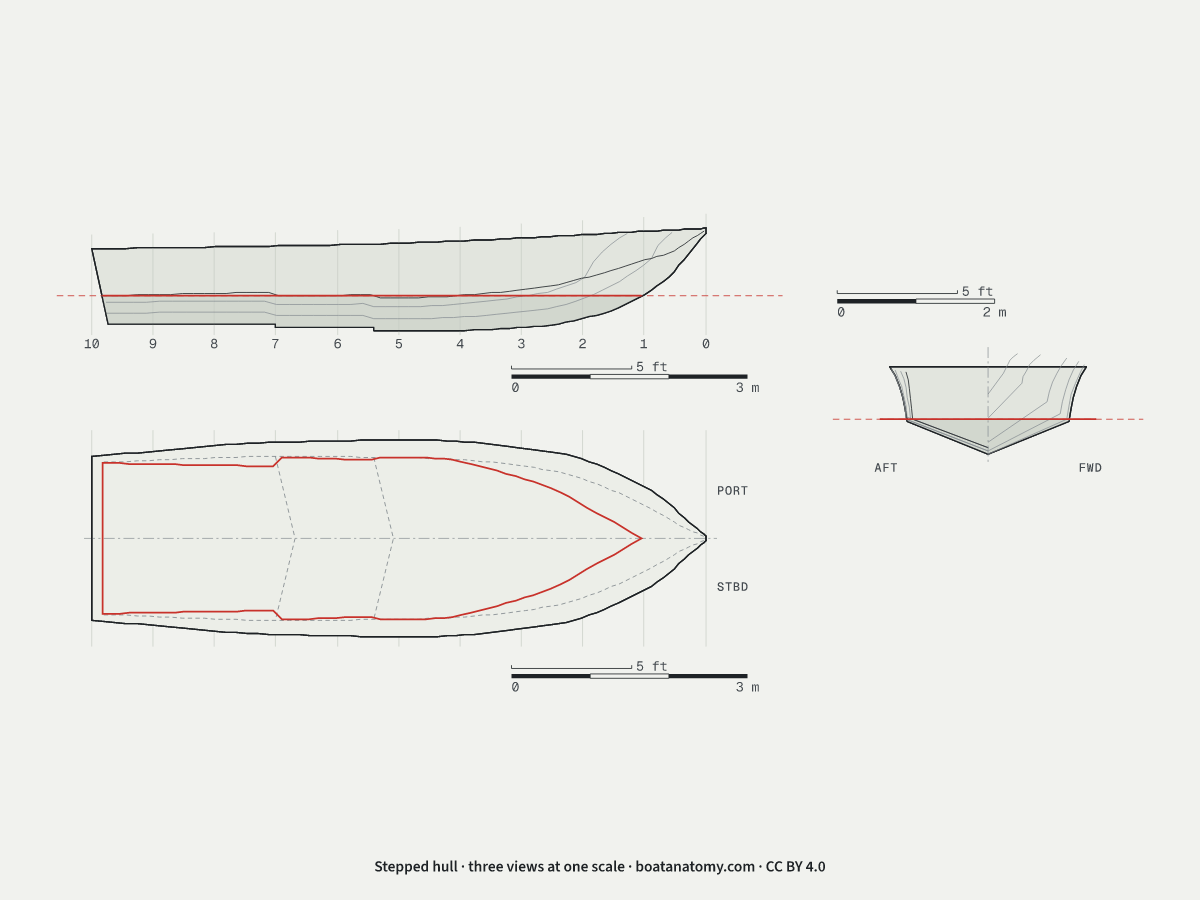
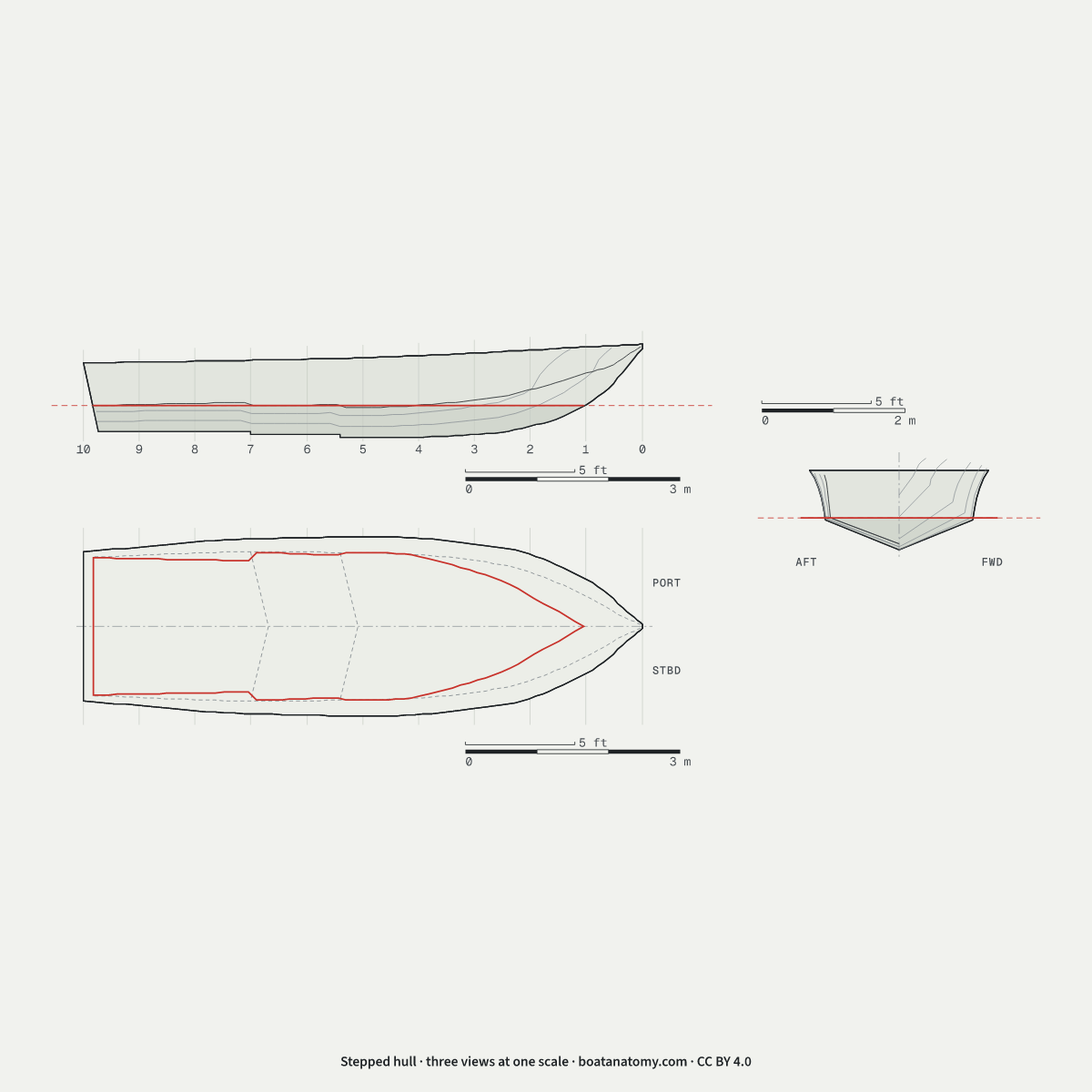
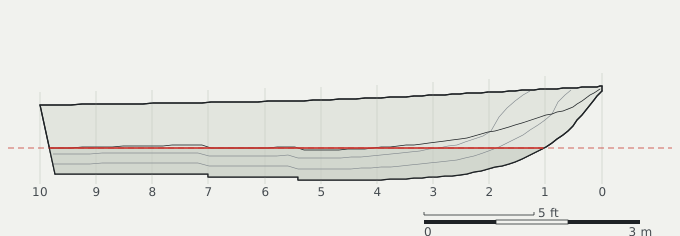
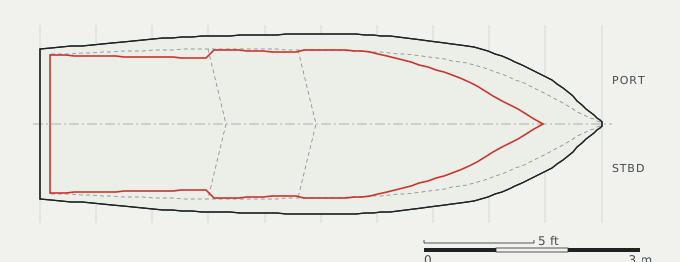
Stepped hull
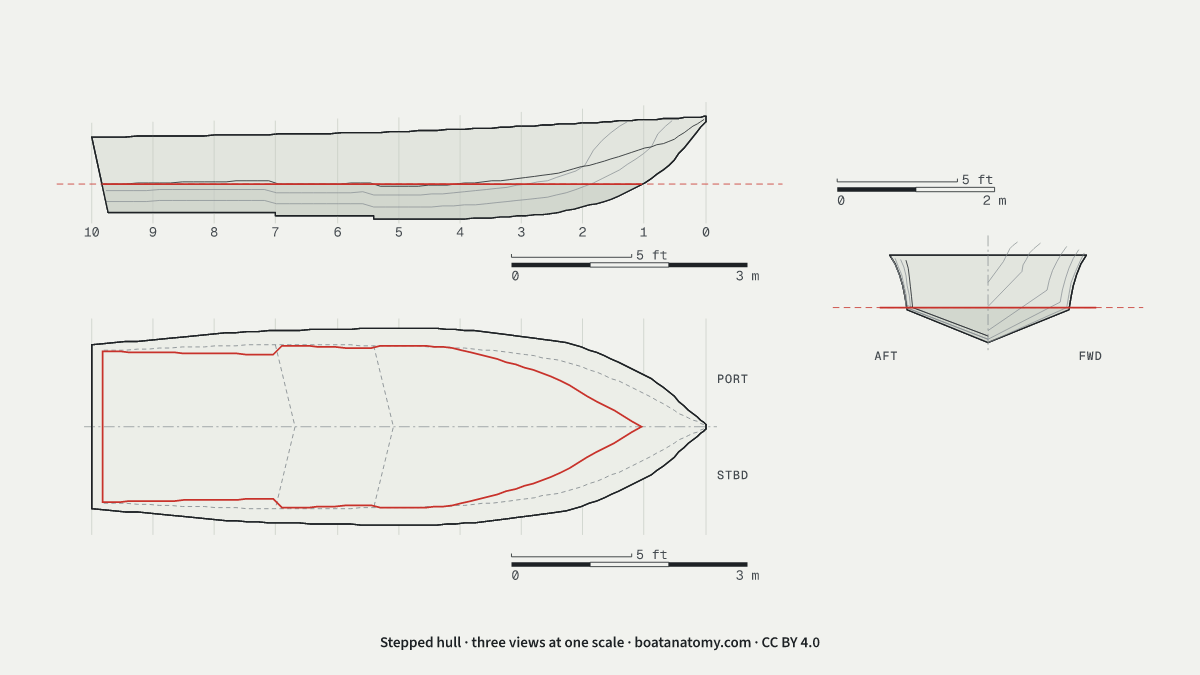
A stepped hull has one or more notches across the bottom where the bottom surface steps up going aft.
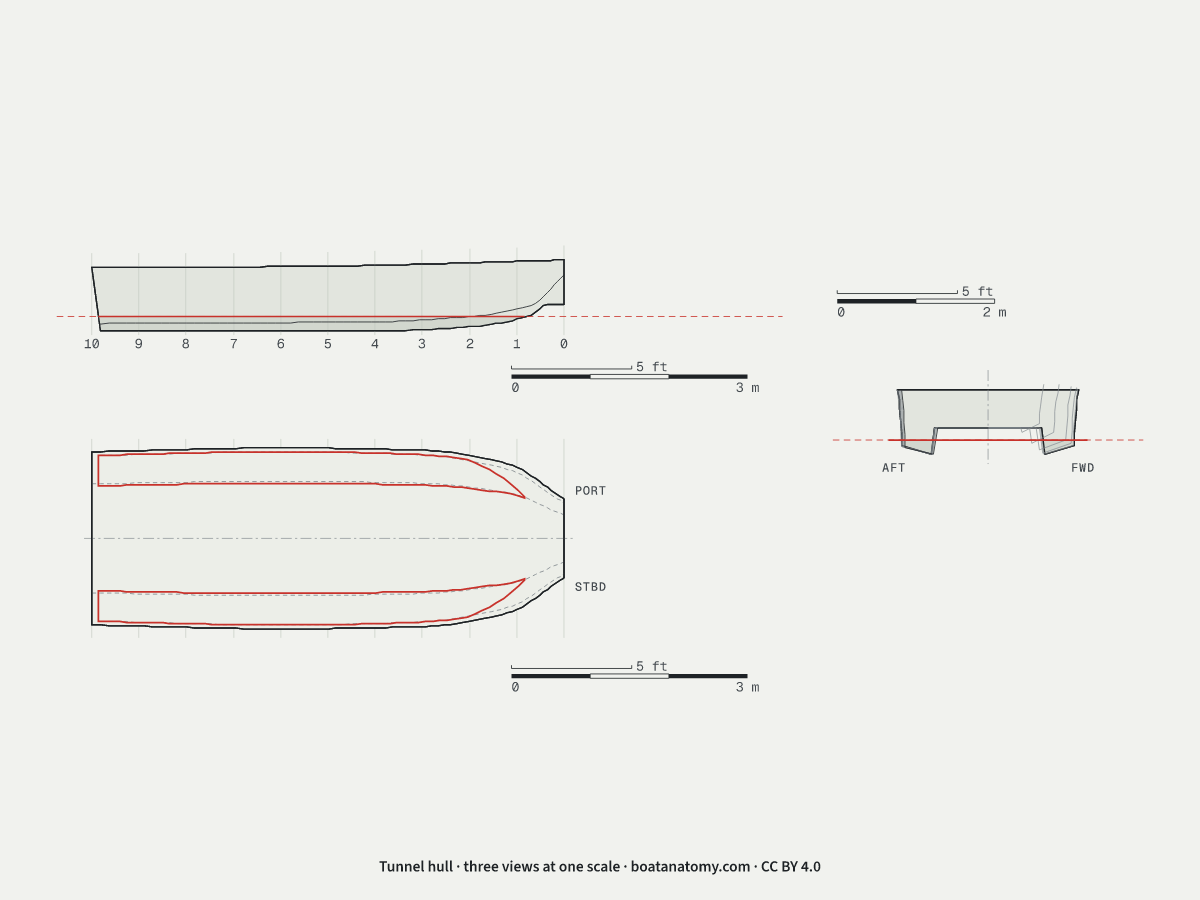
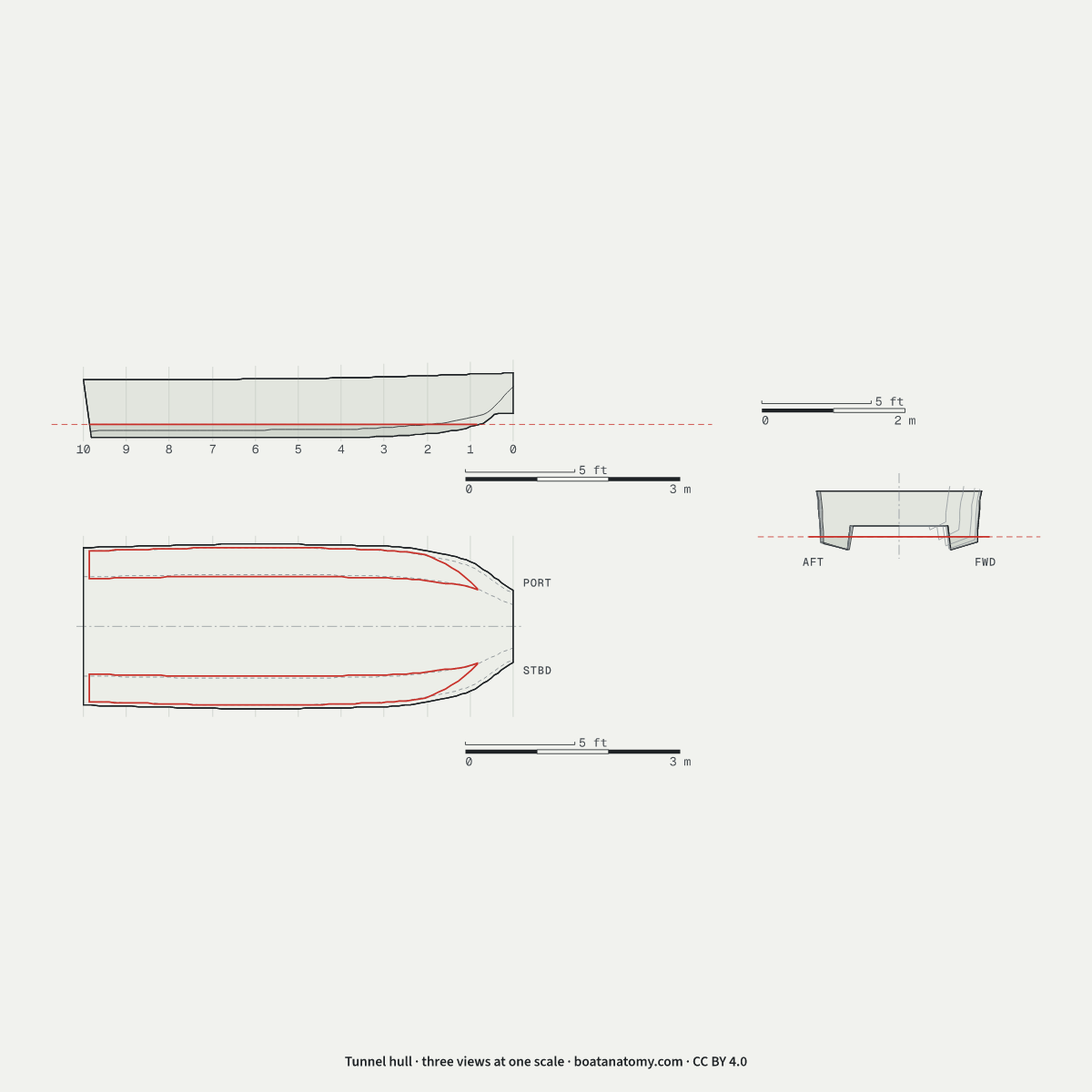
Tunnel hull
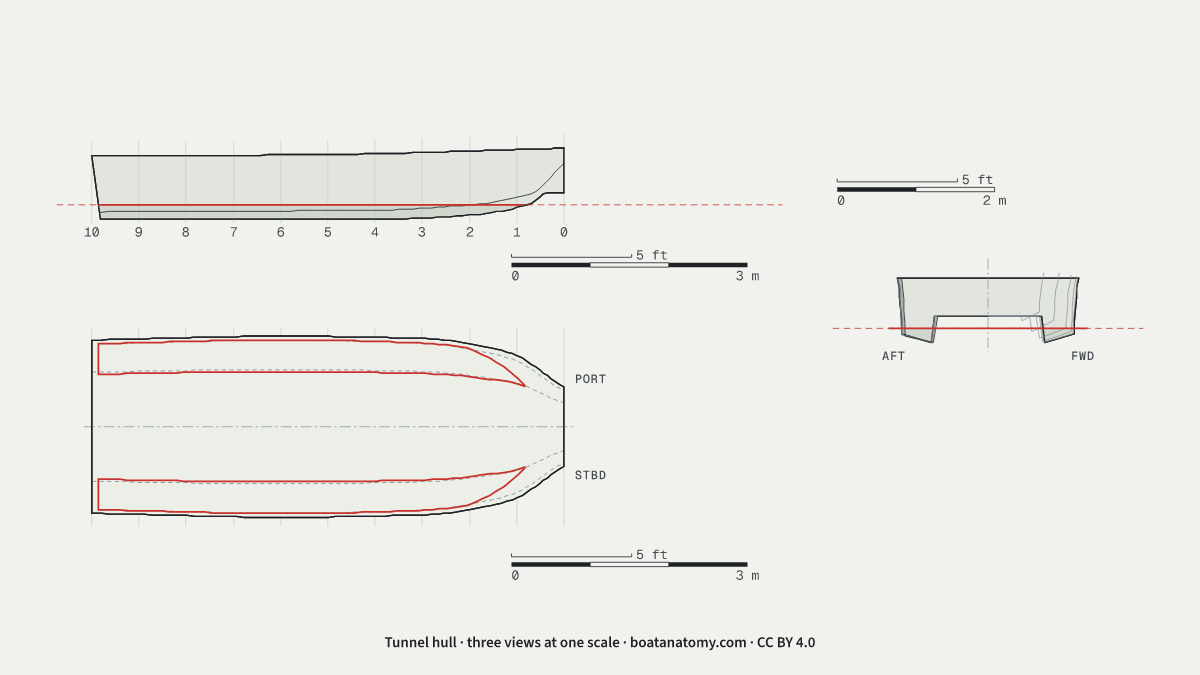
This drawing has a sponson on each side and a tunnel running fore and aft between them under the deck.
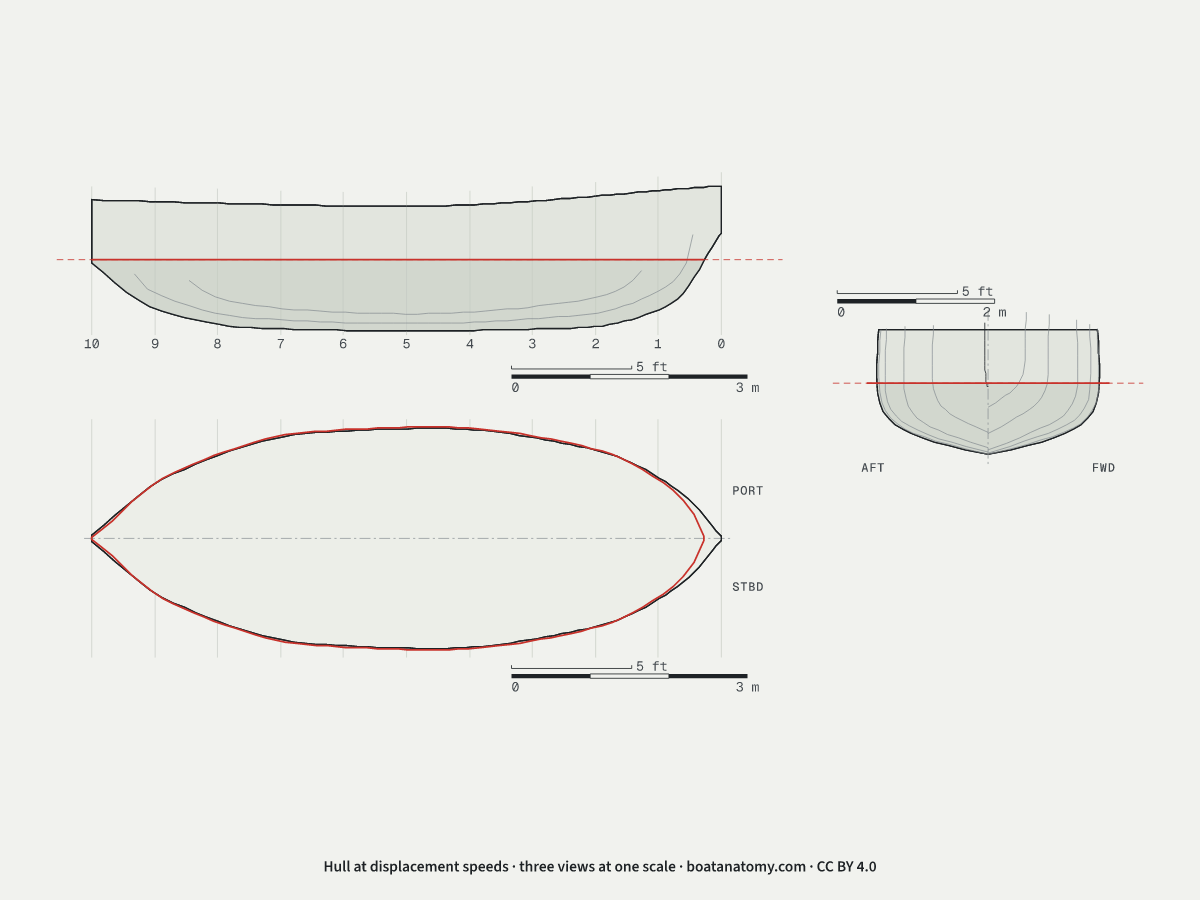
Hull at displacement speedsAn example drawing, not “the” displacement hull
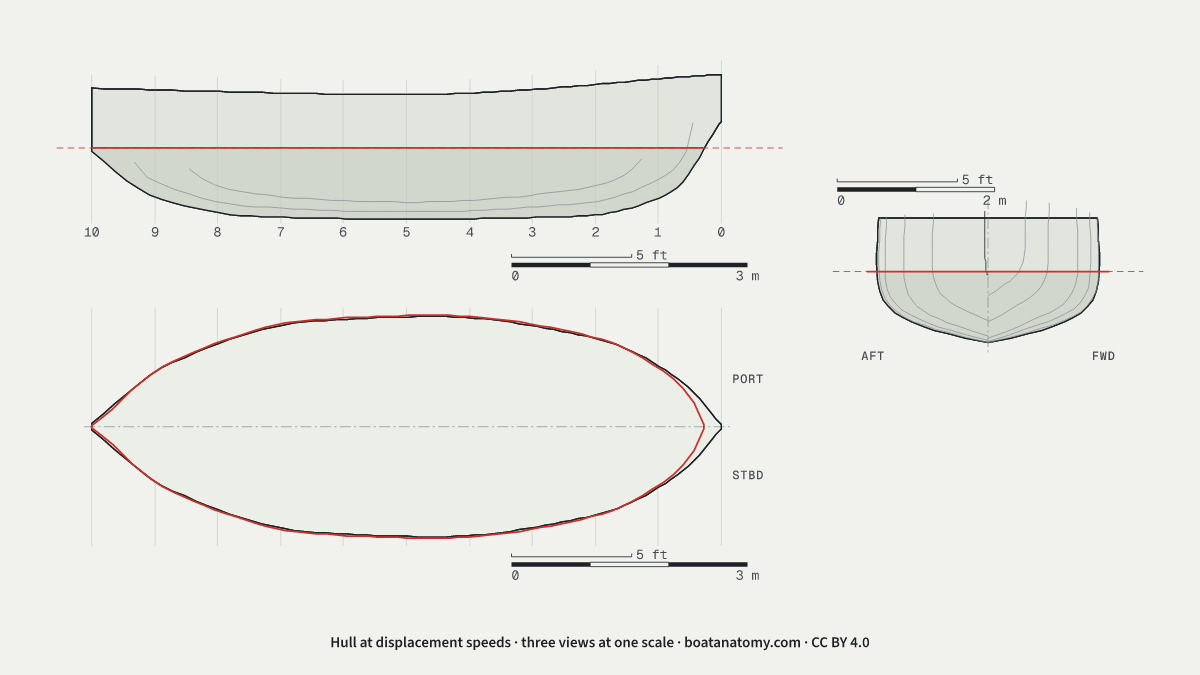
This drawing has a round bilge and a canoe stern; boating-course guides say a round-bottomed hull acts as a displacement hull.
- At rest or slow. At rest and at low speed the hull is carried by buoyancy alone and pushes water aside as it moves.
- Near hull speed. Near hull speed the wave the boat makes is about as long as its waterline; the drawing shows the stern sitting a little lower.
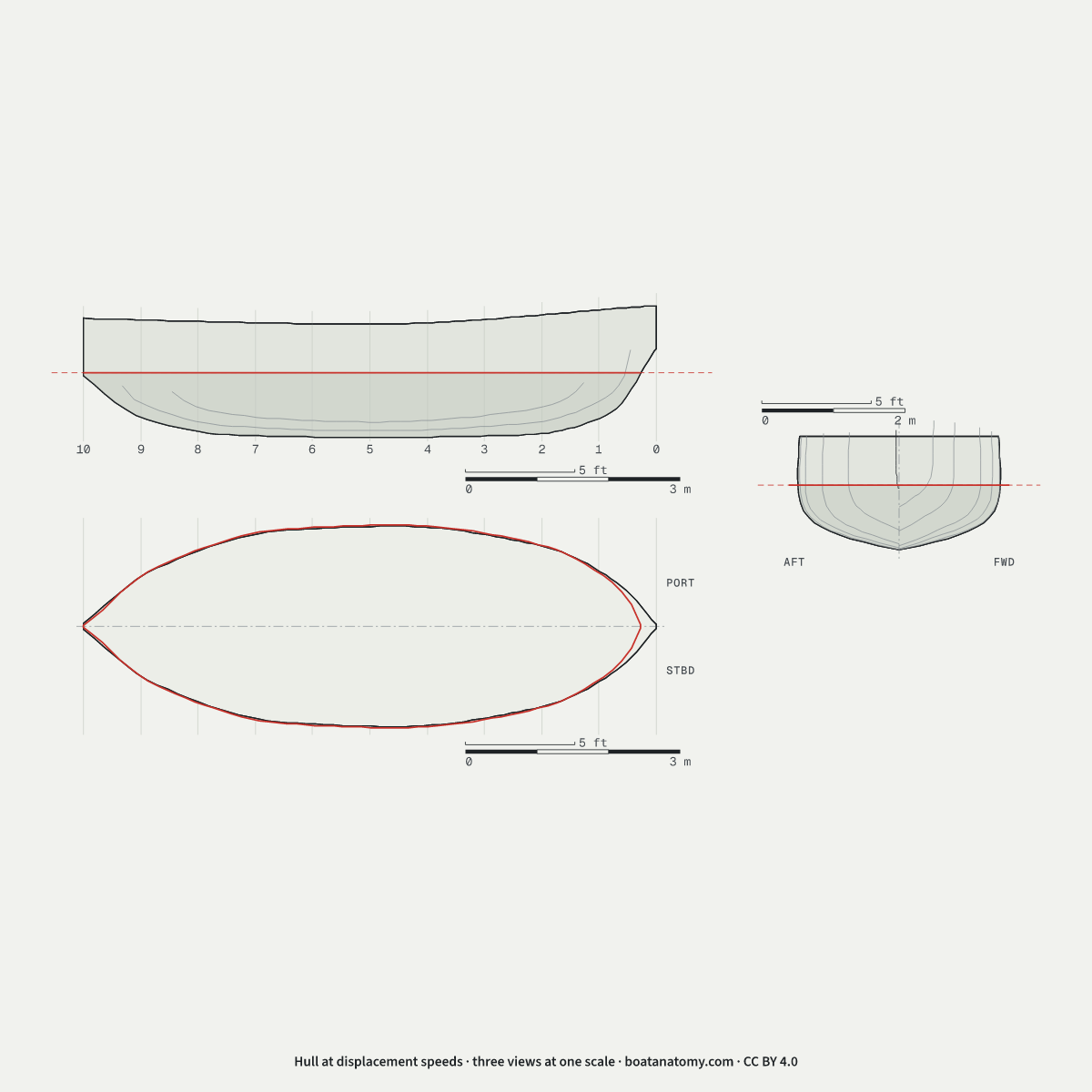
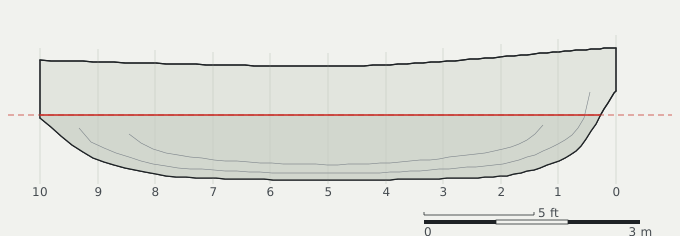
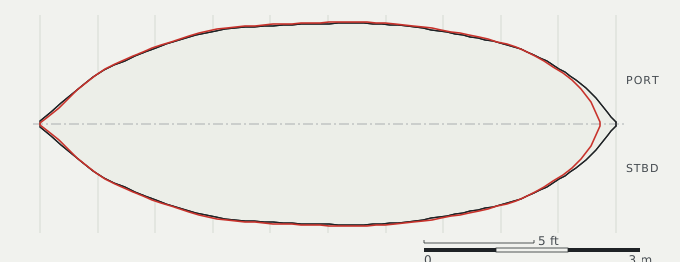
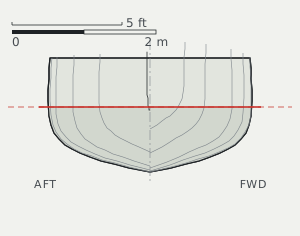
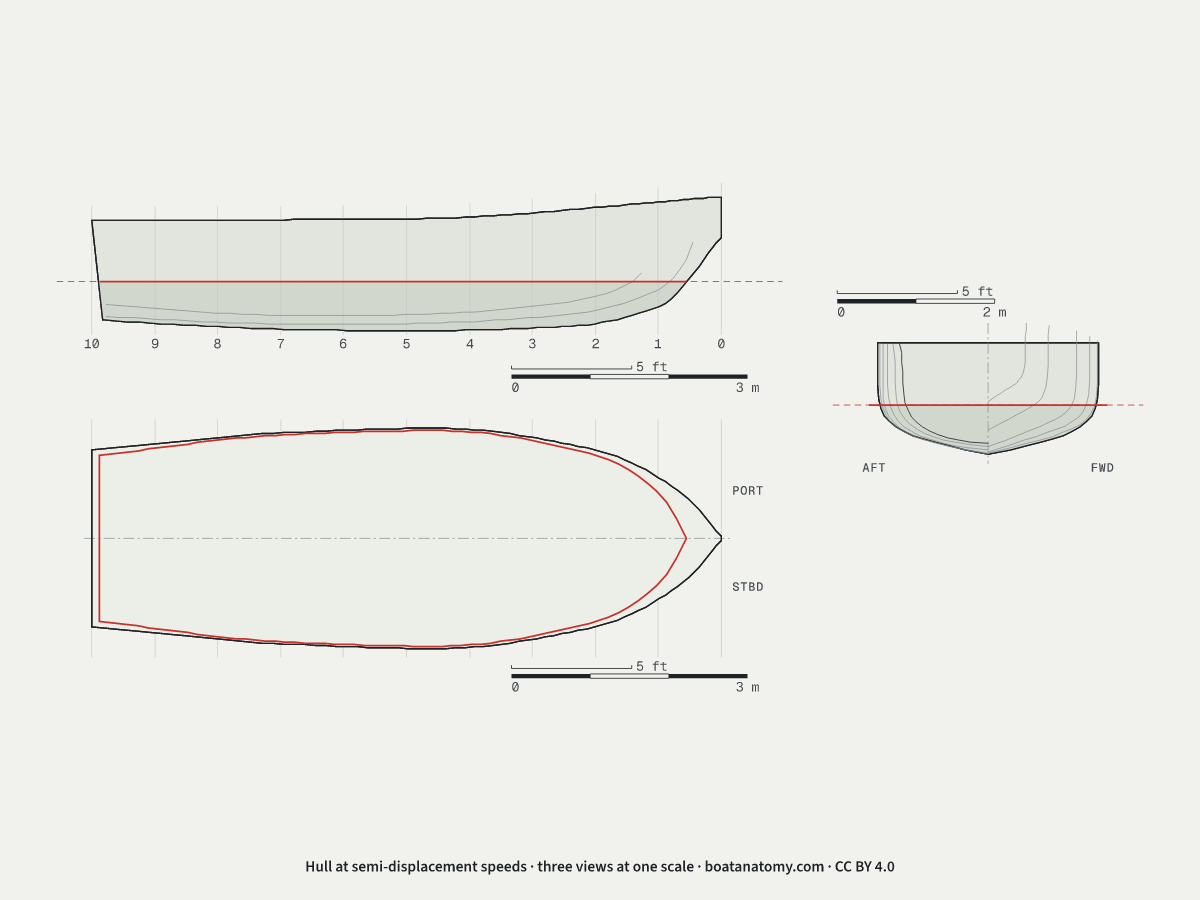
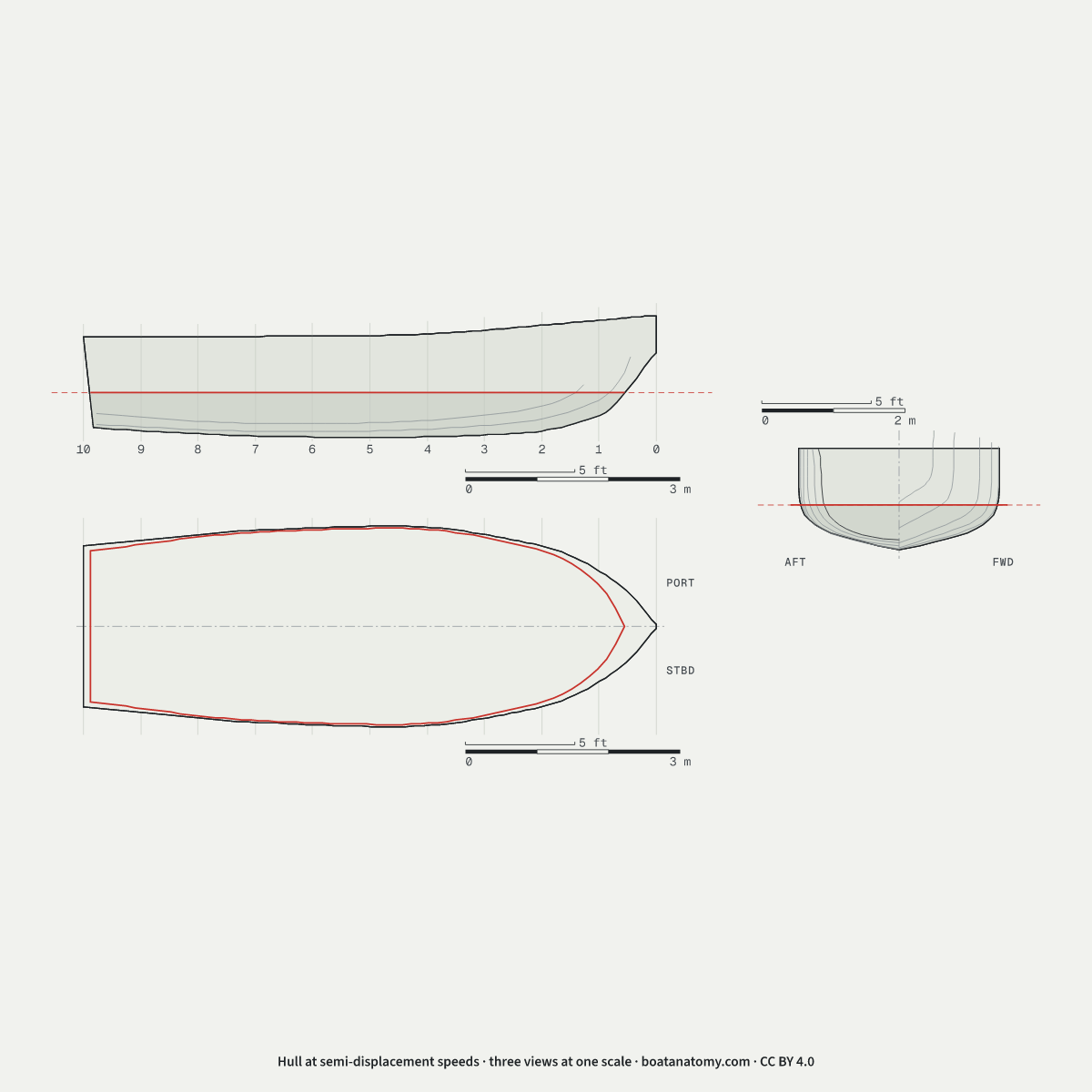
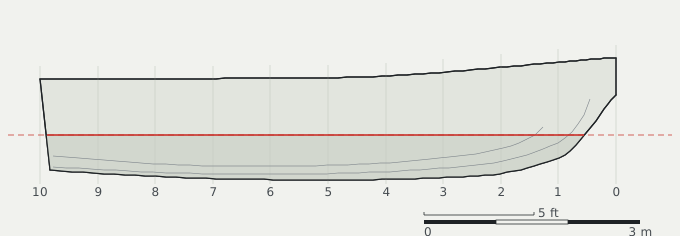
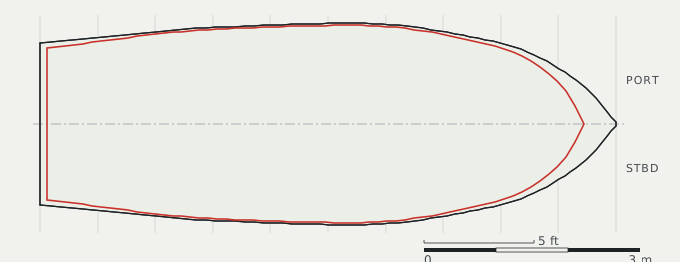
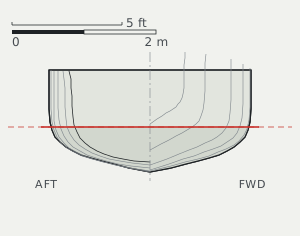
Hull at semi-displacement speedsAn example drawing, not “the” semi-displacement hull
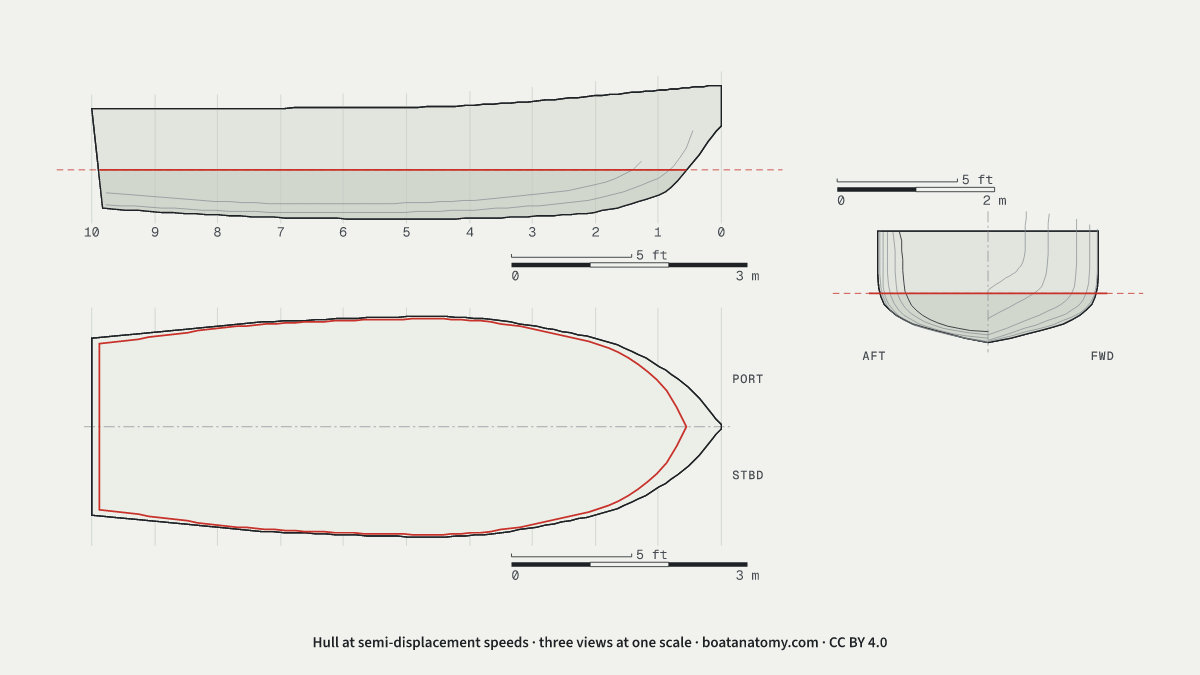
This drawing has a round forefoot and a flatter, wider run aft to an immersed transom.
- At rest or slow. At low speed the hull runs in displacement mode, carried by buoyancy.
- Around hull speed. Around hull speed the boat's own wave is about as long as its waterline; the drawing shows the stern sitting lower in it.
- Faster, partly lifted. Past hull speed, water pressure under the hull starts to carry part of its weight; the drawing shows the hull risen and trimmed bow-up.
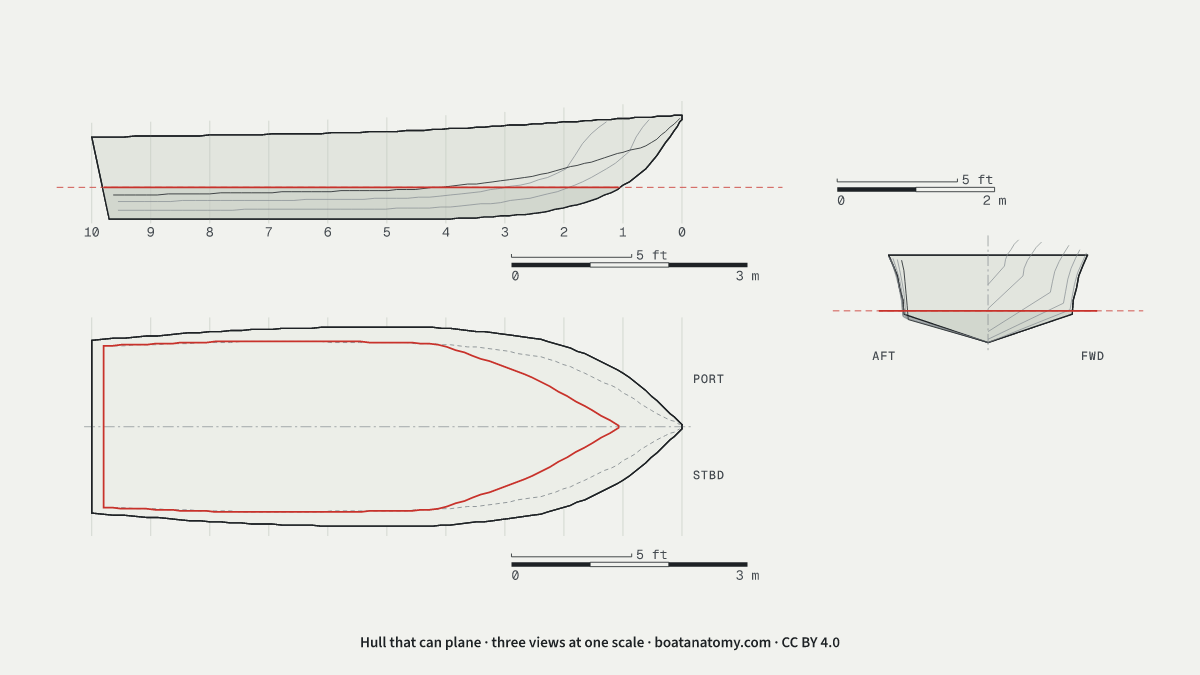
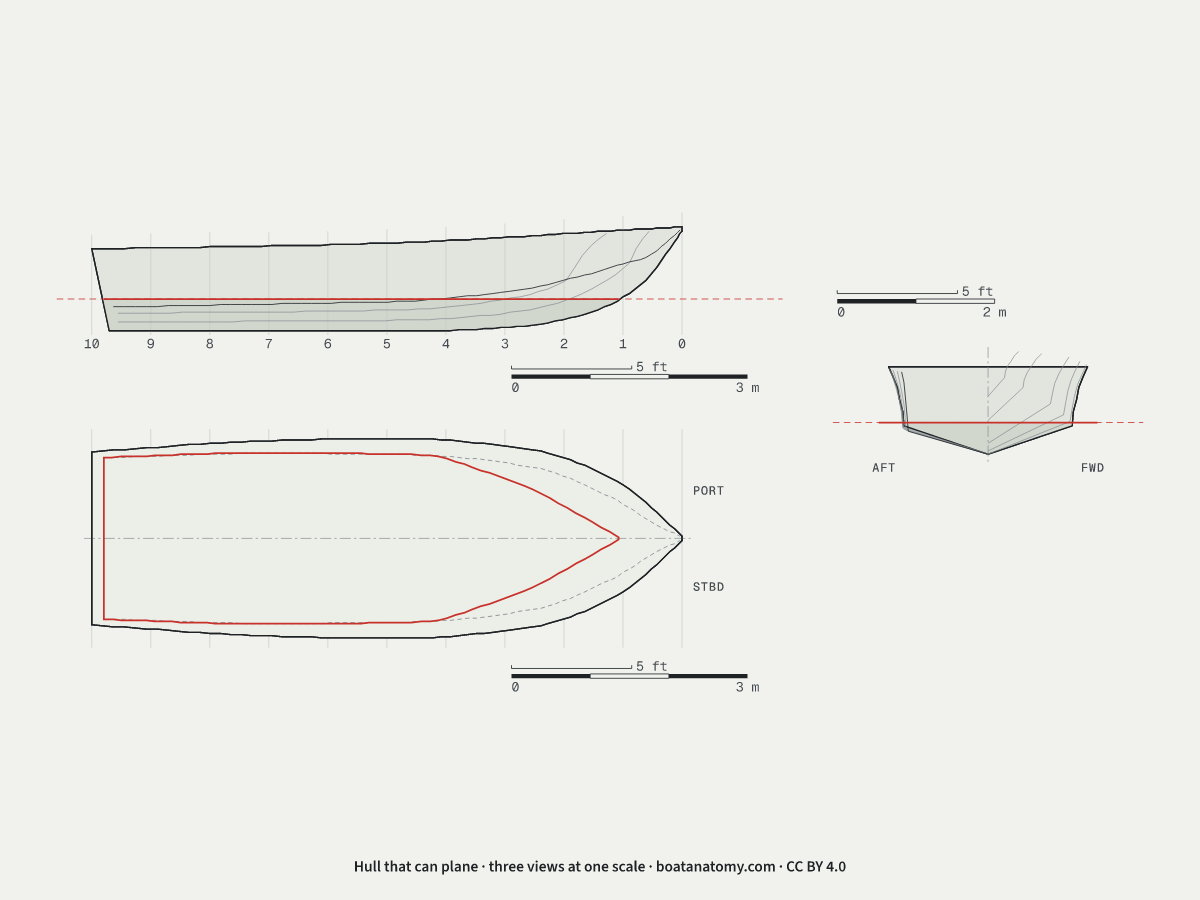
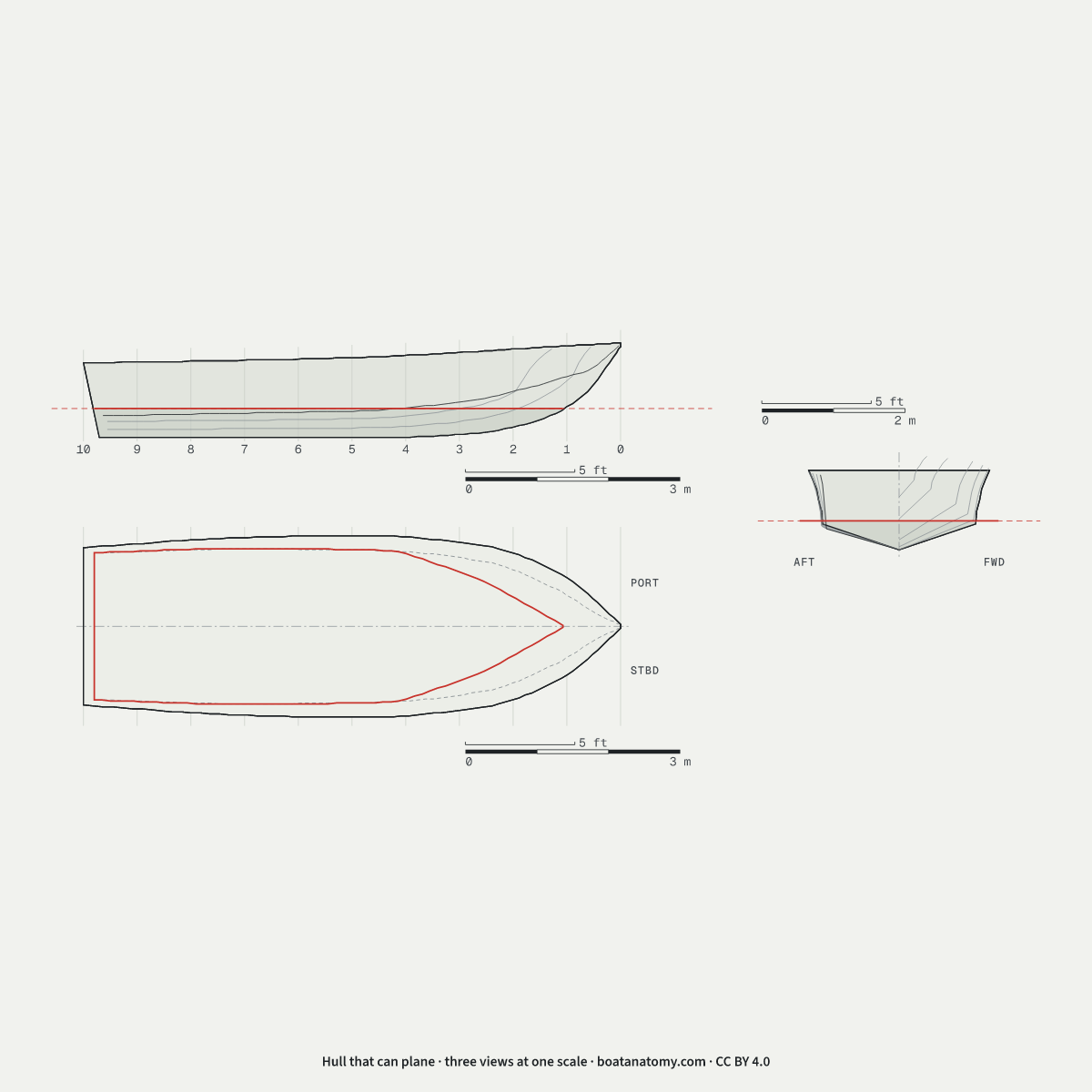
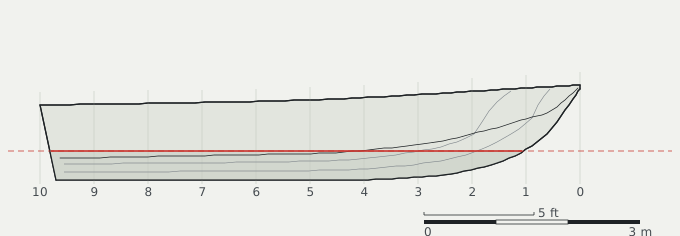
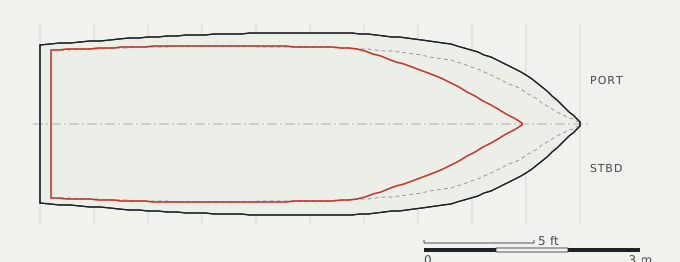
Hull that can planeAn example drawing, not “the” planing hull
This drawing has a hard chine and a flat run aft, a shape built to plane; at low speed the same hull still runs in displacement mode.
- Displacement mode. At low throttle the hull runs in displacement mode: buoyancy carries it and it pushes water aside.
- Plowing mode. In plowing mode, between displacement and planing, the bow rides high, the stern digs in and the wake is large.
- Planing mode. In planing mode the hull rises and skims across the surface on dynamic lift, with less of it in the water.
Save these drawings as pictures
-
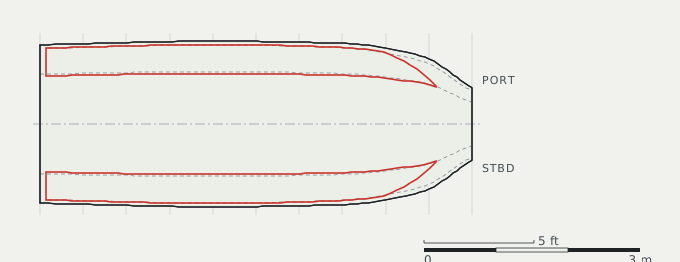
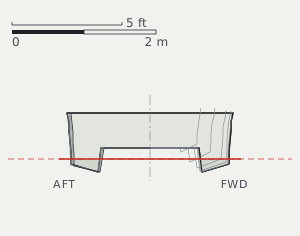
Flat-bottom hull 4:3 picture Square picture Side view From above Cross-section
-
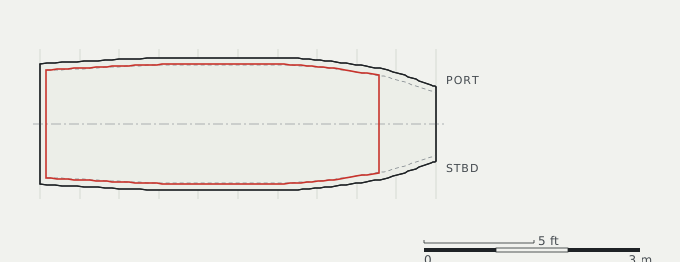
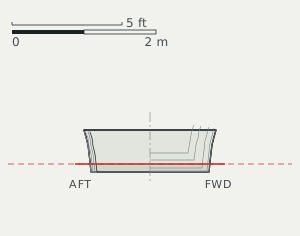
Shallow-V hull 4:3 picture Square picture Side view From above Cross-section
-
Modified-V hull 4:3 picture Square picture Side view From above Cross-section
-
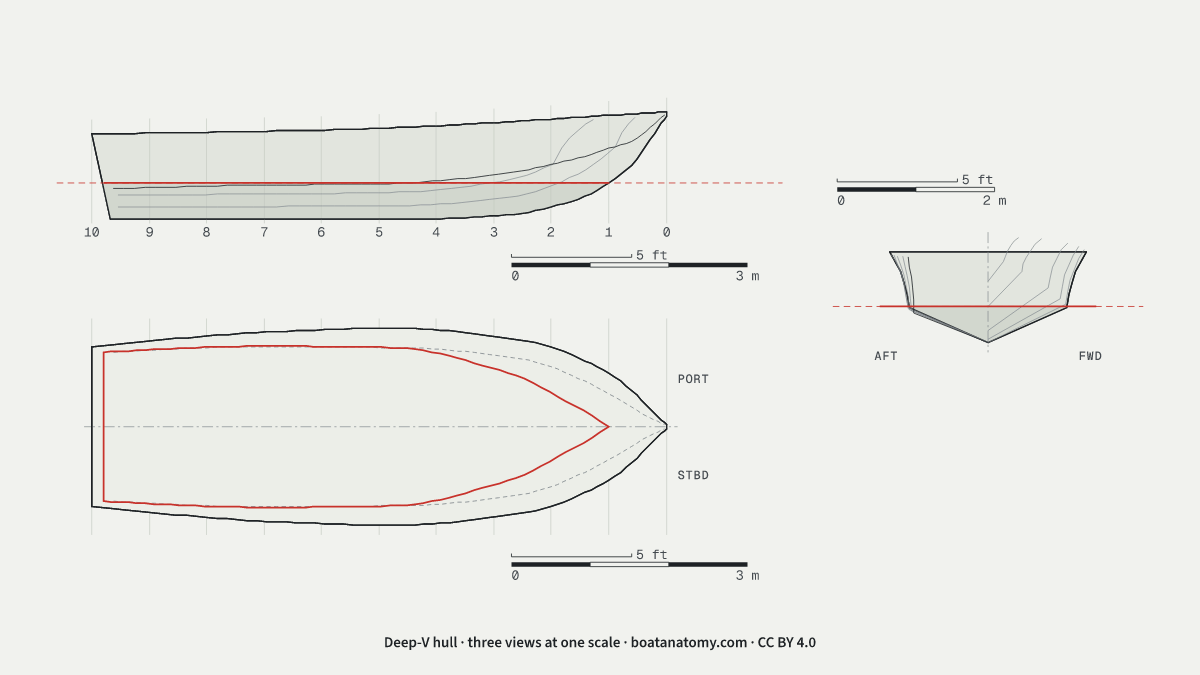
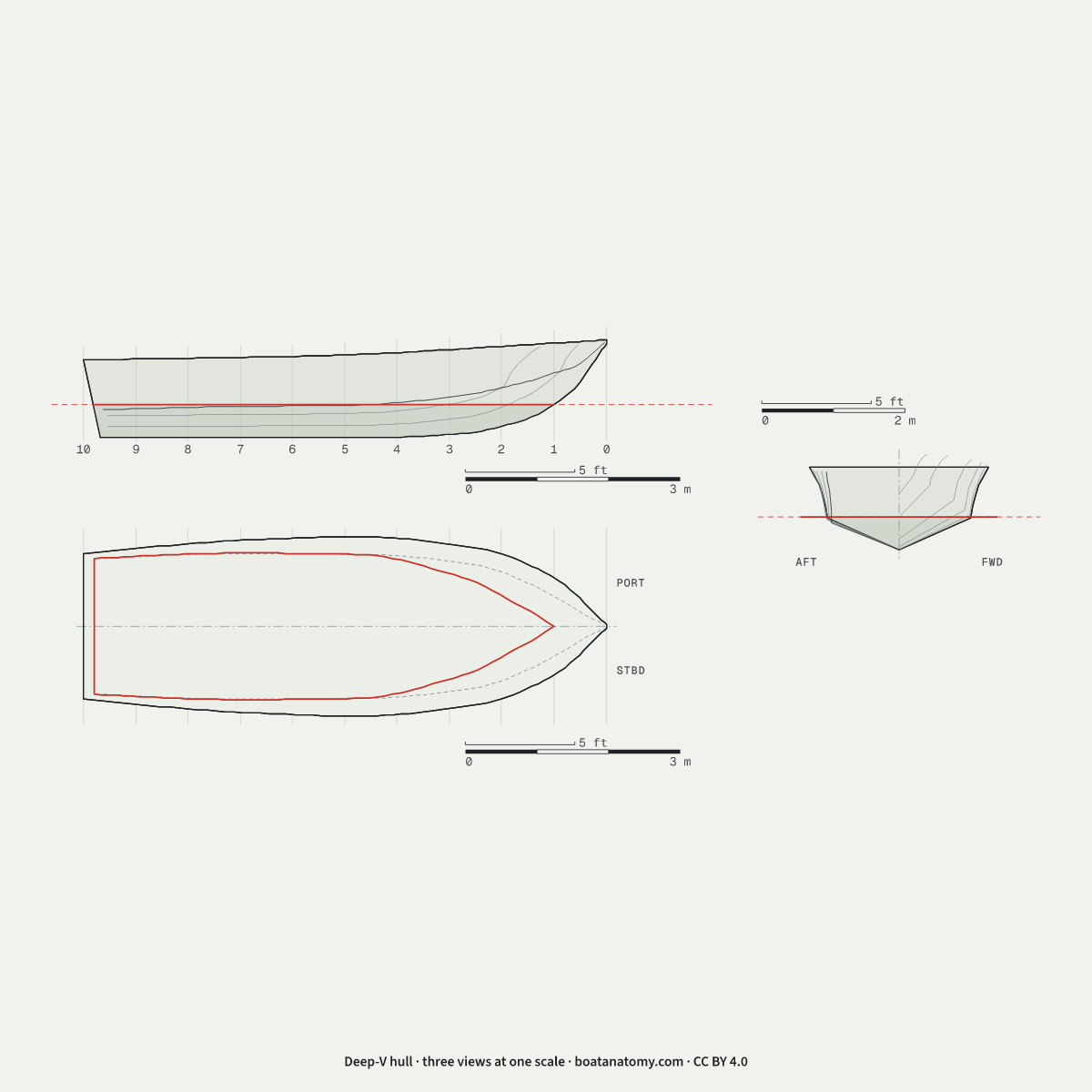
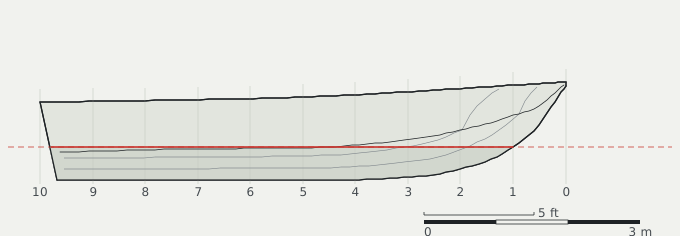
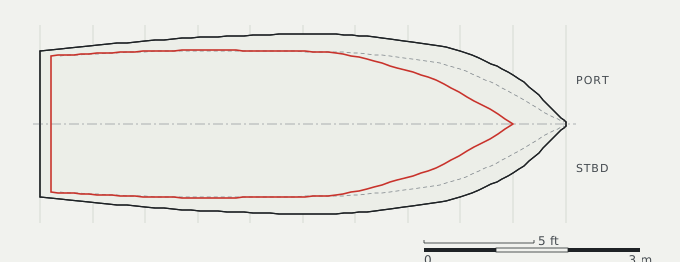
Deep-V hull 4:3 picture Square picture Side view From above Cross-section
-
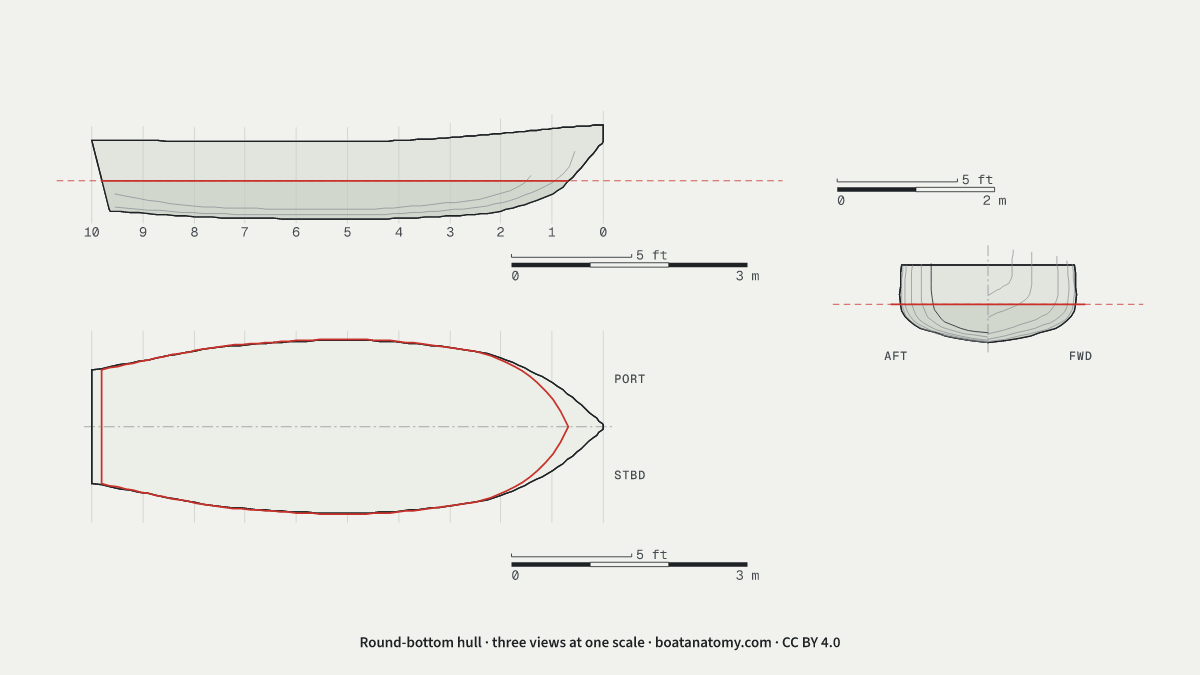
Round-bottom hull 4:3 picture Square picture Side view From above Cross-section
-
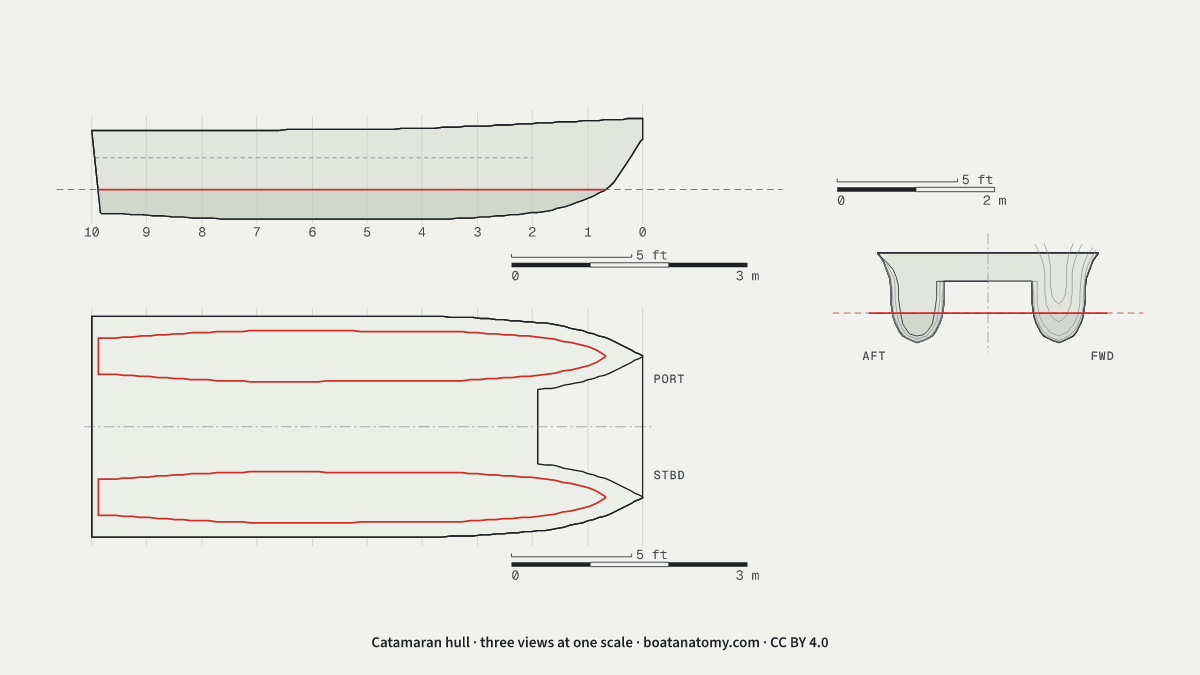
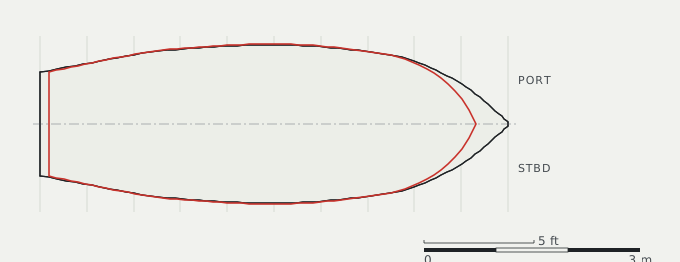
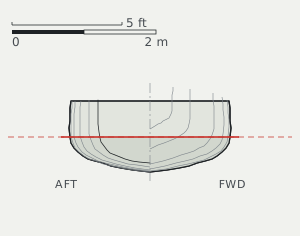
Catamaran hull 4:3 picture Square picture Side view From above Cross-section
-
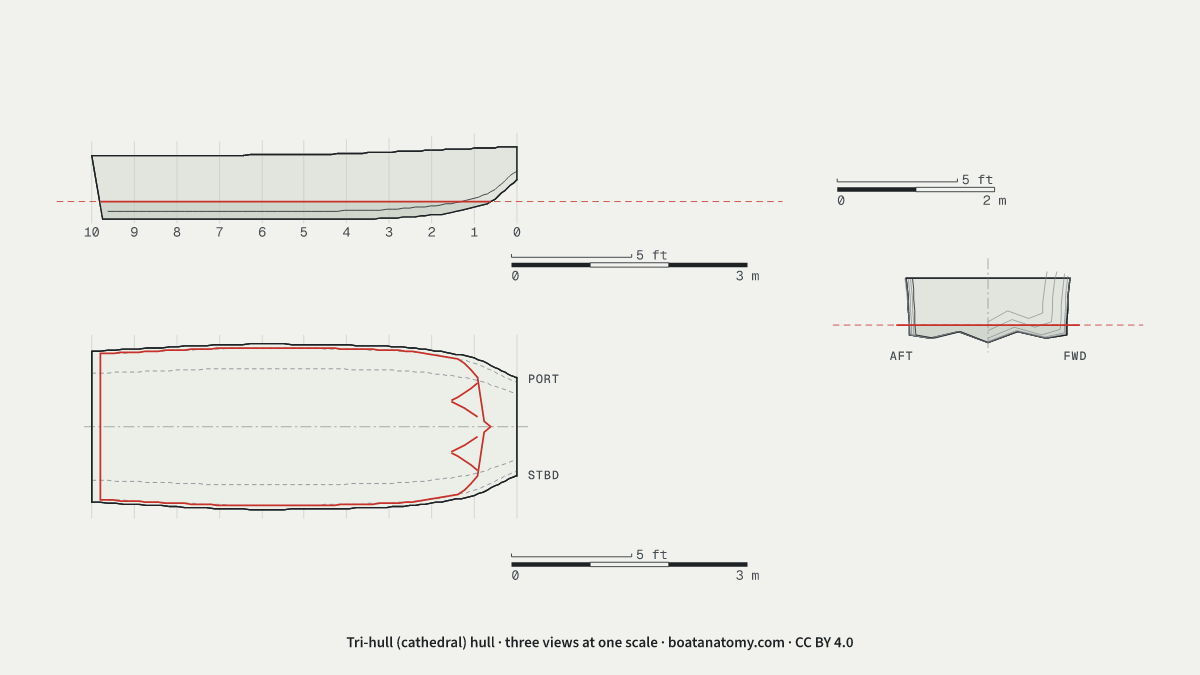
Tri-hull (cathedral) hull 4:3 picture Square picture Side view From above Cross-section
-
Stepped hull 4:3 picture Square picture Side view From above Cross-section
-
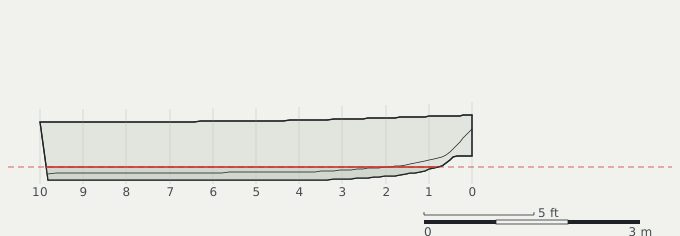
Tunnel hull 4:3 picture Square picture Side view From above Cross-section
-
Hull at displacement speeds 4:3 picture Square picture Side view From above Cross-section
-
Hull at semi-displacement speeds 4:3 picture Square picture Side view From above Cross-section
-
Hull that can plane 4:3 picture Square picture Side view From above Cross-section
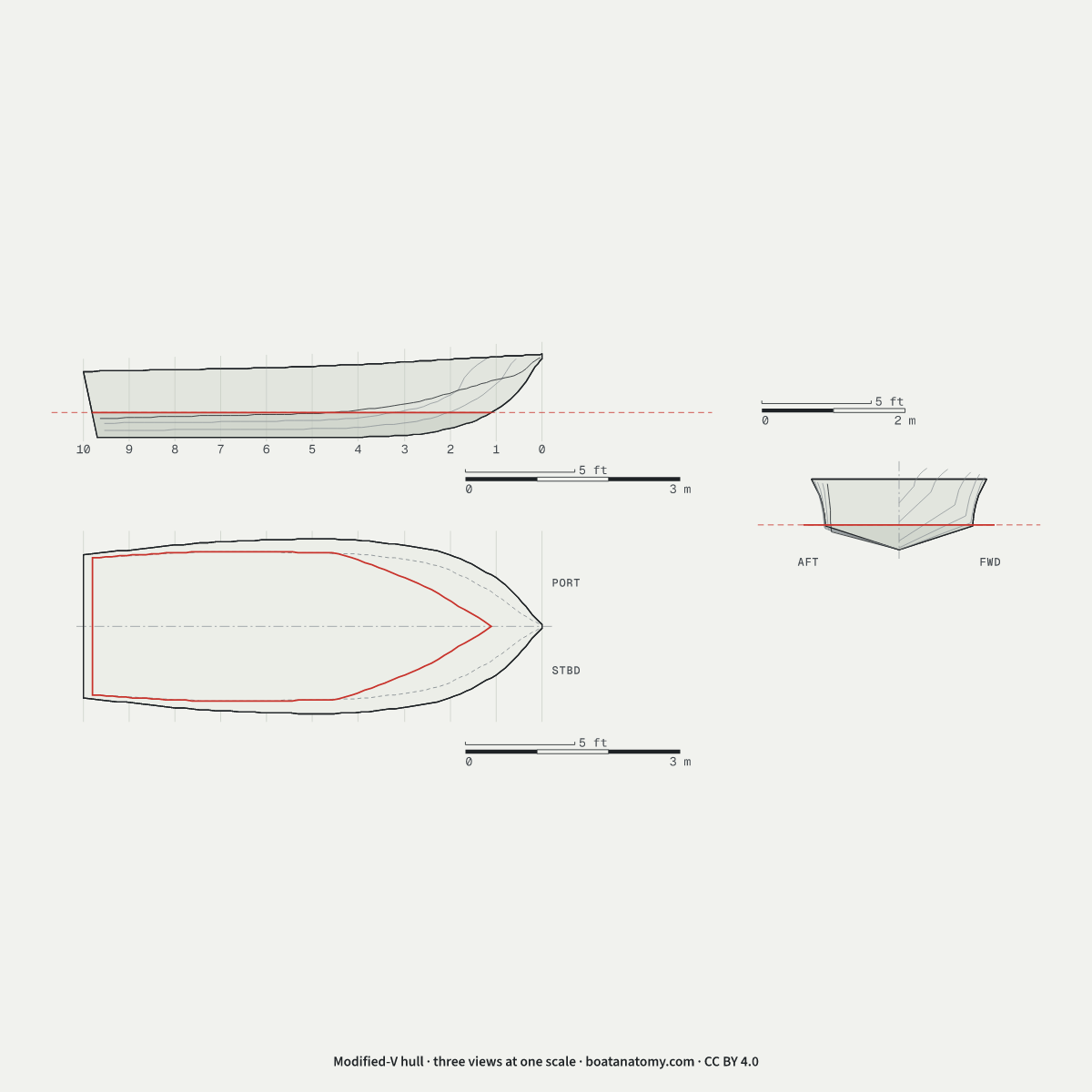
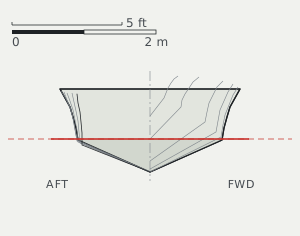
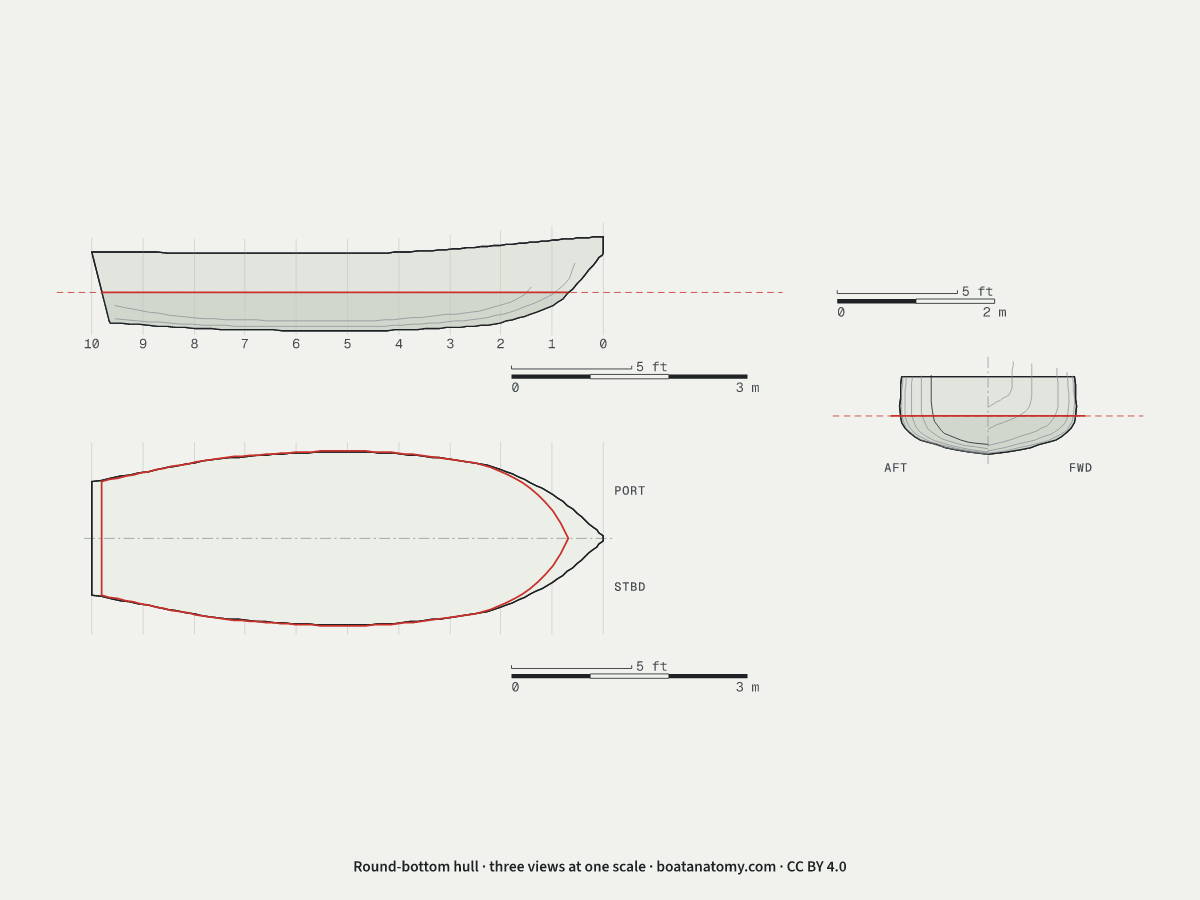
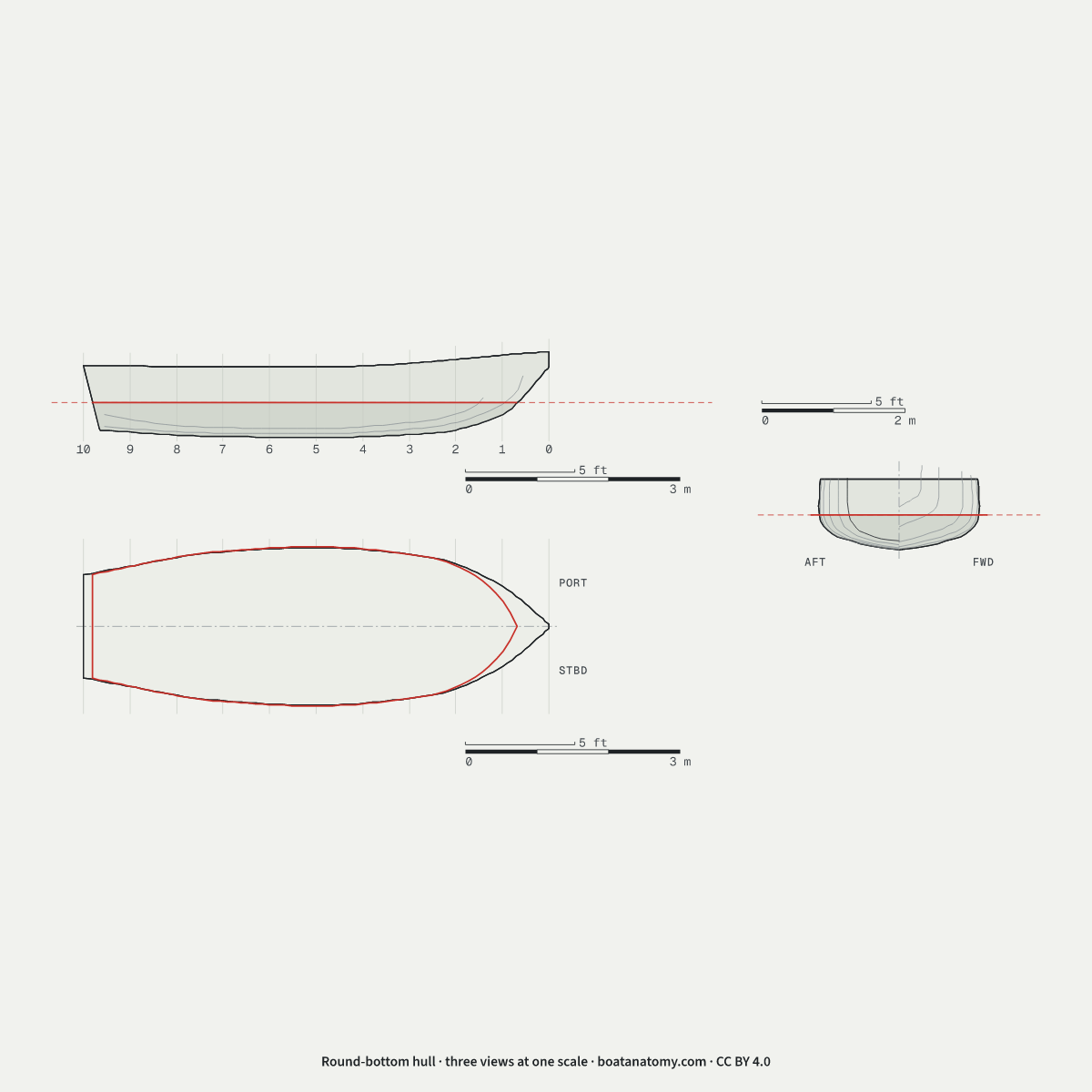
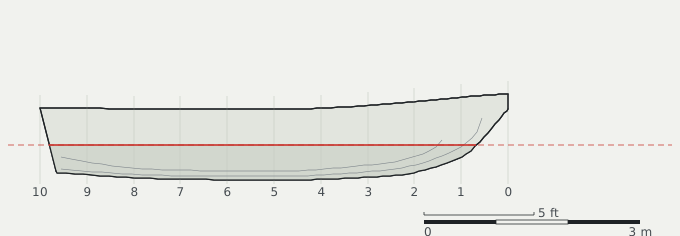
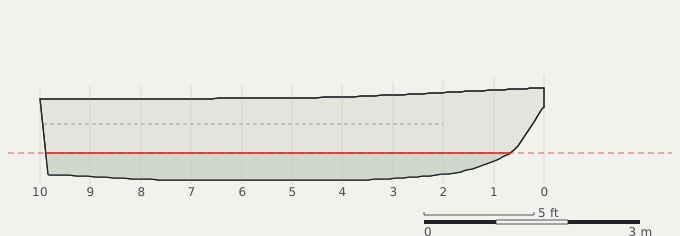
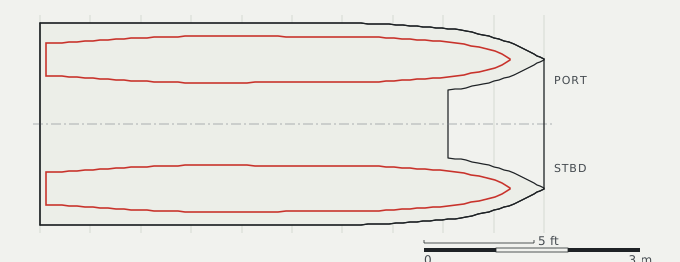
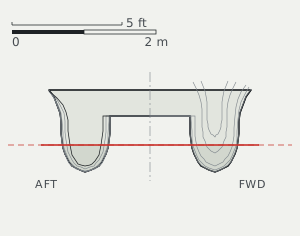
How to read the three views
A lines plan shows a hull three ways: the sheer plan from the side, the half-breadth plan from above and the body plan from the end. Each view is a set of slices through the same hull. Pick a slice to see where it lands in each view.
Modified-V hull Drawn to scale Checked
Slice across the hull and you get a station. It shows its true curve in the body plan and appears as a straight line in the sheer and half-breadth plans.
Slice the hull horizontally and you get a waterline. It shows its true curve in the half-breadth plan and appears as a straight line in the other two views.
Slice lengthwise, parallel to the centerline, and you get a buttock line. It shows its true curve in the sheer plan and appears as a straight line in the other two views.
By convention the body plan puts the forward sections on the right and the aft sections on the left, and a traditional half-breadth plan draws one side only, because the hull is symmetric. The atlas above draws the full plan so both sides show.
Terms often confused
Hull shapeOperating mode
A shape label such as deep-V describes geometry; displacement and planing describe how the hull is supported at a given speed, and one hull can run in both.
ChineLifting strake
The chine is the corner where bottom meets side; the drawings show lifting strakes as narrow fore-and-aft ridges on the bottom inside the chines.
Boat hull in more detail
The hull is the body of the boat, the part you see and the part under water. The deck, the fittings, the rig and the motor all sit on it. Afloat, it displaces a weight of water equal to its own weight, which is Archimedes’ principle. The section at the top of the page names the parts of a hull seen end-on; the atlas draws twelve hulls in three views at one scale.
Three types by speed
Boating guides, including the Coast Guard’s boat crew handbook, name three basic hull types by speed: displacement, semi-displacement and planing. Those three describe what a hull is doing, not its shape, so the atlas keeps mode and shape on separate controls.
Displacement
A displacement hull is carried by buoyancy alone and pushes water aside as it moves. Course guides usually group round-bottomed hulls with displacement hulls, which they describe as limited to slower speeds.
Semi-displacement
A semi-displacement hull runs in displacement mode at low speed, carried by buoyancy. Past hull speed, water pressure under the hull starts to carry part of its weight.
Planing
A hull built to plane is carried at speed by hydrodynamic pressure, and at slow speed it floats on buoyancy like any displacement hull. Course guides usually group flat-bottomed and V-bottomed hulls with planing hulls.
Hull shapes
Flat bottom
The bottom is flat, or nearly so, from side to side, and meets the sides at a hard chine.
Round bottom
The hull turns from bottom to side in a curve instead of a hard chine.
Stepped
One or more notches run across the bottom, where the bottom surface steps up going aft.
Catamaran
Two hulls side by side, joined by a deck or bridge deck, with open water between them.
Trimaran
Three hulls side by side: a main hull in the middle and a smaller outer hull, or float, on each side.
Pontoon and tritoon
A pontoon boat has a broad, flat deck fixed on top of closed cylinders that keep it afloat; a tritoon has three rows of them rather than two.
The drawings are the atlas’s own sections at one scale, seen from ahead. The atlas draws all of these except the trimaran and the pontoon boats, and adds a tri-hull and a tunnel hull.
Which hull does my boat have?
Guides describe the usual hull for each common kind of boat. These are tendencies, not rules: a particular boat’s specifications say what it has.
| Boat | Usual hull, as guides describe it | Shape in section |
|---|---|---|
| Bowrider or runabout | Industry and boating-course guides describe bowriders, a kind of runabout, as usually built on a V-bottom hull that planes. | V bottom |
| Center console | Boating writers say modern center consoles are usually planing hulls, either deep-V or semi-V, told apart by deadrise at the transom. | Deep V |
| Bass boat | A boating-course guide says bass boats usually have planing hulls; a bass-fishing magazine traces their move from flat bottoms to V-hulls with running pads. | V bottom |
| Jon boat | Dictionaries and boating guides describe the jon boat as a narrow, flat-bottomed boat with square ends rather than a pointed bow. | Flat bottom |
| Deck boat | Industry and boating-course guides describe deck boats as usually built on a modified-V or V-shaped hull, with the beam carried wide into the bow. | Modified V |
| Pontoon boat | Boating-course guides class pontoon boats as multihulls; US regulations say they usually float on two rows of closed cylinders, or three on a tritoon. | Pontoons: no atlas drawing |
| Personal watercraft | Boating-course and industry guides say personal watercraft, like most small powerboats, usually have planing hulls. | Guides name no shape |
| Trawler | Boating guides describe trawlers as usually built on displacement or semi-displacement hulls; course guides say many trawlers have round bottoms. | Round bottom |
| Cruising sailboat | Boating-course guides say most sailboats have displacement hulls, typically round-bottomed; reference and industry guides say most modern monohulls carry fin keels. | Round bottom, fin keel |
| Catamaran | Dictionaries and boating guides describe catamarans, sail or power, as two-hulled; the guides add each hull may be a displacement or planing form. | Catamaran |
Chines and strakes
A chine is called hard when the corner between bottom and side is sharp, and soft when that corner is rounded. A round bottom has no hard chine at all. The drawings add lifting strakes, narrow fore-and-aft ridges along the bottom of the planing hulls; the runabout drawing shows them as thin lines forward of amidships.
Common questions
What are the three types of boat hulls?
Boating guides, including the Coast Guard's boat crew handbook, name three by speed: displacement, semi-displacement and planing. Shape is a separate list, and one hull can run in more than one mode.
What kind of hull does my boat have?
Guides describe the usual hull for each kind of boat: bowriders usually have a V-bottom that planes, jon boats a flat bottom, and cruising sailboats a round-bottomed displacement hull. A particular boat's specifications say what it has.
What is a pontoon boat?
A pontoon boat has a broad, flat deck fixed on top of closed cylinders, the pontoons, that keep it afloat. A tritoon has three rows of them instead of two.
What does hull mean on a boat?
The hull is the body of the boat, above and below the waterline. The deck closes it in on top.
What is the bottom of a boat hull called?
The bottom is the underside of the hull, running from the keel out to the chines, where it meets the sides. The angle it makes with the horizontal is the deadrise.
What are chines and strakes on a boat?
Chines are the corners where the bottom of a hull turns into the sides. Lifting strakes are the narrow fore-and-aft ridges along the bottom; the drawings show them on the planing hulls.
What are boat hulls made of?
Federal boat-numbering rules list the hull materials as aluminum, fiberglass, plastic, rubber, vinyl or canvas, steel, wood or other.
Print and practice
All worksheets- Parts of a hull in section Labeled sheet Blank sheet to fill in